
TVS SCS and Italy's ALA launch aerospace & defence supply chain JV in India


Chennai: India’s push for defence self-reliance and the prospect of a trade deal with the European Union are opening new avenues for foreign collaboration in the aerospace and defence sector. TVS Supply Chain Solutions (TVS SCS), part of the $3-billion-plus TVS Mobility Group and the wider TVS conglomerate, is the latest to seize the opportunity, entering the aerospace and defence supply chain business through a joint venture with Italy-based aerospace and defence supply chain integrator ALA Group .
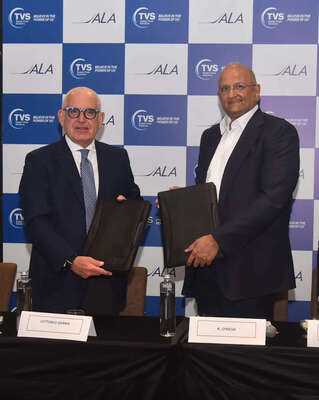
The 51:49 venture between the Indian and Italian companies, backed by an initial investment of about 2 million euros, aims to provide inventory management, production support, spare-parts distribution and aftermarket services to aerospace and defence manufacturers. Operations are expected to begin by Oct, subject to regulatory approvals and industry certifications.
The move reflects two converging trends. One is India’s Atmanirbhar Bharat programme, which is driving defence production and localisation. The other is the prospect of closer economic ties between India and Europe through a proposed India-European Union free-trade agreement , which both partners believe could accelerate industrial collaboration and cross-border supply chains.
“The aerospace sector emerged as a highly attractive opportunity. There is a strong focus on self-reliance in the aerospace sector,” said Dinesh, director of TVS Mobility and executive chairman of TVS SCS. “Significant investments are being made not only in manufacturing but also in supporting production, supply chain and aftermarket requirements, both in defence and the private sector,” he added.
He said India’s aerospace and defence logistics market is pegged at roughly $12 billion and is expected to expand rapidly as global manufacturers deepen their presence in the country. The company believes the opportunity is large enough to generate Rs 2,000 crore in revenue within five years. “We are being conservative in our assessment of the opportunity,” he added.
For TVS SCS, the partnership is a strategic entry route into a highly regulated industry. Aerospace supply chains have significant entry barriers, requiring years of certification and qualification. Rather than build capabilities from scratch in India, the company has chosen to partner with ALA. This Naples-based company has been serving some of the world’s largest aerospace and defence programmes over three decades. TVS SCS already derives about 30% of its UK business revenue from the defence sector.
ALA reported revenue of about 350 million euros in 2025 and is targeting 1.2-1.3 billion euros in three-four years. Its customer base includes Airbus, Boeing, Lockheed Martin, Leonardo and Dassault, as well as programmes such as the Rafale, Eurofighter and F-35.
“We have spent 35 years building expertise in one of the world’s most demanding and highly certified industries,” said Vittorio Genna , ALA Group’s vice-president and co-founder. “Certification can either be a barrier or a source of value.”
The economics are attractive. Conventional logistics businesses typically generate pre-tax margins of 4%-5%, according to Dinesh. Aerospace and defence supply chains can deliver margins of 8%-10%, supported by long-term contracts, stringent certification requirements, and high switching costs.
The 51:49 venture between the Indian and Italian companies, backed by an initial investment of about 2 million euros, aims to provide inventory management, production support, spare-parts distribution and aftermarket services to aerospace and defence manufacturers. Operations are expected to begin by Oct, subject to regulatory approvals and industry certifications.
The move reflects two converging trends. One is India’s Atmanirbhar Bharat programme, which is driving defence production and localisation. The other is the prospect of closer economic ties between India and Europe through a proposed India-European Union free-trade agreement , which both partners believe could accelerate industrial collaboration and cross-border supply chains.
“The aerospace sector emerged as a highly attractive opportunity. There is a strong focus on self-reliance in the aerospace sector,” said Dinesh, director of TVS Mobility and executive chairman of TVS SCS. “Significant investments are being made not only in manufacturing but also in supporting production, supply chain and aftermarket requirements, both in defence and the private sector,” he added.
He said India’s aerospace and defence logistics market is pegged at roughly $12 billion and is expected to expand rapidly as global manufacturers deepen their presence in the country. The company believes the opportunity is large enough to generate Rs 2,000 crore in revenue within five years. “We are being conservative in our assessment of the opportunity,” he added.
For TVS SCS, the partnership is a strategic entry route into a highly regulated industry. Aerospace supply chains have significant entry barriers, requiring years of certification and qualification. Rather than build capabilities from scratch in India, the company has chosen to partner with ALA. This Naples-based company has been serving some of the world’s largest aerospace and defence programmes over three decades. TVS SCS already derives about 30% of its UK business revenue from the defence sector.
ALA reported revenue of about 350 million euros in 2025 and is targeting 1.2-1.3 billion euros in three-four years. Its customer base includes Airbus, Boeing, Lockheed Martin, Leonardo and Dassault, as well as programmes such as the Rafale, Eurofighter and F-35.
“We have spent 35 years building expertise in one of the world’s most demanding and highly certified industries,” said Vittorio Genna , ALA Group’s vice-president and co-founder. “Certification can either be a barrier or a source of value.”
The economics are attractive. Conventional logistics businesses typically generate pre-tax margins of 4%-5%, according to Dinesh. Aerospace and defence supply chains can deliver margins of 8%-10%, supported by long-term contracts, stringent certification requirements, and high switching costs.
Next Story