
Why South Asian Univ Has Stopped Scholarships For Afghan Students


New Delhi: South Asian University ( SAU ) has discontinued scholarships for Afghan students after objections from Bhutan over Afghanistan's continued default in paying its agreed financial contribution to the SAARC-run institution, with the university saying efforts to resolve the issue remain in limbo as India does not officially recognise the Taliban govt.
"We have received objections from Bhutan that it is unfair for countries paying their share regularly. We have to be equal to all representing countries, hence we had to stop the scholarships," SAU President K K Aggarwal told TOI.
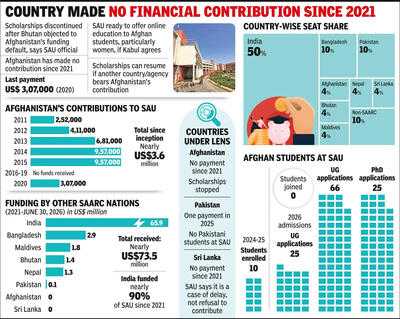
Official funding records accessed by TOI show Afghanistan has not made any financial contribution to the university since 2021, with its last recorded payment of US$307,000 received in 2020.
The records further show that Sri Lanka has also not made any contribution since 2021, while Pakistan made only one recorded payment of US$69,921 in 2025 after a gap of several years. University officials said there are currently no Pakistani students enrolled at SAU. Aggarwal, however, clarified that Sri Lanka's case was different, describing it as one of delayed payment rather than refusal to contribute. "Sri Lanka has not declined to contribute its share. It is a case of delay," he said.
University officials said after the Taliban came into office, there has been no communication from the new dispensation on the issue. "Since India has not formally recognised the Taliban govt, the university has been unable to establish an official channel of communication to resolve the funding matter," Aggarwal said.
The Embassy of Afghanistan in Delhi did not respond to queries.
Despite discontinuing scholarships, Aggarwal said the university is willing to offer online education to Afghan students, particularly women, if the Afghan authorities agree, considering the country's restrictions on women's education and visa-related challenges.
"We receive a lot of emails from Afghan students, many of them women, saying they want to study here but because of the ban on women's education and visa-related issues they are unable to do so. How can a country progress if half of its strength is deprived of education? SAARC was formed for shared collaboration and regional upliftment. We are ready to provide online education to Afghan students if their govt agrees," he said.
Aggarwal added that scholarships could be restored if any member country or agency was willing to bear Afghanistan's financial contribution. He also appealed to the Ministry of Education to consider extending ICCR-supported scholarships for Afghan students seeking to study at SAU.
University records for the period between 2021 and June 30, 2026, show India remained the largest contributor, providing US$65.91 million, followed by Bangladesh (US$2.99 million), Maldives (US$1.82 million), Bhutan (US$1.35 million), Nepal (US$1.26 million) and Pakistan (US$136,810).
"We have received objections from Bhutan that it is unfair for countries paying their share regularly. We have to be equal to all representing countries, hence we had to stop the scholarships," SAU President K K Aggarwal told TOI.
Official funding records accessed by TOI show Afghanistan has not made any financial contribution to the university since 2021, with its last recorded payment of US$307,000 received in 2020.
The records further show that Sri Lanka has also not made any contribution since 2021, while Pakistan made only one recorded payment of US$69,921 in 2025 after a gap of several years. University officials said there are currently no Pakistani students enrolled at SAU. Aggarwal, however, clarified that Sri Lanka's case was different, describing it as one of delayed payment rather than refusal to contribute. "Sri Lanka has not declined to contribute its share. It is a case of delay," he said.
University officials said after the Taliban came into office, there has been no communication from the new dispensation on the issue. "Since India has not formally recognised the Taliban govt, the university has been unable to establish an official channel of communication to resolve the funding matter," Aggarwal said.
The Embassy of Afghanistan in Delhi did not respond to queries.
Despite discontinuing scholarships, Aggarwal said the university is willing to offer online education to Afghan students, particularly women, if the Afghan authorities agree, considering the country's restrictions on women's education and visa-related challenges.
"We receive a lot of emails from Afghan students, many of them women, saying they want to study here but because of the ban on women's education and visa-related issues they are unable to do so. How can a country progress if half of its strength is deprived of education? SAARC was formed for shared collaboration and regional upliftment. We are ready to provide online education to Afghan students if their govt agrees," he said.
Aggarwal added that scholarships could be restored if any member country or agency was willing to bear Afghanistan's financial contribution. He also appealed to the Ministry of Education to consider extending ICCR-supported scholarships for Afghan students seeking to study at SAU.
University records for the period between 2021 and June 30, 2026, show India remained the largest contributor, providing US$65.91 million, followed by Bangladesh (US$2.99 million), Maldives (US$1.82 million), Bhutan (US$1.35 million), Nepal (US$1.26 million) and Pakistan (US$136,810).
Next Story