
Desert Snowfall: A Rare Natural Wonder Worth Witnessing Once

Sand and snow are not supposed to share the same ground. Deserts are defined by their dryness, not their cold, and most people carry that definition so firmly that the idea of snowfall over dunes reads as fantasy. Yet it happens, and the photographs that surface when it does stop people mid-scroll for exactly that reason.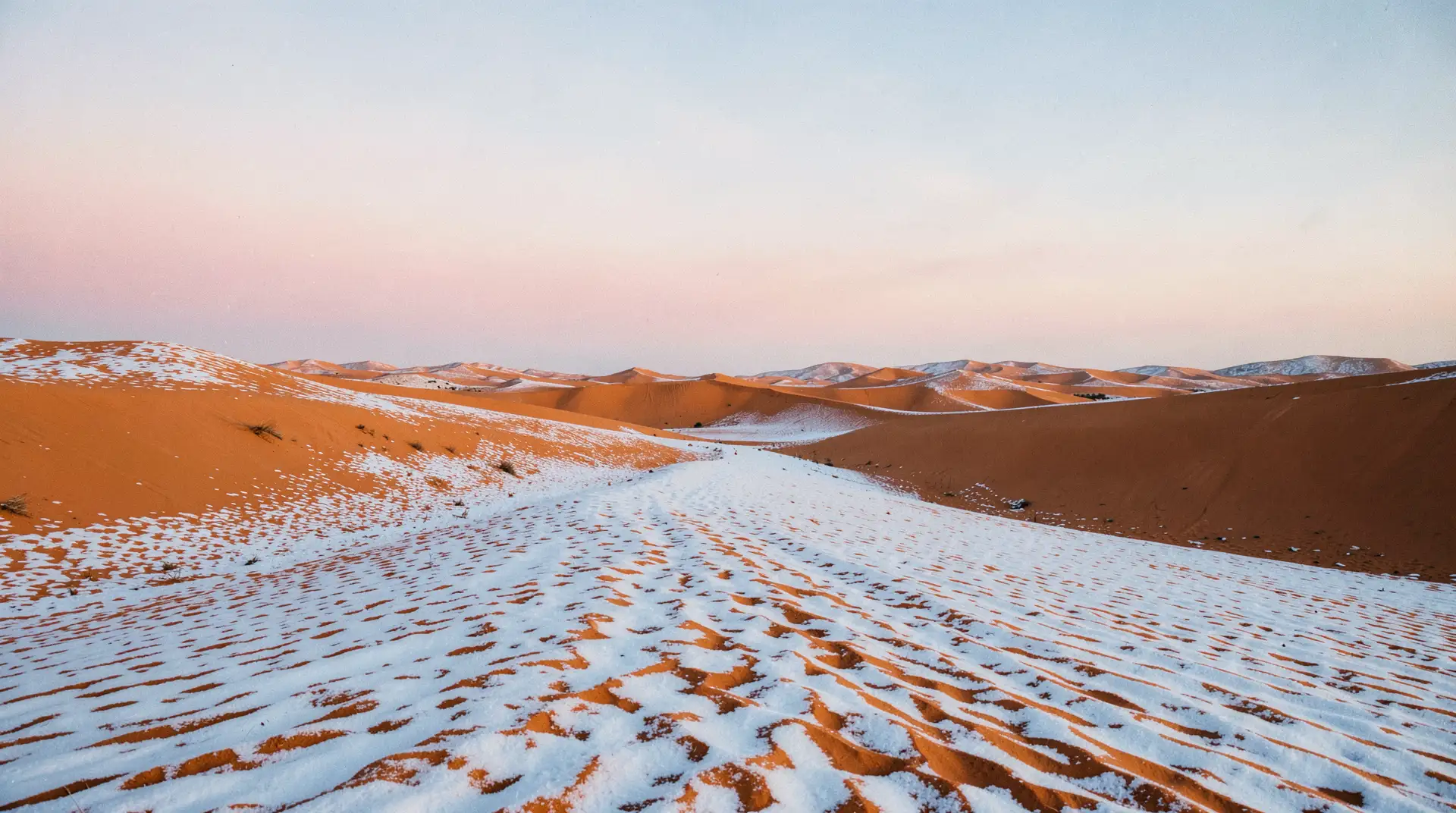
The Sahara, which last saw significant snowfall over its dunes in the Algerian region of Aïn Séfra, sits at over a thousand metres in parts. When a cold front pushes in from the right direction and carries just enough moisture, the conditions collide. The dunes do not care that they are supposed to be hot.
The sandstone forts and havelis, which glow amber in summer, take on a grey-blue stillness in the cold. The light changes. The air, stripped of dust by the cold, carries sounds farther. Travellers who visit in peak summer and return in January often say it feels like a different country.
What changes is that more people now have cameras in their pockets when it happens, so the record grows. The rarity is what gives it weight: a desert in snow is the world briefly being something other than what it is supposed to be.
When snow covers the Spiti valley, it covers a terrain that looks more like Mars than Rajasthan. The experience of standing in a cold desert under snowfall is different from warm-desert snow precisely because the cold is expected, but the silence and the scale are the same.
Travel researchers who study memorable experiences consistently find that novelty, genuine perceptual surprise, not staged novelty, is what converts a trip into a story told years later. A desert in snow is that kind of surprise. It does not require a planned expedition. It requires going to the right place in the right season and staying long enough for the weather to decide.
Why Snow Falls on Deserts at All
Snow needs two things: cold air and enough moisture for ice crystals to form. Deserts are dry, not necessarily warm. The Thar in Rajasthan sits at an elevation where winter nights drop sharply.The Sahara, which last saw significant snowfall over its dunes in the Algerian region of Aïn Séfra, sits at over a thousand metres in parts. When a cold front pushes in from the right direction and carries just enough moisture, the conditions collide. The dunes do not care that they are supposed to be hot.
What the Thar Looks Like When It Happens
Rajasthan's desert towns, Jaisalmer, Barmer, Bikaner, have recorded frost and near-freezing temperatures in the depths of winter. Snowfall proper is rare here, but the cold is real and the landscape shifts in ways that feel close to it.The sandstone forts and havelis, which glow amber in summer, take on a grey-blue stillness in the cold. The light changes. The air, stripped of dust by the cold, carries sounds farther. Travellers who visit in peak summer and return in January often say it feels like a different country.
You may also like
- Over 1,500 TNSTC buses grounded due to tyre shortage, says Anbumani; urges immediate procurement
- Nearly 1 in 2 Telangana kids aged 1-4 anaemic, state ranks fifth: NIN survey
- 80-year-old Mumbai man on ventilator support last month sees Bank of Baroda unilaterally deduct Rs 1.2 crore from his FDs in 2023; after RBI Ombudsman rejects complaint and 3-year legal battle, Bombay HC intervention gets him nearly Rs 1.5 crore with interest
- Mangaluru's Nanthoor underpass project hits roadblock again; decade-long wait continues
- CM Shivakumar accuses BJP leaders of 'instigating' protesting ASHA workers in K'taka
The Sahara's Snow Moments and What They Tell Us
The Algerian Sahara has seen snow settle on its dunes more than once in recorded history. The contrast, white crystals on orange sand, melting within hours, is the kind of image that makes the physics of weather feel genuinely strange. It is not climate change alone that causes it; cold snaps have always been part of desert winters at elevation.What changes is that more people now have cameras in their pockets when it happens, so the record grows. The rarity is what gives it weight: a desert in snow is the world briefly being something other than what it is supposed to be.
Cold Deserts and the Confusion of Categories
Ladakh and Spiti in India complicate the idea of what a desert is. Both are classified as cold deserts, high-altitude rain-shadow zones where precipitation is minimal but temperatures fall well below freezing. Snow here is not rare; it is the season. The landscape is still desert by definition: sparse, dry, stripped of most vegetation.When snow covers the Spiti valley, it covers a terrain that looks more like Mars than Rajasthan. The experience of standing in a cold desert under snowfall is different from warm-desert snow precisely because the cold is expected, but the silence and the scale are the same.
Why It Stays With You
The memory of desert snowfall persists because it breaks a category the mind holds firmly. The brain files deserts under heat, sand, and sun. When snow arrives, the filing system has nowhere to put it, and that dissonance is what makes the moment vivid.Travel researchers who study memorable experiences consistently find that novelty, genuine perceptual surprise, not staged novelty, is what converts a trip into a story told years later. A desert in snow is that kind of surprise. It does not require a planned expedition. It requires going to the right place in the right season and staying long enough for the weather to decide.






Loving Newspoint? Download the app now
