
Global banks are pulling back credit cards once prized by rich Indians


Mumbai: For years, many rich Indians have revelled in the hushed convenience of international credit cards from offshore banks-unlimited spends, no currency conversion charges, and, more importantly, income tax and enforcement departments not automatically coming to know where and how money was spent abroad. That's becoming a problem now.
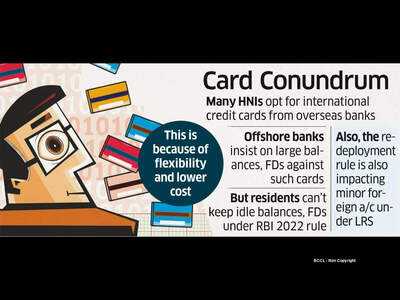
Several offshore banks in Zurich, Singapore, London and even parts of West Asia-usual centres for operating investment and chequeable accounts-are refusing to issue cards to wealthy Indians. Not that credit scores of such clients have plunged, but simply because an Indian rule forbids resident Indians to have idle money lying in foreign accounts beyond six months, multiple persons told ET.

Cards that expired or are coming up for renewal, are impacted by this 2022 regulation introduced when Reserve Bank of India (RBI) overhauled overseas investment norms, including Liberalised Remittance Scheme (LRS)-the window for residents to legitimately invest and spend up to $250,000 a year abroad.
 "An unintended consequence of the 180-day deployment requirement under LRS is beginning to show up in overseas banking relationships of Indian families. Residents have limited flexibility to retain meaningful balances overseas, making some international banks reluctant to offer credit cards linked to these accounts, even though regulations recognise use of such cards," said Moin Ladha, partner at law firm Khaitan & Co.
Under 'redeployment', a resident must spend or invest within 180 days the LRS amount remitted or bring back unused funds. Holding unspent money in checking account (like savings account) or as fixed deposits with foreign banks don't qualify as deployment which stand for buying securities and properties or undertaking permitted current account transactions like booking hotels, purchasing air tickets, and settling restaurant bills.
"Resident individuals and returning Indians often hold foreign-issued international credit cards (ICCs) which are operationally efficient as expenditure is incurred in the same currency, thereby eliminating conversion cost. Besides, under FEMA, there's no specific monetary ceiling fixed by RBI for remittances from India towards settlement of such foreign card liabilities, with the operative limit effectively being the credit limit sanctioned by foreign bank or card operator.
Technically, since settlement of such dues isn't treated as LRS remittance under RBI guidance, foreign-issued ICC spends may remain outside TCS, even after Indian banks operationalise TCS collection framework for forex spends incurred in India using ICCs issued in India," said Harshal Bhuta, partner at the CA firm PR Bhuta & Co. Under FATCA and other data-exchange pacts, foreign jurisdictions don't share ICC spend details with India.
MINOR ACCOUNTS, MAJOR CHALLENGEs
Minors are particularly hit by the redeployment challenge. "Minors are permitted to remit under LRS but have relatively limited avenues to appropriately deploy those funds, and overseas banks are increasingly questioning the continuation of such accounts.
Some calibrated flexibility in the 180-day requirement, particularly for minors, could address these practical challenges without diluting the broader regulatory intent of LRS framework," said Ladha. According to Rajesh Shah, partner at the CA firm Jayantilal Thakkar & Co which specialises in FEMA issues among other things, "The position on minors' remittance has remained unchanged since February 2004 when LRS was introduced. There is no point in changing the stand after 22 years."
Shah's view stems from unconfirmed rumours about regulatory reservations on LRS by non-earning family members, including minors, who become channels for parents to remit more than what they could have officially transferred. After hard-selling minor accounts, overseas banks are now reneging, as security investments require accountholders' consent post risk-assessment, which minors can't provide.
Several offshore banks in Zurich, Singapore, London and even parts of West Asia-usual centres for operating investment and chequeable accounts-are refusing to issue cards to wealthy Indians. Not that credit scores of such clients have plunged, but simply because an Indian rule forbids resident Indians to have idle money lying in foreign accounts beyond six months, multiple persons told ET.
Cards that expired or are coming up for renewal, are impacted by this 2022 regulation introduced when Reserve Bank of India (RBI) overhauled overseas investment norms, including Liberalised Remittance Scheme (LRS)-the window for residents to legitimately invest and spend up to $250,000 a year abroad.
Under 'redeployment', a resident must spend or invest within 180 days the LRS amount remitted or bring back unused funds. Holding unspent money in checking account (like savings account) or as fixed deposits with foreign banks don't qualify as deployment which stand for buying securities and properties or undertaking permitted current account transactions like booking hotels, purchasing air tickets, and settling restaurant bills.
"Resident individuals and returning Indians often hold foreign-issued international credit cards (ICCs) which are operationally efficient as expenditure is incurred in the same currency, thereby eliminating conversion cost. Besides, under FEMA, there's no specific monetary ceiling fixed by RBI for remittances from India towards settlement of such foreign card liabilities, with the operative limit effectively being the credit limit sanctioned by foreign bank or card operator.
Technically, since settlement of such dues isn't treated as LRS remittance under RBI guidance, foreign-issued ICC spends may remain outside TCS, even after Indian banks operationalise TCS collection framework for forex spends incurred in India using ICCs issued in India," said Harshal Bhuta, partner at the CA firm PR Bhuta & Co. Under FATCA and other data-exchange pacts, foreign jurisdictions don't share ICC spend details with India.
MINOR ACCOUNTS, MAJOR CHALLENGEs
Minors are particularly hit by the redeployment challenge. "Minors are permitted to remit under LRS but have relatively limited avenues to appropriately deploy those funds, and overseas banks are increasingly questioning the continuation of such accounts.
Some calibrated flexibility in the 180-day requirement, particularly for minors, could address these practical challenges without diluting the broader regulatory intent of LRS framework," said Ladha. According to Rajesh Shah, partner at the CA firm Jayantilal Thakkar & Co which specialises in FEMA issues among other things, "The position on minors' remittance has remained unchanged since February 2004 when LRS was introduced. There is no point in changing the stand after 22 years."
Shah's view stems from unconfirmed rumours about regulatory reservations on LRS by non-earning family members, including minors, who become channels for parents to remit more than what they could have officially transferred. After hard-selling minor accounts, overseas banks are now reneging, as security investments require accountholders' consent post risk-assessment, which minors can't provide.
Next Story