
Guess who's got an AI edge in a tough job market?


Mentioning artificial intelligence to the graduating class of 2026 has been sure to get you booed. And why not? Fresh graduates have spent the past few years being told about the wonders of AI and watched seniors struggle to get a toehold in the labor market. As much as they are right to worry, there’s hope on the horizon.
The labor market for fresh graduates is beginning to look more welcoming than it has in recent years. Companies are better placed to hire again after headcount reductions and hiring freezes on white-collar roles helped them get past the over-staffing of the pandemic era. We’re also in a moment now when AI is looking as much like an opportunity as it is a longer-term concern for young professionals.
This improved outlook has become more pronounced over the past few months. The unemployment rate for workers between the ages of 20 to 24 has fallen on a year-over-year basis every month in 2026 after rising steadily the previous two years.
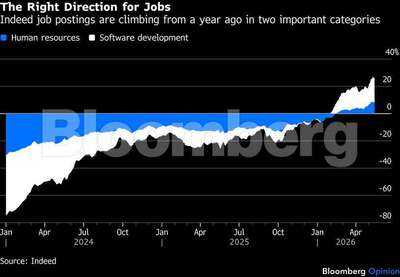
The decline doesn’t look like noise because job postings in two key industries have been picking up at the same time, according to employment website Indeed. Software development and human resources roles, which witnessed long slumps, have risen steadily since February. Postings for software developers shouldn’t be rising if AI is killing technology jobs, and employers tend to only hire HR workers when they’re expecting headcount to increase rather than fall in the future.
When it comes to AI, companies are in the middle of a messy transition. They’ve committed significant money to adopting the new tools but are still foggy about their use cases and value beyond a few niche areas. Anthropic PBC’s surging revenue growth represents tens of billions of dollars of spending that its customers weren’t doing even at the end of last year. Ara Kharazian, lead economist at Ramp Economics Lab, notes that the average business is spending 13 times more on AI tokens now than it was in January 2025.
The sticker shock is beginning to hit home. Uber Technologies Inc. is a case in point: Despite reportedly burning through its annual AI budget in four months, Chief Operating Officer Andrew Macdonald said the company hasn’t yet seen the spending translate directly into more useful features for customers. “We’re going to have to start talking about token consumption and the associated costs versus headcount,” he told Rapid Response. CEOs aren’t sure when the actual benefits will show up, Match CEO Spencer Rascoff said earlier this month.
Bottlenecks throughout the AI supply chain threaten to raise costs further, meaning there won’t be enough computing power for the technology to disrupt large numbers of jobs in the near-term.
This is all good news for fresh graduates. AI tools like ChatGPT, Claude and Gemini have been around long enough now that they can pitch themselves as AI native in a way mid-career and older workers can’t. Who better to help companies figure out what their AI strategy should be than young, hungry, low-cost workers who have spent the past two years learning AI skills because everyone was telling them that’s the future and they’d be entering a difficult labor market?
This realization is spreading among early corporate adopters. Bank of New York Mellon Corp., for example, has tripled the size of its intern and analyst classes since 2022 to tap into “a cohort that’s naturally AI inclined,” Chief Executive Officer Robin Vince told Bloomberg Television. Executives using AI most extensively were the most bullish on entry-level hiring, according to Strada Education Foundation, which surveyed about 1,500 employers about their graduate hiring plans for this year.
Companies spending millions or tens of millions of dollars a year on AI need structure around that spending including which providers to use, token budgets, prompt efficiency and measuring returns. These are all issues that AI-native staff are well suited to address, unburdened by legacy workflows and “the way things have always been done.”
It’s also an opportunity for new workers to rise through the ranks faster than they ordinarily would. Companies that limited hiring or laid off workers don’t have as many second or third-year employees in a position to be promoted. New graduates who demonstrate sharp AI abilities will find themselves in more senior positions quicker than usual as employers look to justify their investments.
It might not be as easy to get a job now as it was in the salad days of 2021, but it’s not as dire as it’s been since then. New grads should feel encouraged that there are more opportunities now for them to get their shot.
The labor market for fresh graduates is beginning to look more welcoming than it has in recent years. Companies are better placed to hire again after headcount reductions and hiring freezes on white-collar roles helped them get past the over-staffing of the pandemic era. We’re also in a moment now when AI is looking as much like an opportunity as it is a longer-term concern for young professionals.
This improved outlook has become more pronounced over the past few months. The unemployment rate for workers between the ages of 20 to 24 has fallen on a year-over-year basis every month in 2026 after rising steadily the previous two years.
The decline doesn’t look like noise because job postings in two key industries have been picking up at the same time, according to employment website Indeed. Software development and human resources roles, which witnessed long slumps, have risen steadily since February. Postings for software developers shouldn’t be rising if AI is killing technology jobs, and employers tend to only hire HR workers when they’re expecting headcount to increase rather than fall in the future.
When it comes to AI, companies are in the middle of a messy transition. They’ve committed significant money to adopting the new tools but are still foggy about their use cases and value beyond a few niche areas. Anthropic PBC’s surging revenue growth represents tens of billions of dollars of spending that its customers weren’t doing even at the end of last year. Ara Kharazian, lead economist at Ramp Economics Lab, notes that the average business is spending 13 times more on AI tokens now than it was in January 2025.
The sticker shock is beginning to hit home. Uber Technologies Inc. is a case in point: Despite reportedly burning through its annual AI budget in four months, Chief Operating Officer Andrew Macdonald said the company hasn’t yet seen the spending translate directly into more useful features for customers. “We’re going to have to start talking about token consumption and the associated costs versus headcount,” he told Rapid Response. CEOs aren’t sure when the actual benefits will show up, Match CEO Spencer Rascoff said earlier this month.
Bottlenecks throughout the AI supply chain threaten to raise costs further, meaning there won’t be enough computing power for the technology to disrupt large numbers of jobs in the near-term.
This is all good news for fresh graduates. AI tools like ChatGPT, Claude and Gemini have been around long enough now that they can pitch themselves as AI native in a way mid-career and older workers can’t. Who better to help companies figure out what their AI strategy should be than young, hungry, low-cost workers who have spent the past two years learning AI skills because everyone was telling them that’s the future and they’d be entering a difficult labor market?
This realization is spreading among early corporate adopters. Bank of New York Mellon Corp., for example, has tripled the size of its intern and analyst classes since 2022 to tap into “a cohort that’s naturally AI inclined,” Chief Executive Officer Robin Vince told Bloomberg Television. Executives using AI most extensively were the most bullish on entry-level hiring, according to Strada Education Foundation, which surveyed about 1,500 employers about their graduate hiring plans for this year.
Companies spending millions or tens of millions of dollars a year on AI need structure around that spending including which providers to use, token budgets, prompt efficiency and measuring returns. These are all issues that AI-native staff are well suited to address, unburdened by legacy workflows and “the way things have always been done.”
It’s also an opportunity for new workers to rise through the ranks faster than they ordinarily would. Companies that limited hiring or laid off workers don’t have as many second or third-year employees in a position to be promoted. New graduates who demonstrate sharp AI abilities will find themselves in more senior positions quicker than usual as employers look to justify their investments.
It might not be as easy to get a job now as it was in the salad days of 2021, but it’s not as dire as it’s been since then. New grads should feel encouraged that there are more opportunities now for them to get their shot.
Next Story