
Jobs outlook may cool down in Sept quarter amid economic woes


India's employment outlook is expected to soften in July-September 2026 compared with the June quarter, with employers likely to scale back hiring plans amid economic uncertainty and geopolitical concerns.
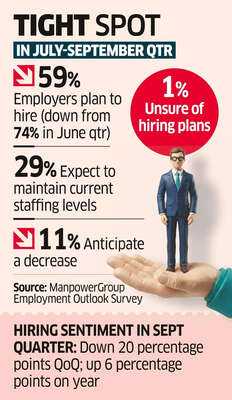
Around 59% of Indian employers of the 3,100-plus surveyed in the latest ManpowerGroup Employment Outlook Survey anticipate an increase in hiring in the September 2026 quarter, down from 74% in the June quarter. As many as 29% expect to maintain current staffing levels in July-September 2026, up from 19% in April-June; 11% anticipate a decrease, and 1% are unsure of their hiring plans.

This puts the net employment outlook-a bellwether of labour market trends-at 48%, representing the difference between companies planning to hire and those expecting a decline.
Hiring sentiment is down 20 percentage points quarter-on-quarter but up 6 percentage points year-on-year.
However, globally, India leads in terms of its employment outlook at 22 percentage points higher than the global average net employment outlook (NEO) of 26%.
"India's hiring outlook for the upcoming quarter remains the strongest globally, reflecting continued employer confidence in the country's growth trajectory despite an increasingly complex business environment," said Sandeep Gulati, managing director, ManpowerGroup India and Middle East. "While the outlook has moderated from 68% in the previous quarter, the shift reflects a more measured approach to hiring rather than a slowdown in business confidence."
"Strong activity across manufacturing and services, along with the continued expansion of global capability centres, continues to support hiring demand," added Gulati. "At the same time, employers are navigating a broader mix of challenges, including AI-led workforce optimisation, softer entry-level hiring demand, global trade uncertainty, and geopolitical developments impacting supply chains and business costs. As a result, organisations remain positive about growth but are becoming more selective in their hiring decisions."
Around 15% of those considering workforce expansion remain optimistic about identifying growth opportunities despite ongoing geopolitical challenges. Among organisations reducing staff, 31% cited economic challenges, while 27% pointed to geopolitical challenges as the primary factor impacting staffing decisions. And 26% of those uncertain about changing staffing cite geopolitical challenges and 20% want to keep things stable as a result.
The utilities and natural resources sectors have the strongest hiring intentions, with an NEO of 61%, followed by finance and insurance sectors with 56% and construction and real estate at 55%.
While the finance and insurance sectors have seen the most improved YoY outlook, on a quarter-on-quarter basis, nearly all sectors have seen a decline in outlook. Hospitality is the only sector expected to record quarterly growth, with hiring expectations rising by 6 points since the June quarter, though 18pp down YoY.
Around 59% of Indian employers of the 3,100-plus surveyed in the latest ManpowerGroup Employment Outlook Survey anticipate an increase in hiring in the September 2026 quarter, down from 74% in the June quarter. As many as 29% expect to maintain current staffing levels in July-September 2026, up from 19% in April-June; 11% anticipate a decrease, and 1% are unsure of their hiring plans.
This puts the net employment outlook-a bellwether of labour market trends-at 48%, representing the difference between companies planning to hire and those expecting a decline.
Hiring sentiment is down 20 percentage points quarter-on-quarter but up 6 percentage points year-on-year.
However, globally, India leads in terms of its employment outlook at 22 percentage points higher than the global average net employment outlook (NEO) of 26%.
"India's hiring outlook for the upcoming quarter remains the strongest globally, reflecting continued employer confidence in the country's growth trajectory despite an increasingly complex business environment," said Sandeep Gulati, managing director, ManpowerGroup India and Middle East. "While the outlook has moderated from 68% in the previous quarter, the shift reflects a more measured approach to hiring rather than a slowdown in business confidence."
"Strong activity across manufacturing and services, along with the continued expansion of global capability centres, continues to support hiring demand," added Gulati. "At the same time, employers are navigating a broader mix of challenges, including AI-led workforce optimisation, softer entry-level hiring demand, global trade uncertainty, and geopolitical developments impacting supply chains and business costs. As a result, organisations remain positive about growth but are becoming more selective in their hiring decisions."
Around 15% of those considering workforce expansion remain optimistic about identifying growth opportunities despite ongoing geopolitical challenges. Among organisations reducing staff, 31% cited economic challenges, while 27% pointed to geopolitical challenges as the primary factor impacting staffing decisions. And 26% of those uncertain about changing staffing cite geopolitical challenges and 20% want to keep things stable as a result.
The utilities and natural resources sectors have the strongest hiring intentions, with an NEO of 61%, followed by finance and insurance sectors with 56% and construction and real estate at 55%.
While the finance and insurance sectors have seen the most improved YoY outlook, on a quarter-on-quarter basis, nearly all sectors have seen a decline in outlook. Hospitality is the only sector expected to record quarterly growth, with hiring expectations rising by 6 points since the June quarter, though 18pp down YoY.
Next Story