
Why Students Protested at Jantar Mantar: CBSE, CUET & Education Reforms

Jantar Mantar is now widely known for the act of protests, for the political and social issue has recently witnessed a large number of school students gathering to voice concerns. Instead of discussing conventional political matters, students are highlighting problems related to education including the CBSE examination system, CUET admission and the widening gap between private and government schools. This demonstration reflects growing anxiety among India’s youth about academic pressure and unequal educational opportunities.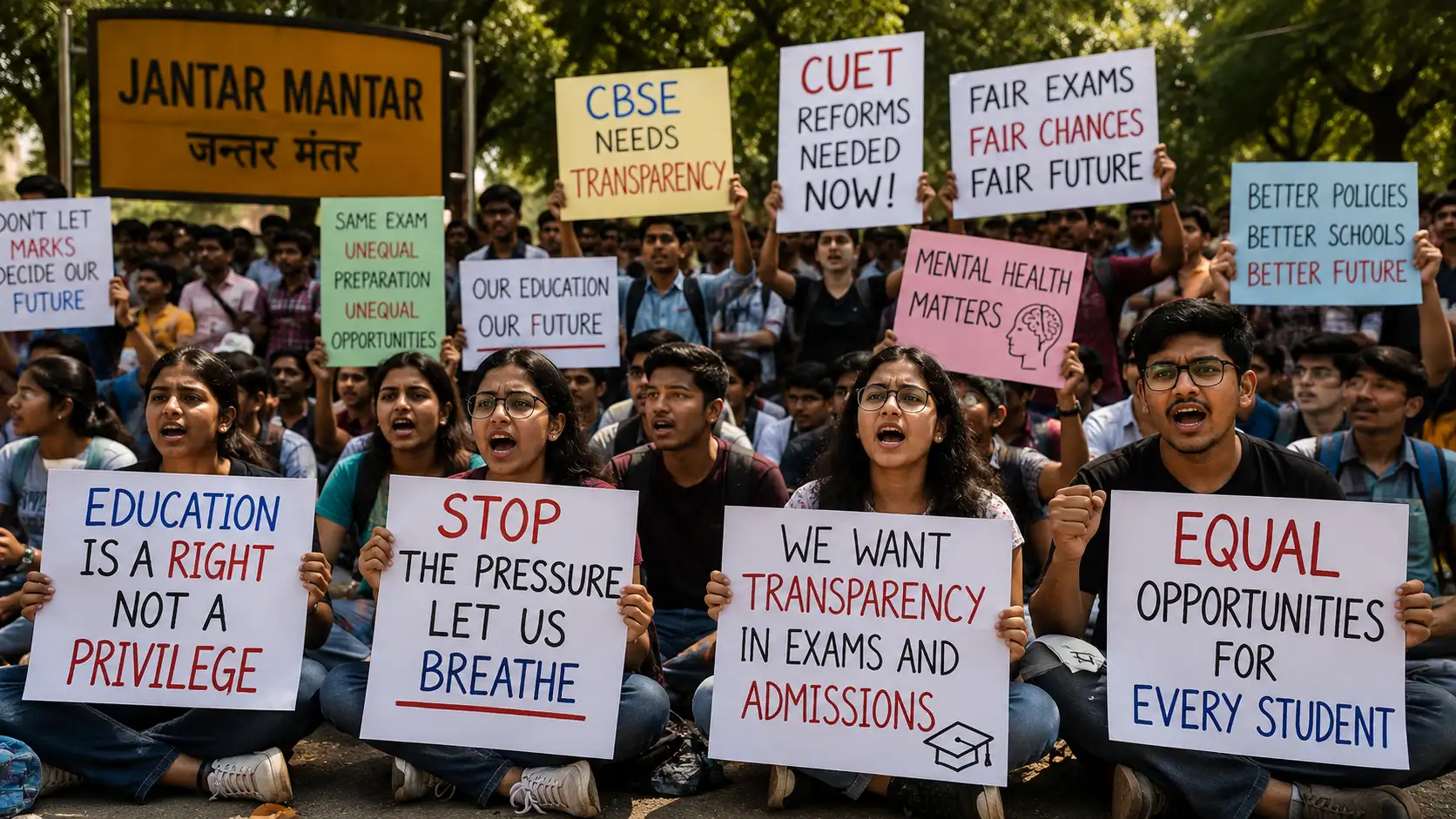
Hundreds of students assembled to demand reforms in the education system, highlighting issues related to school and college admissions rather than political agendas. Protesters argued that existing policies place immense pressure on students while failing to ensure fairness and equal opportunities. Carrying placards with slogans calling for transparency, equitable access, and improved educational policies, they urged authorities to address the challenges faced by students and create a more inclusive and merit-based education system.
Students voiced concerns over the growing pressure surrounding CBSE board examinations, saying unpredictable exam patterns, unclear evaluation methods, and high academic expectations are increasing stress and anxiety among students. They also called for greater transparency and timely communication regarding syllabus revisions, examination guidelines, and assessment criteria to ensure a fairer and more student-friendly system.
The Common University Entrance Test (CUET) emerged as one of the biggest concerns,
Students also highlighted the disparity between government and private schools, citing unequal access to quality teaching, inadequate infrastructure, limited laboratories and libraries, insufficient digital learning resources, and fewer extracurricular opportunities. They argued that these gaps place government school students at a disadvantage, affecting their CUET preparation and limiting their chances of securing quality higher education opportunities.
Many students also discussed the emotional impact of the current education system, the key concerns were :
The gathering reflects increasing awareness among young people about education rights. Unlike earlier student movements centered on campus politics, these protests focus on structural challenges within school education. It also highlights how students are using democratic performances to seek policy reforms.
The presence of school students at Jantar Mantar underscores growing dissatisfaction with aspects of India's education system. Their concerns ranging from CBSE examinations and CUET to the inequality between private and government schools reflect broader questions about fairness, access, and student well-being. The demonstrations signal that today's students are seeking not only academic success but also a more equitable and supportive educational environment.
Why do students gather at Jantar Mantar ?
Hundreds of students assembled to demand reforms in the education system, highlighting issues related to school and college admissions rather than political agendas. Protesters argued that existing policies place immense pressure on students while failing to ensure fairness and equal opportunities. Carrying placards with slogans calling for transparency, equitable access, and improved educational policies, they urged authorities to address the challenges faced by students and create a more inclusive and merit-based education system.
Concern Over CBSE Examination
Students voiced concerns over the growing pressure surrounding CBSE board examinations, saying unpredictable exam patterns, unclear evaluation methods, and high academic expectations are increasing stress and anxiety among students. They also called for greater transparency and timely communication regarding syllabus revisions, examination guidelines, and assessment criteria to ensure a fairer and more student-friendly system.
You may also like
- Big Opportunity for IGNOU Students and Alumni: Placement Drive Set to Begin
- What is the Pacific Decadal Oscillation (PDO) that is being linked to Gujarat's heavy rains? Here's what students should know
- "I felt guilty about my salary": A young professional's Reddit post has sparked a workplace debate
- KEA DCET mock seat allotment result 2026 today at 6 PM: Direct link to download scorecards here
- 25 nations including France and Singapore pilot India's DPI platform: Official
CUET Related Issues
The Common University Entrance Test (CUET) emerged as one of the biggest concerns,
Students highlight the concerns as:
- Technical glitches during examinations.
- Frequent changes in exam schedules.
- Delays in result announcements.
- Uncertainty during the university admission process.
- Fear that a single examination determines admission into prestigious universities.
Private vs Government School Gap
Students also highlighted the disparity between government and private schools, citing unequal access to quality teaching, inadequate infrastructure, limited laboratories and libraries, insufficient digital learning resources, and fewer extracurricular opportunities. They argued that these gaps place government school students at a disadvantage, affecting their CUET preparation and limiting their chances of securing quality higher education opportunities.
Mental Health and Academic Pressure
Many students also discussed the emotional impact of the current education system, the key concerns were :
- Stress caused by board examinations.
- Anxiety surrounding competitive entrance tests.
- Pressure from parents and society to achieve high scores.
- Fear of missing admission opportunities.
Why does this protest matter ?
The gathering reflects increasing awareness among young people about education rights. Unlike earlier student movements centered on campus politics, these protests focus on structural challenges within school education. It also highlights how students are using democratic performances to seek policy reforms.
The presence of school students at Jantar Mantar underscores growing dissatisfaction with aspects of India's education system. Their concerns ranging from CBSE examinations and CUET to the inequality between private and government schools reflect broader questions about fairness, access, and student well-being. The demonstrations signal that today's students are seeking not only academic success but also a more equitable and supportive educational environment.






Loving Newspoint? Download the app now
