
'Blind devotion to Israel': Congress takes a dig at PM Modi as US and Iran agree peace pact


NEW DELHI: The Congress on Monday welcomed US President Donald Trump’s announcement of a peace agreement between the United States and Iran but criticised Prime Minister Narendra Modi for his “blind devotion” to Israel.
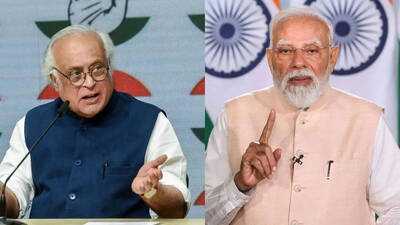
Congress MP Jairam Ramesh cited Prime Minister Modi’s visit to Israel just days before it launched strikes on Iran in a joint operation with the US, triggering the Middle East conflict.
The agreement will be signed later this week in Switzerland.
"The news that the US and Iran will be signing an agreement on June 19th in Geneva to halt hostilities in West Asia is to be welcomed, even though the full details are yet to be made public officially. There is universal hope that the two countries (as also Israel) will abide by the accord - even though it is of an interim nature - and that the accord will lead to a more permanent normalization," he wrote on X.
Ramesh noted that although the pact would result in the unrestricted reopening of the Strait of Hormuz — a key maritime route that has been under a virtual blockade since early March in Iran’s retaliation for the war — this does not mean that structural problems facing the Indian economy would soon be surmounted.
These issues, he added, were already there even before the war broke out on February 28, two days before Prime Minister Modi’s Israel visit.
The Rajya Sabha member also pointed to Pakistan’s role in mediating the truce, saying that Islamabad has acquired a new regional and global influence despite its isolation due to India's efforts after the November 2008 terror attacks in Mumbai.
"This, coupled with China’s deep embedding in Pakistan’s strategic apparatus, poses a formidable geo-political challenge for India’s foreign policy. It is too much to expect Mr. Modi to rethink his blind devotion and unconditional support to Israel. But humanitarian considerations and long-standing commitments apart, our national interest demands greater balance than Mr. Modi has shown," Ramesh said,
Ramesh’s remarks came after Pakistan Prime Minister Shehbaz Sharif announced that a peace deal between the US and Iran had been reached, which was followed by Trump’s announcement.
Sharif added that both sides had declared the “immediate and permanent termination of military operations on all fronts.” This also includes Lebanon, which was drawn into the conflict after Hezbollah, a Tehran-backed militant group based in Lebanon, entered the war after the killing of Iran’s then-Supreme Leader Ali Khamenei on the first day of the operation.
Khamenei’s son, Mojtaba, is now the Supreme Leader, but has not been seen in public since the war began.
Congress MP Jairam Ramesh cited Prime Minister Modi’s visit to Israel just days before it launched strikes on Iran in a joint operation with the US, triggering the Middle East conflict.
The agreement will be signed later this week in Switzerland.
"The news that the US and Iran will be signing an agreement on June 19th in Geneva to halt hostilities in West Asia is to be welcomed, even though the full details are yet to be made public officially. There is universal hope that the two countries (as also Israel) will abide by the accord - even though it is of an interim nature - and that the accord will lead to a more permanent normalization," he wrote on X.
Ramesh noted that although the pact would result in the unrestricted reopening of the Strait of Hormuz — a key maritime route that has been under a virtual blockade since early March in Iran’s retaliation for the war — this does not mean that structural problems facing the Indian economy would soon be surmounted.
These issues, he added, were already there even before the war broke out on February 28, two days before Prime Minister Modi’s Israel visit.
The Rajya Sabha member also pointed to Pakistan’s role in mediating the truce, saying that Islamabad has acquired a new regional and global influence despite its isolation due to India's efforts after the November 2008 terror attacks in Mumbai.
"This, coupled with China’s deep embedding in Pakistan’s strategic apparatus, poses a formidable geo-political challenge for India’s foreign policy. It is too much to expect Mr. Modi to rethink his blind devotion and unconditional support to Israel. But humanitarian considerations and long-standing commitments apart, our national interest demands greater balance than Mr. Modi has shown," Ramesh said,
Ramesh’s remarks came after Pakistan Prime Minister Shehbaz Sharif announced that a peace deal between the US and Iran had been reached, which was followed by Trump’s announcement.
Sharif added that both sides had declared the “immediate and permanent termination of military operations on all fronts.” This also includes Lebanon, which was drawn into the conflict after Hezbollah, a Tehran-backed militant group based in Lebanon, entered the war after the killing of Iran’s then-Supreme Leader Ali Khamenei on the first day of the operation.
Khamenei’s son, Mojtaba, is now the Supreme Leader, but has not been seen in public since the war began.
Next Story