
Data vs. dahi-chini: Why AI can code your life, but only your mom can decode your face


We live in an era where artificial intelligence can diagnose our lifestyle errors, draft our corporate emails, and map out a step-by-step strategy to text our crush. It processes billions of data points and language patterns in milliseconds to simulate human reasoning. Today, millions of people treat apps like ChatGPT and Google Gemini as digital confidantes, feeding them their deepest anxieties, career dilemmas, and late-night identity crises. But as the old saying goes, knowledge is knowing a tomato is a fruit; wisdom is not putting it in a fruit salad. And when life throws a curveball, absolute wisdom doesn’t live in a cloud server.
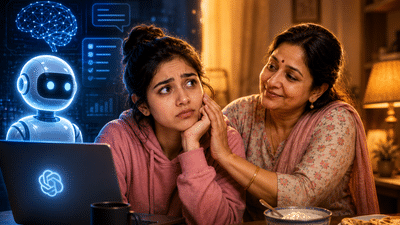
The fundamental difference? AI has a vast knowledge base, but it only knows what you type into it. Your mother has been tracking your beta-testing phase for 20 to 30 years, so she knows the source code of your soul.
To see how bytes stack up against maternal instinct, we experimented with the world's leading Large Language Models - ChatGPT and Google Gemini. We presented these two advanced AI models with a series of common everyday crises, from existential weights like feeling depressed or navigating a painful breakup, to professional milestones like prepping for a high-stakes job interview, all the way down to mundane frustrations like losing house keys or trying to figure out how to approach a crush. The stark contrast between their calculated text generations and a traditional mother's instinctual reactions reveals a hilarious, comforting truth about how we seek comfort today.
Here is how the battle of human intuition vs. artificial intelligence plays out in the chaotic situations of everyday life.
1. The crisis: Failing an exam
The AI response: A meticulously structured, empathetic-yet-clinical guide. It suggests analyzing your weak areas, creating a pomodoro-timed study schedule, and offers a list of online resources to improve your score.
The Desi Mom response: Her heart breaks for you, but her immediate instinct is action. She transforms into an admissions officer, an investigator, and a private tutor all at once. “Work harder next time,” she will say, before personally hunting down the best tuitions in the neighborhood. Her attention to your schedule becomes hyper-focused. AI gives you a plan; Mom gives you a push.
2. The great search: Finding a missing thing (Like your keys)
The AI response: “Losing keys is frustrating. A practical way to search is to retrace your movements in reverse order. Check sofa cushions, bag compartments, and use a flashlight to catch the metal reflection.”
The Desi Mom response: She doesn't need to retrace steps. She uses pure maternal radar. When you complain you can’t find it and mom has already pointed where it is kept, she issues the ultimate dare, “Agar mili na fir dekhio tu, main btaungi” (And if I find it, you're in trouble). And predictably, through some distortion of space and time, she walks into the room and picks it up from the exact spot you just checked five times. AI offers a logical search algorithm; Mom executes a miracle.
3. The heartbreak: Dealing with a breakup
The AI response: “I’m sorry you’re going through that. Focus on the next few hours, not the next few months. Eat something, drink water, and avoid sending emotionally charged messages while emotions are at their peak.”
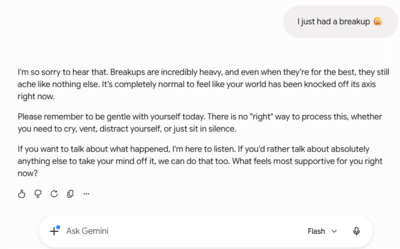
The Desi Mom response: This depends entirely on the " Mom Archetype ." If she belongs to the strict school of thought, you might get a swift lecture (or a beating) for prioritizing a relationship over your career. But if she’s the understanding confidante, she skips the clinical checklists and hands you the ultimate cosmic balm: “Jo hota hai, acche ke liye hota hai” (Whatever happens, happens for the best). AI tells you how to survive the day; Mom aligns your perspective with destiny.
4. The milestone: Navigating a job interview
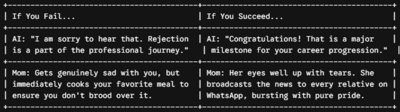
The AI response: It generates a mock interview simulator, refines your resume, and reminds you to maintain eye contact and talk about work-life balance.
The Desi Mom response: Long before the interview begins, her spiritual machinery is in motion. She is actively praying for your success. As you walk out the door, she meets you with the ultimate Indian good-luck charm—a spoonful of dahi-chini.
5. The secret matters of heart: Having a crush
The AI response: A highly strategic, low-pressure toolkit. “Start with casual conversations. Comment on a shared experience. Look for signs of engagement, and invite them for a coffee.”
The Desi Mom response: Let's be honest—sharing a crush with an AI is a thousand times safer than telling a Desi mother. If you are still in school or college, asking your mom how to impress a crush is the fastest way to get your phone confiscated. AI gives you an instruction manual; Mom gives you a reality check on your priorities.
6. The psychological void: “I think I need therapy”
The AI response: It asks clarifying questions: “How long have you been feeling depressed? Are you able to get through your normal daily activities?” It then provides emergency helpline numbers like Tele-MANAS. It is structured, safe, and necessary.
The Desi Mom response: While mental health awareness is growing, a mother’s therapy is deeply physical and immediate. While an AI tells you to "prioritize yourself," your mom will visually assess your pale face, drag you away from your laptop, and say: “Koi kaam khane se zruri nhi h, tune subah se nhi khaya” (No work is more important than food, you haven't eaten since morning). You don't argue; you just abide.
7. The peer pressure dilemma
When navigating the suffocating weight of peer pressure, the contrast is sharper than ever. If you prompt ChatGPT or Gemini about feeling pressured to fit in, choose a certain career path, or indulge in things you aren't comfortable with, they will offer objective, non-judgmental frameworks on setting healthy boundaries, learning to say no, and building self-esteem.
Your mother, however, cuts straight through the social anxiety with zero regard for your "cool quotient." Her response is an immediate, reality-shattering protective shield: "Agar woh kuye mein koodenge, toh tum bhi koodoge?" (If they jump into a well, will you jump too?). While AI meticulously teaches you how to negotiate your individuality within a group, Mom completely devalues the group’s opinion in a single sentence, reminding you that your identity is anchored to your home, not a circle of friends.
The mother of all algorithms
Ultimately, there is a boundary that AI's programming will never cross. It requires an input to generate an output. If you type "I'm fine," the AI will take your word for it.
A mother doesn’t need an input.
She reads the micro-expressions on your face. She hears the heavy sigh behind a casual "hello" over a phone call. She knows you are sad even when you repeatedly insist you are perfectly okay. She notices if you laugh a fraction of a second less, or if your mind seems a little more occupied than usual.
AI operates on data, text, and logic. Mothers operate on a lifelong, uninterrupted emotional bandwidth. The chatbot might give you the perfect answer, but only your mother can hear the question you were too afraid to ask.
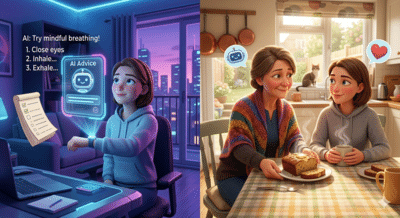
AI can give you ten coping strategies when you’re upset like meditation, journaling, breathing exercises. Mom skips the list. She shows up with your favorite food: the grilled cheese cut diagonally, the extra-cheese pasta, the midnight ice cream she hid in the freezer just for you, or a simmering plate of rajma chawal exactly as you’ve loved it since you were two. She might not use words like “anxiety” or “mental health.” She might not agree with the terms, or she might dismiss them as “just a phase.” There’s stigma, yes. But there’s also care. She won’t search for symptoms online; she’ll study your face, notice you left food on your plate, and quietly make the one thing that lights you up. AI understands sadness as a dataset. Mom understands you as her child. And sometimes care doesn’t sound like therapy. It sounds like, “Did you eat?”
This was never an argument about whether AI could replace mothers. It can’t. It’s an evolutionary and emotional impossibility. Yet, in our modern, hyper-connected lives, we increasingly find ourselves laying our heaviest problems in front of both, the chatbot on our screens and the matriarch in the next room. When you cross-examine their responses, the contrast tells you everything you need to know about the human condition. AI mimics empathy with flawless grammar. Mom is empathy, even when she fumbles the words. AI is trained to help, so it jumps to solve. Mom often is the solution, just by walking into the room.
The fundamental difference lies in the stakes. AI wants you to feel better; Mom wants you to be better. Admittedly, in an Indian household, that desire can sound a lot like, "Dekho usko!" or the stinging reminder that "Sharma ji ka beta 95 le aaya." But that sharp delivery is just love wearing a judge’s wig. Underneath the agonizing comparison is fear, pride, and a lifetime bet that you will eventually outshine everyone. AI has data, but Mom has dreams for you. Deep down, all that questionable delivery comes from a place of wanting her child to be the absolute best. If an AI gives you bad advice, you simply close the tab, and the algorithm moves on without consequence. If Mom gives you bad advice, she loses sleep over it. One operates with digital detachment; the other lives with every single consequence because she has her whole life invested in your future.
This baseline of investment completely alters how they process information. With AI, you are trapped in a loop of explaining the backstory, the context, and why a specific problem matters. With Mom, you can start in the very middle of a sentence and she already knows the beginning. One needs a prompt; the other knows the whole book. The machine operates on a vast knowledge base, but it only knows what you actively choose to describe. It has a perfect recall of what you typed three minutes ago, but it can never feel the weight of your silence. Your mother, on the other hand, might have an imperfect recall of what you said at age six, but she vividly remembers how you looked when you said it. One stores your conversations; the other stores you.
This is not to say that artificial intelligence has nothing to offer. It does. It is entirely objective, fiercely non-judgmental, and reliably available at 2:00 AM when the rest of the world is asleep. It can provide structured advice, practical toolkits, and step-by-step plans when your brain is too foggy to think clearly. Sometimes, that digital distance helps. But that distance is also its greatest limitation. AI can heavily validate your feelings without ever calling you out on your flaws. It doesn't know the things you chose not to say, the self-destructive patterns you don't see, or the rich history you share. Mom might judge, and she might frequently be wrong, but she is working with twenty to thirty years of deep personal data that you never had to type out.
Ultimately, when you put the exact same life crisis in front of both, you don’t just get two different perspectives, you get a clear line drawn between information and love. One gives you clinical steps to feel better; the other offers deeply personal, practical advice that stems from layers of life experiences and a profound understanding of your personal nits and bits. While the algorithm leaves you with a screen of bullet points, your mother has already hidden your favorite ice cream in the freezer. And even if both of them end their responses by asking if you’ve eaten yet, you already know there is only one who will actually care for your answer.
The fundamental difference? AI has a vast knowledge base, but it only knows what you type into it. Your mother has been tracking your beta-testing phase for 20 to 30 years, so she knows the source code of your soul.
To see how bytes stack up against maternal instinct, we experimented with the world's leading Large Language Models - ChatGPT and Google Gemini. We presented these two advanced AI models with a series of common everyday crises, from existential weights like feeling depressed or navigating a painful breakup, to professional milestones like prepping for a high-stakes job interview, all the way down to mundane frustrations like losing house keys or trying to figure out how to approach a crush. The stark contrast between their calculated text generations and a traditional mother's instinctual reactions reveals a hilarious, comforting truth about how we seek comfort today.
Here is how the battle of human intuition vs. artificial intelligence plays out in the chaotic situations of everyday life.
1. The crisis: Failing an exam
The AI response: A meticulously structured, empathetic-yet-clinical guide. It suggests analyzing your weak areas, creating a pomodoro-timed study schedule, and offers a list of online resources to improve your score.
The Desi Mom response: Her heart breaks for you, but her immediate instinct is action. She transforms into an admissions officer, an investigator, and a private tutor all at once. “Work harder next time,” she will say, before personally hunting down the best tuitions in the neighborhood. Her attention to your schedule becomes hyper-focused. AI gives you a plan; Mom gives you a push.
2. The great search: Finding a missing thing (Like your keys)
The AI response: “Losing keys is frustrating. A practical way to search is to retrace your movements in reverse order. Check sofa cushions, bag compartments, and use a flashlight to catch the metal reflection.”
The Desi Mom response: She doesn't need to retrace steps. She uses pure maternal radar. When you complain you can’t find it and mom has already pointed where it is kept, she issues the ultimate dare, “Agar mili na fir dekhio tu, main btaungi” (And if I find it, you're in trouble). And predictably, through some distortion of space and time, she walks into the room and picks it up from the exact spot you just checked five times. AI offers a logical search algorithm; Mom executes a miracle.
3. The heartbreak: Dealing with a breakup
The AI response: “I’m sorry you’re going through that. Focus on the next few hours, not the next few months. Eat something, drink water, and avoid sending emotionally charged messages while emotions are at their peak.”
The Desi Mom response: This depends entirely on the " Mom Archetype ." If she belongs to the strict school of thought, you might get a swift lecture (or a beating) for prioritizing a relationship over your career. But if she’s the understanding confidante, she skips the clinical checklists and hands you the ultimate cosmic balm: “Jo hota hai, acche ke liye hota hai” (Whatever happens, happens for the best). AI tells you how to survive the day; Mom aligns your perspective with destiny.
4. The milestone: Navigating a job interview
The AI response: It generates a mock interview simulator, refines your resume, and reminds you to maintain eye contact and talk about work-life balance.
The Desi Mom response: Long before the interview begins, her spiritual machinery is in motion. She is actively praying for your success. As you walk out the door, she meets you with the ultimate Indian good-luck charm—a spoonful of dahi-chini.
5. The secret matters of heart: Having a crush
The AI response: A highly strategic, low-pressure toolkit. “Start with casual conversations. Comment on a shared experience. Look for signs of engagement, and invite them for a coffee.”
The Desi Mom response: Let's be honest—sharing a crush with an AI is a thousand times safer than telling a Desi mother. If you are still in school or college, asking your mom how to impress a crush is the fastest way to get your phone confiscated. AI gives you an instruction manual; Mom gives you a reality check on your priorities.
6. The psychological void: “I think I need therapy”
The AI response: It asks clarifying questions: “How long have you been feeling depressed? Are you able to get through your normal daily activities?” It then provides emergency helpline numbers like Tele-MANAS. It is structured, safe, and necessary.
The Desi Mom response: While mental health awareness is growing, a mother’s therapy is deeply physical and immediate. While an AI tells you to "prioritize yourself," your mom will visually assess your pale face, drag you away from your laptop, and say: “Koi kaam khane se zruri nhi h, tune subah se nhi khaya” (No work is more important than food, you haven't eaten since morning). You don't argue; you just abide.
When navigating the suffocating weight of peer pressure, the contrast is sharper than ever. If you prompt ChatGPT or Gemini about feeling pressured to fit in, choose a certain career path, or indulge in things you aren't comfortable with, they will offer objective, non-judgmental frameworks on setting healthy boundaries, learning to say no, and building self-esteem.
Your mother, however, cuts straight through the social anxiety with zero regard for your "cool quotient." Her response is an immediate, reality-shattering protective shield: "Agar woh kuye mein koodenge, toh tum bhi koodoge?" (If they jump into a well, will you jump too?). While AI meticulously teaches you how to negotiate your individuality within a group, Mom completely devalues the group’s opinion in a single sentence, reminding you that your identity is anchored to your home, not a circle of friends.
The mother of all algorithms
Ultimately, there is a boundary that AI's programming will never cross. It requires an input to generate an output. If you type "I'm fine," the AI will take your word for it.
A mother doesn’t need an input.
She reads the micro-expressions on your face. She hears the heavy sigh behind a casual "hello" over a phone call. She knows you are sad even when you repeatedly insist you are perfectly okay. She notices if you laugh a fraction of a second less, or if your mind seems a little more occupied than usual.
AI operates on data, text, and logic. Mothers operate on a lifelong, uninterrupted emotional bandwidth. The chatbot might give you the perfect answer, but only your mother can hear the question you were too afraid to ask.
AI can give you ten coping strategies when you’re upset like meditation, journaling, breathing exercises. Mom skips the list. She shows up with your favorite food: the grilled cheese cut diagonally, the extra-cheese pasta, the midnight ice cream she hid in the freezer just for you, or a simmering plate of rajma chawal exactly as you’ve loved it since you were two. She might not use words like “anxiety” or “mental health.” She might not agree with the terms, or she might dismiss them as “just a phase.” There’s stigma, yes. But there’s also care. She won’t search for symptoms online; she’ll study your face, notice you left food on your plate, and quietly make the one thing that lights you up. AI understands sadness as a dataset. Mom understands you as her child. And sometimes care doesn’t sound like therapy. It sounds like, “Did you eat?”
This was never an argument about whether AI could replace mothers. It can’t. It’s an evolutionary and emotional impossibility. Yet, in our modern, hyper-connected lives, we increasingly find ourselves laying our heaviest problems in front of both, the chatbot on our screens and the matriarch in the next room. When you cross-examine their responses, the contrast tells you everything you need to know about the human condition. AI mimics empathy with flawless grammar. Mom is empathy, even when she fumbles the words. AI is trained to help, so it jumps to solve. Mom often is the solution, just by walking into the room.
The fundamental difference lies in the stakes. AI wants you to feel better; Mom wants you to be better. Admittedly, in an Indian household, that desire can sound a lot like, "Dekho usko!" or the stinging reminder that "Sharma ji ka beta 95 le aaya." But that sharp delivery is just love wearing a judge’s wig. Underneath the agonizing comparison is fear, pride, and a lifetime bet that you will eventually outshine everyone. AI has data, but Mom has dreams for you. Deep down, all that questionable delivery comes from a place of wanting her child to be the absolute best. If an AI gives you bad advice, you simply close the tab, and the algorithm moves on without consequence. If Mom gives you bad advice, she loses sleep over it. One operates with digital detachment; the other lives with every single consequence because she has her whole life invested in your future.
This baseline of investment completely alters how they process information. With AI, you are trapped in a loop of explaining the backstory, the context, and why a specific problem matters. With Mom, you can start in the very middle of a sentence and she already knows the beginning. One needs a prompt; the other knows the whole book. The machine operates on a vast knowledge base, but it only knows what you actively choose to describe. It has a perfect recall of what you typed three minutes ago, but it can never feel the weight of your silence. Your mother, on the other hand, might have an imperfect recall of what you said at age six, but she vividly remembers how you looked when you said it. One stores your conversations; the other stores you.
This is not to say that artificial intelligence has nothing to offer. It does. It is entirely objective, fiercely non-judgmental, and reliably available at 2:00 AM when the rest of the world is asleep. It can provide structured advice, practical toolkits, and step-by-step plans when your brain is too foggy to think clearly. Sometimes, that digital distance helps. But that distance is also its greatest limitation. AI can heavily validate your feelings without ever calling you out on your flaws. It doesn't know the things you chose not to say, the self-destructive patterns you don't see, or the rich history you share. Mom might judge, and she might frequently be wrong, but she is working with twenty to thirty years of deep personal data that you never had to type out.
Ultimately, when you put the exact same life crisis in front of both, you don’t just get two different perspectives, you get a clear line drawn between information and love. One gives you clinical steps to feel better; the other offers deeply personal, practical advice that stems from layers of life experiences and a profound understanding of your personal nits and bits. While the algorithm leaves you with a screen of bullet points, your mother has already hidden your favorite ice cream in the freezer. And even if both of them end their responses by asking if you’ve eaten yet, you already know there is only one who will actually care for your answer.
Next Story