
From office towers to open skies: How India's digital nomads are changing the way we work


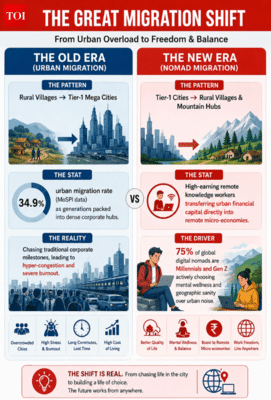
For generations, the economic narrative of modern India was written in one direction: a relentless, exhausting migration from rural villages to hyper-urban hubs.
Millions packed their lives into suitcases, chasing the glittering promises of Delhi, Mumbai, and Bangalore. They traded clean air for corporate ladders and starry skies for the sterile glow of office cubicles.
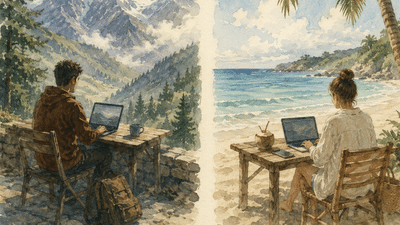
But a quiet, profound revolution is happening.
The tide has turned a full 180 degrees. According to the State of Digital Nomads Report, India ranks 11th globally in digital nomads, housing an estimated 1.7 million location-independent workers (roughly 2% of the global total).
A digital nomad is a professional who leverages internet-based technology to earn a living while living a highly mobile, location-independent lifestyle. Once a niche counterculture among Western freelancers, this lifestyle has transitioned into a mainstream global workforce segment.
Leading the charge are millennials and Gen Z. This generation is rewriting the rules of career, lifestyle, and success.
From the high-altitude valleys of Himachal Pradesh to remote eco-stays like Yakten Village in misty Sikkim, a new socio-economic bridge is being built. A collective yearning for something different — sanity and peace — has shifted the tide.
Traditional career track:
Urban Migration ➔ Cubicle Hustle ➔ Burnout ➔ Seclusion
A digital nomad track:
Digital Connectivity ➔ Rural Migration ➔ Mental Well-Being ➔ Global Impact
The irony is striking. The very digitalization critics said would isolate this generation has instead granted them the freedom to seek peace.
Reversing the historic flow: urban-to-rural migrationWhere past generations prioritized corner offices and job titles, today’s young professionals are changing success metrics. Data shows 75% of all digital nomads globally are Gen Z or Millennials.
Digitalization has broken the geographic link between earning power and urban congestion, allowing young professionals to preserve well-being in quiet regions while remaining connected to global markets.
This reverse migration is only possible because India’s rural-urban divide is shrinking fast. The country has adapted digitally with astonishing speed, democratizing economic opportunity across geography. Go into any remote village in Himachal, Uttarakhand, or the Northeast today: you’ll find elders and youngsters alike holding smartphones, scrolling reels, and absorbing global trends in real time.
The Ministry of Statistics and Programme Implementation (MoSPI) historically pegged national urban migration at 34.9%.
Today, the digital nomad movement is triggering a 180-degree reversal: high-earning knowledge workers are leaving tier-1 cities and moving temporarily or semi-permanently into rural towns and villages.
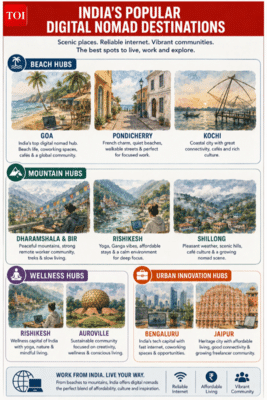
Case study: the indigenous evolutionThe trend appears in eco-tourism initiatives like Yakten Village Homestay in Sikkim, which blends indigenous hospitality with remote-work accessibility. Places such as Kasol , Dharamshala, and Rishikesh—long-stay sanctuaries for international travelers, especially Israelis—are now seeing an influx of domestic workers.
Indian professionals can bypass international visa hassles and currency arbitrage by staying inside their borders. They can code from the Himalayas or design from a Goa beach shack using affordable domestic networks.
Ground realities: the unfiltered nomad experience
Despite the appealing online aesthetic, working on the road involves significant infrastructure and logistical challenges. Vedant Singh, an active Indian digital nomad, highlights the operational friction points of the lifestyle:
The mountain infrastructure deficit“Pahad looks beautiful on screen, but daily logistics can test your patience. Food is expensive because everything has to be hauled up winding roads. And when peak winter hits, it’s absolutely freezing. If you don’t have a reliable heater, your whole routine collapses.”
The Jibbhi freezing loop:
Power Grid Failure ➔ Space Heater Shuts Off ➔ Type for 1 Minute ➔ Warm Hands in Pockets for 5 Minutes
“Most popular nomad destinations have great connectivity now. The Rs 349-a-month unlimited 5G plan works in about 90% of these locations. But you still have to be careful where you sleep and work. I learned to choose places with reliable facilities—mainly Zostel, a trusted backpacker hostel chain,” Singh says.
Transportation in remote micro-hubs often exposes travelers to inflated tourist pricing. “When I was traveling from Dharamshala to Jibbhi, a local cab demanded Rs 2,000 for a 20-km mountain ride. Luckily, another traveller told me a public bus runs the same route for Rs 50,” he added.
A global shift: from exotic foreigners to a homegrown movementWhat Vedant faces in Himachal is part of a massive global phenomenon that accelerated after COVID-19. Post-2020, countries realised remote work was not temporary but a durable structural shift. Governments from Portugal and Spain to Indonesia and Thailand introduced “digital nomad visas” to attract high-earning remote workers.
For years, India’s scenic hubs were primarily playgrounds for international nomads. Hotspots like Kasol, Rishikesh, and Goa long hosted foreign travellers who settled for months, creating self-contained cultural enclaves.
But the true catalyst behind India’s climb to 11th globally is the explosion of homegrown nomads.
The ultimate ultimatum: cubicle vs horizonThe Indian digital nomad vision is compelling. The ability to trade a claustrophobic metropolitan cubicle for a makeshift workstation overlooking Darjeeling’s tea gardens, Jibbhi’s snow-capped peaks, or South Goa’s beaches is no longer a foreign luxury.
This generation’s uncompromising focus on mental well-being, backed by rapid rural digitization, means the infrastructure for location-independent work is on the ground.
However, navigating India as a digital nomad is not a passive vacation; it is an active exercise in resilience.
To succeed, a nomad must trade predictable city comforts for a hyper-adaptable mindset. You must be able to troubleshoot sudden sub-zero power outages, out-negotiate aggressive transit cartels, meticulously vet budget accommodations to avoid poor infrastructure, and accept chores like hand-washing laundry.
Millions packed their lives into suitcases, chasing the glittering promises of Delhi, Mumbai, and Bangalore. They traded clean air for corporate ladders and starry skies for the sterile glow of office cubicles.
But a quiet, profound revolution is happening.
The tide has turned a full 180 degrees. According to the State of Digital Nomads Report, India ranks 11th globally in digital nomads, housing an estimated 1.7 million location-independent workers (roughly 2% of the global total).
A digital nomad is a professional who leverages internet-based technology to earn a living while living a highly mobile, location-independent lifestyle. Once a niche counterculture among Western freelancers, this lifestyle has transitioned into a mainstream global workforce segment.
Leading the charge are millennials and Gen Z. This generation is rewriting the rules of career, lifestyle, and success.
From the high-altitude valleys of Himachal Pradesh to remote eco-stays like Yakten Village in misty Sikkim, a new socio-economic bridge is being built. A collective yearning for something different — sanity and peace — has shifted the tide.
Traditional career track:
Urban Migration ➔ Cubicle Hustle ➔ Burnout ➔ Seclusion
A digital nomad track:
Digital Connectivity ➔ Rural Migration ➔ Mental Well-Being ➔ Global Impact
The irony is striking. The very digitalization critics said would isolate this generation has instead granted them the freedom to seek peace.
Reversing the historic flow: urban-to-rural migrationWhere past generations prioritized corner offices and job titles, today’s young professionals are changing success metrics. Data shows 75% of all digital nomads globally are Gen Z or Millennials.
Digitalization has broken the geographic link between earning power and urban congestion, allowing young professionals to preserve well-being in quiet regions while remaining connected to global markets.
This reverse migration is only possible because India’s rural-urban divide is shrinking fast. The country has adapted digitally with astonishing speed, democratizing economic opportunity across geography. Go into any remote village in Himachal, Uttarakhand, or the Northeast today: you’ll find elders and youngsters alike holding smartphones, scrolling reels, and absorbing global trends in real time.
The Ministry of Statistics and Programme Implementation (MoSPI) historically pegged national urban migration at 34.9%.
Today, the digital nomad movement is triggering a 180-degree reversal: high-earning knowledge workers are leaving tier-1 cities and moving temporarily or semi-permanently into rural towns and villages.
Case study: the indigenous evolutionThe trend appears in eco-tourism initiatives like Yakten Village Homestay in Sikkim, which blends indigenous hospitality with remote-work accessibility. Places such as Kasol , Dharamshala, and Rishikesh—long-stay sanctuaries for international travelers, especially Israelis—are now seeing an influx of domestic workers.
Indian professionals can bypass international visa hassles and currency arbitrage by staying inside their borders. They can code from the Himalayas or design from a Goa beach shack using affordable domestic networks.
Ground realities: the unfiltered nomad experience
Despite the appealing online aesthetic, working on the road involves significant infrastructure and logistical challenges. Vedant Singh, an active Indian digital nomad, highlights the operational friction points of the lifestyle:
The mountain infrastructure deficit“Pahad looks beautiful on screen, but daily logistics can test your patience. Food is expensive because everything has to be hauled up winding roads. And when peak winter hits, it’s absolutely freezing. If you don’t have a reliable heater, your whole routine collapses.”
The Jibbhi freezing loop:
Power Grid Failure ➔ Space Heater Shuts Off ➔ Type for 1 Minute ➔ Warm Hands in Pockets for 5 Minutes
“Most popular nomad destinations have great connectivity now. The Rs 349-a-month unlimited 5G plan works in about 90% of these locations. But you still have to be careful where you sleep and work. I learned to choose places with reliable facilities—mainly Zostel, a trusted backpacker hostel chain,” Singh says.
Transportation in remote micro-hubs often exposes travelers to inflated tourist pricing. “When I was traveling from Dharamshala to Jibbhi, a local cab demanded Rs 2,000 for a 20-km mountain ride. Luckily, another traveller told me a public bus runs the same route for Rs 50,” he added.
A global shift: from exotic foreigners to a homegrown movementWhat Vedant faces in Himachal is part of a massive global phenomenon that accelerated after COVID-19. Post-2020, countries realised remote work was not temporary but a durable structural shift. Governments from Portugal and Spain to Indonesia and Thailand introduced “digital nomad visas” to attract high-earning remote workers.
For years, India’s scenic hubs were primarily playgrounds for international nomads. Hotspots like Kasol, Rishikesh, and Goa long hosted foreign travellers who settled for months, creating self-contained cultural enclaves.
But the true catalyst behind India’s climb to 11th globally is the explosion of homegrown nomads.
The ultimate ultimatum: cubicle vs horizonThe Indian digital nomad vision is compelling. The ability to trade a claustrophobic metropolitan cubicle for a makeshift workstation overlooking Darjeeling’s tea gardens, Jibbhi’s snow-capped peaks, or South Goa’s beaches is no longer a foreign luxury.
This generation’s uncompromising focus on mental well-being, backed by rapid rural digitization, means the infrastructure for location-independent work is on the ground.
However, navigating India as a digital nomad is not a passive vacation; it is an active exercise in resilience.
To succeed, a nomad must trade predictable city comforts for a hyper-adaptable mindset. You must be able to troubleshoot sudden sub-zero power outages, out-negotiate aggressive transit cartels, meticulously vet budget accommodations to avoid poor infrastructure, and accept chores like hand-washing laundry.
Next Story