
'Functional urban settlements': Govt may create new category


NEW DELHI: With villages around cities and towns acquiring urban characteristics - more built-up area, less dependence on agriculture for livelihood and more facilities like high-speed transport network - govt is looking at creating a new category - ' functional urban settlements ' - in addition to the existing 'rural' and 'urban' classifications.
An estimate based on the UN's Degree of Urbanisation framework suggests that nearly 84% of India's population resided in urban settlements in 2025, much higher than govt's estimate of 36%. This is because at present, the framework of urbanisation falls under two categories - Census Towns (over 5,000 population) and Statutory Towns (with municipal entities).
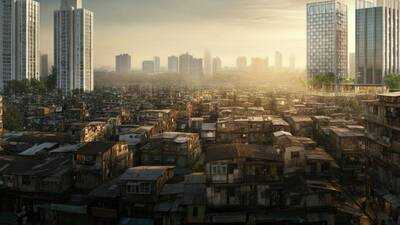
But a visit to some villages close to urban areas in Haryana, Uttar Pradesh, Maharashtra, Kerala or Madhya Pradesh will show that these have most ‘urban’ features.
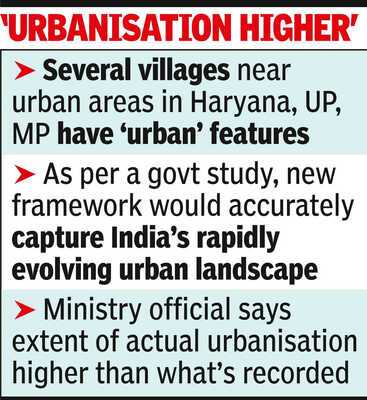
A recent study by National Institute of Urban Affairs (NIUA), under the housing and urban affairs ministry, has recommended the new national settlement classification framework — Functional Urban Settlements — to accurately capture the country’s rapidly evolving urban landscape, as a substantial share of urbanisation is taking place beyond officially recognised towns and cities. The study was released by P K Mishra, principal secretary to PM.
“The extent of actual urbanisation is higher than what’s recorded,” a senior ministry official said, adding there are several areas that exhibit urban characteristics but continue to be governed as rural areas, creating significant gap between geography of urbanisation and governance structures.
Govt has also announced financial aid for City Economic Regions (CERs) in the last Budget. CERs are beyond strict administrative borders and map integrated supply chains, labour markets and surrounding towns to serve as strategic economic hubs.
The NIUA study identified hundreds of functional urban settlements outside the existing system of Statutory and Census Towns by applying its modified Degree of Urbanisation framework in Kerala and MP.
In Kerala, Statutory Towns have increased from 63 to 93 in 2025, while the transition matrix shows that 77 of 461 Census Towns identified in 2011 were upgraded to municipalities and 102 villages were incorporated into urban local bodies. This reflects Kerala’s dispersed urbanisation and expanding urban governance network.
An estimate based on the UN's Degree of Urbanisation framework suggests that nearly 84% of India's population resided in urban settlements in 2025, much higher than govt's estimate of 36%. This is because at present, the framework of urbanisation falls under two categories - Census Towns (over 5,000 population) and Statutory Towns (with municipal entities).
But a visit to some villages close to urban areas in Haryana, Uttar Pradesh, Maharashtra, Kerala or Madhya Pradesh will show that these have most ‘urban’ features.
A recent study by National Institute of Urban Affairs (NIUA), under the housing and urban affairs ministry, has recommended the new national settlement classification framework — Functional Urban Settlements — to accurately capture the country’s rapidly evolving urban landscape, as a substantial share of urbanisation is taking place beyond officially recognised towns and cities. The study was released by P K Mishra, principal secretary to PM.
“The extent of actual urbanisation is higher than what’s recorded,” a senior ministry official said, adding there are several areas that exhibit urban characteristics but continue to be governed as rural areas, creating significant gap between geography of urbanisation and governance structures.
Govt has also announced financial aid for City Economic Regions (CERs) in the last Budget. CERs are beyond strict administrative borders and map integrated supply chains, labour markets and surrounding towns to serve as strategic economic hubs.
The NIUA study identified hundreds of functional urban settlements outside the existing system of Statutory and Census Towns by applying its modified Degree of Urbanisation framework in Kerala and MP.
In Kerala, Statutory Towns have increased from 63 to 93 in 2025, while the transition matrix shows that 77 of 461 Census Towns identified in 2011 were upgraded to municipalities and 102 villages were incorporated into urban local bodies. This reflects Kerala’s dispersed urbanisation and expanding urban governance network.
Next Story