
NCERT textbook shows Indus Valley's 'Dancing Girl' with covered torso to make it 'age-appropriate'


NEW DELHI: The iconic "Dancing Girl" of Mohenjo-daro, one of the most celebrated artefacts of the Indus Valley Civilisation, appears in an altered form in NCERT's new Class 9 arts textbook, with its traditionally bare torso visually covered, sparking debate over the representation of one of India's best-known archaeological treasures in school textbooks.
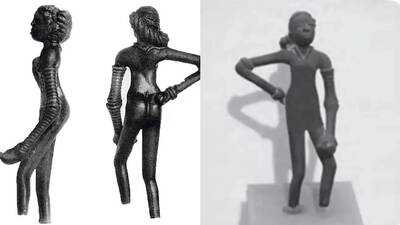
The 4,500-year-old bronze figurine, traditionally depicted with its bare torso visible, appears with shaded modifications in NCERT's new Class 9 arts textbook Madhurima, obscuring anatomical details seen in the original sculpture.
The image features in the opening chapter, History of Arts. Compared with photographs of the original artefact, the figurine's upper body appears visually altered, drawing attention to how one of India's best-known archaeological treasures is being presented to students.
Notably, the same artefact appears in NCERT's Class 6 Social Science textbook in a form much closer to the original bronze sculpture.
'Not age-appropriate'
Michel Danino, who headed the textbook development committee for NCERT's new Class 6 Social Science books, said he had earlier been informed that the Dancing Girl image was considered unsuitable for younger students.
"This refers to our Grade 6 Social Science textbook. The reason I was given was that the image of the Dancing Girl was not age-appropriate," Danino told PTI.
"Our team disagreed; we even checked with teachers of class 6, and they told us there was never a problem with the Dancing Girl," he said.
Questioning the rationale, Danino added, "The notion that nudity is inappropriate is, in my opinion, an obsolete Victorian view. Yet we speak of decolonising Indian education."
Reacting to the modified image in the Class 9 arts textbook, he said he was initially taken aback. "If the Dancing Girl cannot figure as she is, and with proper dimensions, in a chapter on Indian art, then we have a serious problem," he added.
'Misrepresents the original artefact'
Danino strongly criticised the alteration, arguing that it distorts the historical object. "The modification misrepresents the original artefact just as the Church's addition of a fig leaf to Michelangelo's statue of David in the Middle Ages misrepresented that beautiful work of art," he said.
"Unless this is clearly done to indicate the possible reconstruction of a partial artefact, altering such an image amounts to creating a fake artefact. It points to a serious lack of understanding of how historical artefacts are to be pictured," Danino added.
Discussing the figurine's significance, he noted that archaeologists have long debated its meaning and context. However, he pointed out that the same akimbo posture has been found on at least two potsherds from the Harappan site of Bhirrana in Rajasthan, suggesting it carried "a precise cultural value, probably an artistic one."
What is the Dancing Girl?
Discovered at Mohenjo-daro, the Dancing Girl is among the most celebrated artefacts of the Indus Valley Civilisation.
The original bronze statuette stands just 10.5 cm tall and is noted for its naturalistic depiction. The figure is shown unclothed except for jewellery, including multiple bangles on one arm and a necklace.
In the new textbook, however, the figurine appears in a darker shade, with parts of the torso visually covered compared to the original sculpture.
The chapter identifies the Dancing Girl as a bronze figurine from Mohenjo-daro dating to around 2600 BCE. According to the textbook, the sculpture was created using the lost-wax technique, a method still practised in parts of West Bengal, Jharkhand and Chhattisgarh.
"This sculpture depicts a posture with one knee bent, one hand on the waist and a slightly lifted chin," the textbook states.
NCERT reviewing the matter
According to ANI, an NCERT official said the issue has been referred to the textbook development team for examination.
"The matter has been referred to the textbook development team. They are looking into it. There is no specific reason. In the Grade 6 Social Science textbook, the Dancing Girl appears in its original form along with many other artefacts," the official said.
The Dancing Girl has previously been at the centre of debates over representation. In May 2023, Prime Minister Narendra Modi unveiled the mascot for the International Museum Expo at Delhi's Pragati Maidan. The mascot was a modern adaptation of the Dancing Girl and was described by organisers as a contemporary interpretation of the ancient figure.
However, the over five-foot-tall version drew criticism from historians and archaeologists because it significantly altered the appearance of the original artefact. While the ancient bronze figurine is dark in colour and largely unclothed except for jewellery, the expo mascot featured a fairer complexion and was dressed in a bright pink blouse and an off-white waistcoat.
The 4,500-year-old bronze figurine, traditionally depicted with its bare torso visible, appears with shaded modifications in NCERT's new Class 9 arts textbook Madhurima, obscuring anatomical details seen in the original sculpture.
The image features in the opening chapter, History of Arts. Compared with photographs of the original artefact, the figurine's upper body appears visually altered, drawing attention to how one of India's best-known archaeological treasures is being presented to students.
Notably, the same artefact appears in NCERT's Class 6 Social Science textbook in a form much closer to the original bronze sculpture.
'Not age-appropriate'
Michel Danino, who headed the textbook development committee for NCERT's new Class 6 Social Science books, said he had earlier been informed that the Dancing Girl image was considered unsuitable for younger students.
"This refers to our Grade 6 Social Science textbook. The reason I was given was that the image of the Dancing Girl was not age-appropriate," Danino told PTI.
"Our team disagreed; we even checked with teachers of class 6, and they told us there was never a problem with the Dancing Girl," he said.
Questioning the rationale, Danino added, "The notion that nudity is inappropriate is, in my opinion, an obsolete Victorian view. Yet we speak of decolonising Indian education."
Reacting to the modified image in the Class 9 arts textbook, he said he was initially taken aback. "If the Dancing Girl cannot figure as she is, and with proper dimensions, in a chapter on Indian art, then we have a serious problem," he added.
'Misrepresents the original artefact'
Danino strongly criticised the alteration, arguing that it distorts the historical object. "The modification misrepresents the original artefact just as the Church's addition of a fig leaf to Michelangelo's statue of David in the Middle Ages misrepresented that beautiful work of art," he said.
"Unless this is clearly done to indicate the possible reconstruction of a partial artefact, altering such an image amounts to creating a fake artefact. It points to a serious lack of understanding of how historical artefacts are to be pictured," Danino added.
Discussing the figurine's significance, he noted that archaeologists have long debated its meaning and context. However, he pointed out that the same akimbo posture has been found on at least two potsherds from the Harappan site of Bhirrana in Rajasthan, suggesting it carried "a precise cultural value, probably an artistic one."
What is the Dancing Girl?
Discovered at Mohenjo-daro, the Dancing Girl is among the most celebrated artefacts of the Indus Valley Civilisation.
The original bronze statuette stands just 10.5 cm tall and is noted for its naturalistic depiction. The figure is shown unclothed except for jewellery, including multiple bangles on one arm and a necklace.
In the new textbook, however, the figurine appears in a darker shade, with parts of the torso visually covered compared to the original sculpture.
The chapter identifies the Dancing Girl as a bronze figurine from Mohenjo-daro dating to around 2600 BCE. According to the textbook, the sculpture was created using the lost-wax technique, a method still practised in parts of West Bengal, Jharkhand and Chhattisgarh.
"This sculpture depicts a posture with one knee bent, one hand on the waist and a slightly lifted chin," the textbook states.
NCERT reviewing the matter
According to ANI, an NCERT official said the issue has been referred to the textbook development team for examination.
"The matter has been referred to the textbook development team. They are looking into it. There is no specific reason. In the Grade 6 Social Science textbook, the Dancing Girl appears in its original form along with many other artefacts," the official said.
The Dancing Girl has previously been at the centre of debates over representation. In May 2023, Prime Minister Narendra Modi unveiled the mascot for the International Museum Expo at Delhi's Pragati Maidan. The mascot was a modern adaptation of the Dancing Girl and was described by organisers as a contemporary interpretation of the ancient figure.
However, the over five-foot-tall version drew criticism from historians and archaeologists because it significantly altered the appearance of the original artefact. While the ancient bronze figurine is dark in colour and largely unclothed except for jewellery, the expo mascot featured a fairer complexion and was dressed in a bright pink blouse and an off-white waistcoat.
Next Story