
Why Did the Stock Market Crash Today? Here's What You Need to Know

The Indian stock market began the week with a sharp decline on Monday, as the NSE Nifty and BSE Sensex opened over 3.5% lower, hitting 10-month lows. The sell-off mirrored a broader global market crash , with Japan’s Nikkei 225 plummeting nearly 8%, Australia’s S&P/ASX 200 dropping over 6%, and South Korea’s Kospi falling 4.4%.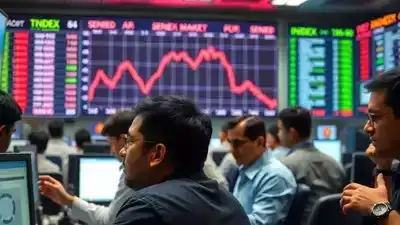
The BSE Sensex plunged 3,939.68 points to 71,425.01 in early trading, while the NSE Nifty sank 1,160.8 points to 21,743.65.
What’s Driving the Market Crash?
1. Escalating Tariff War
The primary trigger for the market downturn is the intensifying global trade war after U.S. President Donald Trump imposed reciprocal tariffs on nearly all imported goods. In retaliation, China announced a 34% tariff hike on U.S. products, worsening trade tensions and sparking a massive sell-off in equities worldwide.
"Global markets are facing extreme volatility due to uncertainty. No one can predict how Trump’s tariff policies will unfold," said V.K. Vijayakumar, Chief Investment Strategist at Geojit Financial Services.
2. Fear of U.S. Recession
Analysts warn that the new tariffs could push the U.S. into a recession amid rising inflation and slowing growth. Goldman Sachs has raised its U.S. recession probability to 45% (from 35%) and warned of further downgrades if additional tariffs take effect.
Sectoral and Broader Market Impact
All major sectors were in the red, with Nifty Metal plunging over 6%. Nifty IT and Nifty Auto also saw heavy losses, dropping 4-5%. The India VIX (volatility index) surged over 55%, crossing 21, reflecting heightened investor fear.
Midcap and smallcap indices weren’t spared either, each losing more than 3%.
Analysts’ Take
ICICI Securities cautioned against buying until the Nifty stabilizes above 22,800, noting that February’s low of 22,000 could act as immediate support.
Vijayakumar advised a "wait-and-watch" approach, highlighting that:
He added that domestic-focused sectors like financials, aviation, hotels, select autos, cement, defense, and digital platforms may weather the storm better. Pharmaceuticals could also remain resilient, as Trump is unlikely to impose tariffs on this sector.
Technical Outlook
Anand James, Chief Market Strategist at Geojit Investments, noted that while 21,800 was a key level, Friday’s panic selling weakened support structures. However, a sharp rebound could see the Nifty reclaim 22,165 or even 22,522 in a best-case scenario.
Global Markets in Turmoil
Asian markets suffered heavy losses:
U.S. futures also pointed to further declines:
On Friday, Wall Street saw its worst drop since the COVID crisis, with the S&P 500 (-6%), Dow (-5.5%), and Nasdaq (-5.8%) all plunging.
With global markets in turmoil and trade tensions escalating, investors are bracing for continued volatility. While India may be relatively better positioned, caution remains the watchword until stability returns.
The BSE Sensex plunged 3,939.68 points to 71,425.01 in early trading, while the NSE Nifty sank 1,160.8 points to 21,743.65.
What’s Driving the Market Crash?
1. Escalating Tariff War
The primary trigger for the market downturn is the intensifying global trade war after U.S. President Donald Trump imposed reciprocal tariffs on nearly all imported goods. In retaliation, China announced a 34% tariff hike on U.S. products, worsening trade tensions and sparking a massive sell-off in equities worldwide.
"Global markets are facing extreme volatility due to uncertainty. No one can predict how Trump’s tariff policies will unfold," said V.K. Vijayakumar, Chief Investment Strategist at Geojit Financial Services.
2. Fear of U.S. Recession
Analysts warn that the new tariffs could push the U.S. into a recession amid rising inflation and slowing growth. Goldman Sachs has raised its U.S. recession probability to 45% (from 35%) and warned of further downgrades if additional tariffs take effect.
You may also like
- UP: Man who shot dead wife, two priests and kept his kids hostage killed in encounter
- Delhi: 3 held for 'gangrape' of 17-year-old near Kalkaji Mandir; 1 shot in leg
- Light to Moderate Rain Expected in Western Ghats of Tamil Nadu with Storm Alert
- Slight Relief from Heat Expected in NCR, But Air Pollution Poses Risks for Respiratory Patients
- Karnataka Legislative Council polls: Voting on October 23, counting on October 27
Sectoral and Broader Market Impact
All major sectors were in the red, with Nifty Metal plunging over 6%. Nifty IT and Nifty Auto also saw heavy losses, dropping 4-5%. The India VIX (volatility index) surged over 55%, crossing 21, reflecting heightened investor fear.
Midcap and smallcap indices weren’t spared either, each losing more than 3%.
Analysts’ Take
ICICI Securities cautioned against buying until the Nifty stabilizes above 22,800, noting that February’s low of 22,000 could act as immediate support.
Vijayakumar advised a "wait-and-watch" approach, highlighting that:
- Trump’s tariffs may not last long.
- India is relatively insulated, with exports to the U.S. accounting for just 2% of GDP.
- A potential U.S.-India trade deal could ease tariffs.
He added that domestic-focused sectors like financials, aviation, hotels, select autos, cement, defense, and digital platforms may weather the storm better. Pharmaceuticals could also remain resilient, as Trump is unlikely to impose tariffs on this sector.
Technical Outlook
Anand James, Chief Market Strategist at Geojit Investments, noted that while 21,800 was a key level, Friday’s panic selling weakened support structures. However, a sharp rebound could see the Nifty reclaim 22,165 or even 22,522 in a best-case scenario.
Global Markets in Turmoil
Asian markets suffered heavy losses:
- Nikkei 225 (Japan): -8%
- S&P/ASX 200 (Australia): -6%
- Kospi (South Korea): -4.4%
U.S. futures also pointed to further declines:
- S&P 500 futures: -4.2%
- Dow Jones futures: -3.5%
- Nasdaq futures: -5.3%
On Friday, Wall Street saw its worst drop since the COVID crisis, with the S&P 500 (-6%), Dow (-5.5%), and Nasdaq (-5.8%) all plunging.
With global markets in turmoil and trade tensions escalating, investors are bracing for continued volatility. While India may be relatively better positioned, caution remains the watchword until stability returns.






Loving Newspoint? Download the app now
