
A 550-million-year-old fossil may reveal the world's oldest right-handed animal, suggesting the trait evolved long before humans, dinosaurs or mammals


Scientists believe the evolutionary origins of handedness may extend beyond mammals or even dinosaurs. A new study published in Scientific Reports has identified evidence that Spriggina floundersi , an extinct marine organism that lived approximately 550 million years ago, favoured turning to the right. If this information is confirmed, the findings would make Spriggina floundersi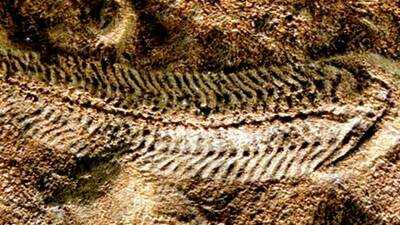 the oldest known animal to display population-level ‘handedness,’ pushing the origins of left-right behavioural patterns hundreds of millions of years deeper into Earth's history than previously recognised.
Fossils preserved a snapshot of life before the Cambrian explosion
The discovery is based on more than 100 preserved fossils collected from Nilpena Edicara National Park and additional specimens housed at the South Australia Museum. Located in South Australia’s Flinders Ranges, Nilpena preserves one of the world’s richest fossil records from the Ediacaran Period, roughly 635-538 million years ago. It is believed that during this time life on Earth underwent a major evolutionary transition as simple multicellular organisms began developing larger bodies, bilateral symmetry and increasingly complex movement. Many researchers believe that storm events buried the entire marine communities beneath layers of sediment, thus preserving detailed impressions of organisms that lived on the ancient seafloor a few hundred million years ago.
Notably, to determine whether Spriggina showed any directional preferences, scientists have carefully observed the shape and curvature of fossil impressions and found that roughly twice as many fossils appeared bent to the left as to the right. As the fossils preserve mirror-image impressions of the original animals, a leftward inclination in the rock indicates that the living animal had bent to the right. This consistent pattern suggests that Spriggina was not randomly curved by fossilisation but instead showed a directional preference during life.
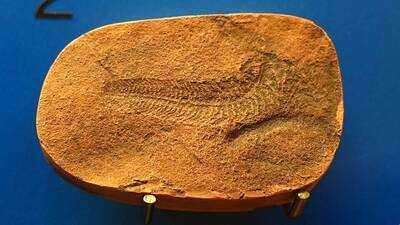
Researchers say that these implications extend well beyond fossil anatomy, as in many living animals consistent left-right behavioural preferences are linked to increasingly sophisticated nervous systems and specialised brain functions. According to co-author Mary Droser of the University of California, Riverside, this discovery suggests that some neurological characteristics associated with modern animals may have emerged much earlier in evolutionary history. Scientists propose that Spriggina might have possessed a relatively advanced nervous system that was capable of consistently processing environmental information in ways that favored moved toward a certain side. While scientists cannot directly observe the behaviour of the extinct organisms, the repeated pattern preserved across numerous fossils shows compelling evidence that this asymmetry reflects biology rather than a coincidence.
Fossils preserved a snapshot of life before the Cambrian explosion
The discovery is based on more than 100 preserved fossils collected from Nilpena Edicara National Park and additional specimens housed at the South Australia Museum. Located in South Australia’s Flinders Ranges, Nilpena preserves one of the world’s richest fossil records from the Ediacaran Period, roughly 635-538 million years ago. It is believed that during this time life on Earth underwent a major evolutionary transition as simple multicellular organisms began developing larger bodies, bilateral symmetry and increasingly complex movement. Many researchers believe that storm events buried the entire marine communities beneath layers of sediment, thus preserving detailed impressions of organisms that lived on the ancient seafloor a few hundred million years ago.
Notably, to determine whether Spriggina showed any directional preferences, scientists have carefully observed the shape and curvature of fossil impressions and found that roughly twice as many fossils appeared bent to the left as to the right. As the fossils preserve mirror-image impressions of the original animals, a leftward inclination in the rock indicates that the living animal had bent to the right. This consistent pattern suggests that Spriggina was not randomly curved by fossilisation but instead showed a directional preference during life.
Researchers say that these implications extend well beyond fossil anatomy, as in many living animals consistent left-right behavioural preferences are linked to increasingly sophisticated nervous systems and specialised brain functions. According to co-author Mary Droser of the University of California, Riverside, this discovery suggests that some neurological characteristics associated with modern animals may have emerged much earlier in evolutionary history. Scientists propose that Spriggina might have possessed a relatively advanced nervous system that was capable of consistently processing environmental information in ways that favored moved toward a certain side. While scientists cannot directly observe the behaviour of the extinct organisms, the repeated pattern preserved across numerous fossils shows compelling evidence that this asymmetry reflects biology rather than a coincidence.
Next Story