
'Architecture must be medicine, not spectacle', says Marlon Blackwell


Architecture should heal, gather and belong to everyone, not merely create impressive skylines. That was the recurring message from celebrated American architect Marlon Blackwell, who delivered the keynote at the 9th Charles Correa Memorial Lecture , on Friday, organised by the Ambuja Neotia Group in association with the Charles Correa Foundation.
A recipient of the 2020 AIA Gold Medal, Blackwell reflected on Charles Correa's enduring influence, describing him as an architect who understood "that the most meaningful buildings belong to the people who inhabit them."
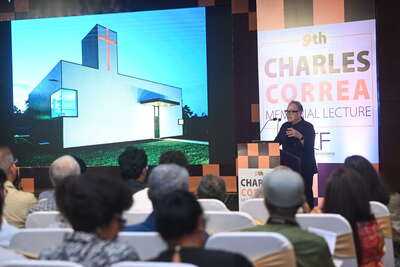
During his presentation, Blackwell took the audience through a cross-section of his award-winning projects from around the world, ranging from the sensitive, low-budget reimagining of a Greek Orthodox church to the American Pavilion at the Venice Biennale. Vastly different in scale and ambition, the projects were united by his signature approach of finding inventive, often radical, architectural solutions to real-world challenges while remaining deeply rooted in context.
Speaking to Calcutta Times on the sidelines of the event, Blackwell said Correa's human-centric approach continues to resonate deeply with him. "Architecture should be able to happen anywhere, at any scale, at any budget, and for anyone," he said. Among Correa's ideas, he singled out courtyards and porches for their ability to solve multiple problems at once by bringing people together while naturally cooling buildings.
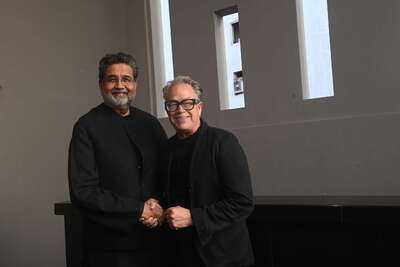
As Indian cities race skywards, Blackwell cautioned against confusing height with progress. "If you want to go vertical, fine. But buildings must breathe," he said, stressing the importance of ventilation, shade and climate-responsive design. "Sometimes it's better to have things that are thick and dark and implicit, a bit more mysterious, than all glass and constant exposure."
A recipient of the 2020 AIA Gold Medal, Blackwell reflected on Charles Correa's enduring influence, describing him as an architect who understood "that the most meaningful buildings belong to the people who inhabit them."
During his presentation, Blackwell took the audience through a cross-section of his award-winning projects from around the world, ranging from the sensitive, low-budget reimagining of a Greek Orthodox church to the American Pavilion at the Venice Biennale. Vastly different in scale and ambition, the projects were united by his signature approach of finding inventive, often radical, architectural solutions to real-world challenges while remaining deeply rooted in context.
Speaking to Calcutta Times on the sidelines of the event, Blackwell said Correa's human-centric approach continues to resonate deeply with him. "Architecture should be able to happen anywhere, at any scale, at any budget, and for anyone," he said. Among Correa's ideas, he singled out courtyards and porches for their ability to solve multiple problems at once by bringing people together while naturally cooling buildings.
As Indian cities race skywards, Blackwell cautioned against confusing height with progress. "If you want to go vertical, fine. But buildings must breathe," he said, stressing the importance of ventilation, shade and climate-responsive design. "Sometimes it's better to have things that are thick and dark and implicit, a bit more mysterious, than all glass and constant exposure."
Next Story