
Brown howler monkeys spend more time resting during hot weather and leaf-rich diets; study finds


Life in the Atlantic Forest is rarely static. Even animals that spend much of their time high in the canopy must constantly balance feeding, avoiding rivals, conserving energy and coping with changing weather. For brown howler monkeys, that balancing act appears to shape how far they travel each day. A study published in the International Journal of Primatology , titled “Determinants of daily path length in Alouatta guariba in a continuous forest”, examined the daily movements of a wild group of brown howler monkeys ( Alouatta guariba) living in Brazil’s Carlos Botelho State Park . By following the animals across several months and tracking their movements throughout entire days, researchers were able to piece together how environmental conditions, diet and interactions with other primates influence the distances these monkeys cover in a continuous Atlantic Forest habitat.
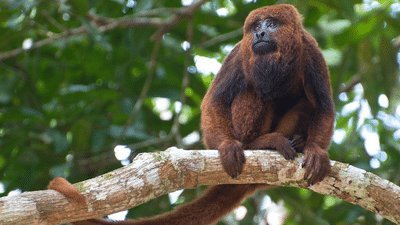
Brown howler monkeys rest more on hot days and travel shorter distances
The team observed that the monkeys tended to spend more time resting during warmer periods and on days with longer daylight hours. As resting time increased, the distance travelled during the day generally fell.
According to the lead author of the study, the pattern suggests that brown howler monkeys adjust their behaviour to manage the demands of temperature and energy use. Rather than taking advantage of longer days to move farther, the animals often devoted additional time to resting.
This behaviour fits with what is already known about howler monkeys. They are among the most energy-conserving primates in the Americas , frequently remaining inactive for long periods while digesting food and avoiding unnecessary exertion.
During the study period, the monitored group travelled an average of 531 metres per day, although distances varied considerably. The shortest recorded daily journey was just over 200 metres, while the longest exceeded 860 metres.
Leaf-rich diets reduce daily travel in brown howler monkeys
Food choices also appeared to influence movement patterns. Leaves formed an important part of the monkeys’ diet, but days with heavier leaf consumption were linked to shorter travel distances. Unlike fruits, leaves are fibrous and require longer digestive processing. The researchers suggest that the animals compensate by resting more, allowing digestion to take place while limiting energy expenditure.
In practical terms, feeding on leaves may reduce the need to search widely for food, while simultaneously encouraging inactivity. The result is a shorter daily route through the forest.
According to the study, fruit consumption, by contrast, showed no clear relationship with how far the monkeys travelled. Although fruit is often patchily distributed and might be expected to encourage longer searches, the study found no evidence that fruit-feeding days produced greater movement. The researchers suggest that familiarity with the forest and knowledge of food locations may allow the animals to reach feeding sites efficiently without increasing travel distances.
How other monkey species influenced howler movement
While weather and diet often encouraged inactivity, encounter with other species had the opposite effect. The brown howlers shared their habitat with several other primates, including southern muriquis (Brachyteles arachnoides) and black capuchin monkeys (Sapajus cucullatus). When these meetings occurred, the howlers frequently ended up travelling farther than usual.
Field observations revealed several instances in which the monkeys abandoned feeding or resting locations after encountering other primates. In some cases, they were actively chased. On other occasions they appeared to leave simply to avoid potential conflict.
As per the study, muriquis often dominate such interactions because of their larger size. Capuchins present a different challenge. Although smaller, they move in sizable groups and can harass howler monkeys by crowding them or disturbing resting sites.
Leaving an area may reduce the risk of confrontation, but it also forces the animals to seek alternative places to rest or feed, increasing the distance travelled during the day.
Brown howler monkey calls do not influence daily travel distances
The study also tracked encounters between different groups of brown howler monkeys. These meetings usually occurred near the edges of home ranges and were largely limited to vocal exchanges.
Despite the species’ famous calls, interactions with neighbouring howler groups did not appear to affect daily travel distances. Researchers recorded only a small number of encounters during the observation period, reflecting the relatively low density of the population within the large protected forest.
That differs from smaller and more fragmented habitats, where groups are often closer together, and vocal encounters occur more frequently.
Researchers used GPS tracking to study brown howler monkey movements
The research was carried out in the São Miguel Arcanjo sector of Carlos Botelho State Park, a protected area covering roughly 38,000 hectares of Atlantic Forest in São Paulo state.
Between August 2023 and January 2024, the team spent 63 days in the field. Tracking the monkeys was not always straightforward. On many days, the group could not be located at all, partly because the animals vocalised less often than populations living in smaller forest fragments.
When the group was found, researchers followed it from morning until evening, recording positions every five minutes using GPS equipment and documenting behaviours such as feeding, resting and travelling. By combining information on temperature, day length, diet, activity patterns and social encounters, the team developed a model that explained around 70 per cent of the variation in daily travel distance.
Brown howler monkeys rest more on hot days and travel shorter distances
The team observed that the monkeys tended to spend more time resting during warmer periods and on days with longer daylight hours. As resting time increased, the distance travelled during the day generally fell.
According to the lead author of the study, the pattern suggests that brown howler monkeys adjust their behaviour to manage the demands of temperature and energy use. Rather than taking advantage of longer days to move farther, the animals often devoted additional time to resting.
This behaviour fits with what is already known about howler monkeys. They are among the most energy-conserving primates in the Americas , frequently remaining inactive for long periods while digesting food and avoiding unnecessary exertion.
During the study period, the monitored group travelled an average of 531 metres per day, although distances varied considerably. The shortest recorded daily journey was just over 200 metres, while the longest exceeded 860 metres.
Leaf-rich diets reduce daily travel in brown howler monkeys
Food choices also appeared to influence movement patterns. Leaves formed an important part of the monkeys’ diet, but days with heavier leaf consumption were linked to shorter travel distances. Unlike fruits, leaves are fibrous and require longer digestive processing. The researchers suggest that the animals compensate by resting more, allowing digestion to take place while limiting energy expenditure.
According to the study, fruit consumption, by contrast, showed no clear relationship with how far the monkeys travelled. Although fruit is often patchily distributed and might be expected to encourage longer searches, the study found no evidence that fruit-feeding days produced greater movement. The researchers suggest that familiarity with the forest and knowledge of food locations may allow the animals to reach feeding sites efficiently without increasing travel distances.
How other monkey species influenced howler movement
While weather and diet often encouraged inactivity, encounter with other species had the opposite effect. The brown howlers shared their habitat with several other primates, including southern muriquis (Brachyteles arachnoides) and black capuchin monkeys (Sapajus cucullatus). When these meetings occurred, the howlers frequently ended up travelling farther than usual.
As per the study, muriquis often dominate such interactions because of their larger size. Capuchins present a different challenge. Although smaller, they move in sizable groups and can harass howler monkeys by crowding them or disturbing resting sites.
Brown howler monkey calls do not influence daily travel distances
The study also tracked encounters between different groups of brown howler monkeys. These meetings usually occurred near the edges of home ranges and were largely limited to vocal exchanges.
That differs from smaller and more fragmented habitats, where groups are often closer together, and vocal encounters occur more frequently.
Researchers used GPS tracking to study brown howler monkey movements
The research was carried out in the São Miguel Arcanjo sector of Carlos Botelho State Park, a protected area covering roughly 38,000 hectares of Atlantic Forest in São Paulo state.
Between August 2023 and January 2024, the team spent 63 days in the field. Tracking the monkeys was not always straightforward. On many days, the group could not be located at all, partly because the animals vocalised less often than populations living in smaller forest fragments.
Next Story