
Cats and snakes have more in common than you think: Surprising similarities between two of nature's most efficient predators


At first glance, cats and snakes appear to have little in common. One is a furry, four-legged mammal that purrs and curls up on the sofa, while the other is a limbless reptile covered in scales. Yet despite their obvious differences, these animals share a surprising number of traits. Both have evolved into highly effective predators, relying on stealth, precision and specialised senses to survive. From their hunting strategies to their eye structure and flexible bodies, cats and snakes demonstrate how evolution can produce similar solutions in very different creatures.
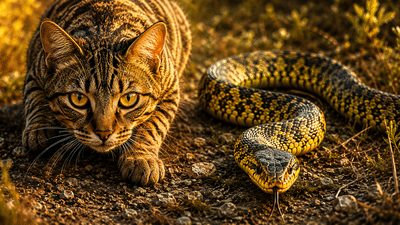
Similarities between cats and snakes
Silent stalkers built for the hunt
One of the most striking similarities between cats and snakes is the way they hunt. Both are ambush predators that prefer stealth over speed. Rather than chasing prey over long distances, they often remain hidden and wait for the perfect opportunity to strike.
Cats carefully stalk birds, rodents and other small animals before pouncing with remarkable precision. Many snake species use a similar strategy, remaining motionless for extended periods before launching a rapid attack. In both cases, patience is often the key to success.
Exceptional sensory abilities
Cats and snakes possess highly developed sensory systems that help them detect prey and navigate their surroundings.
Cats are known for their excellent hearing, acute vision and sensitive whiskers, which help them detect movement even in low light. Snakes rely on a different set of tools, including the ability to sense ground vibrations and, in some species, detect heat emitted by warm-blooded prey.
Although the mechanisms differ, both animals have evolved senses that give them a significant advantage as predators.
The mystery of vertical pupils
Many domestic cats have vertical slit-shaped pupils, a feature commonly associated with hunting animals. Interestingly, numerous snake species possess the same eye structure.
Scientists believe vertical pupils help predators judge distances more accurately and regulate the amount of light entering the eye. This adaptation is especially useful for animals that hunt at dawn, dusk or during the night.
While not all cats or snakes have vertical pupils, the shared feature highlights a fascinating example of convergent evolution.
Flexible bodies for remarkable movement
Flexibility is another trait that links these seemingly unrelated animals.
Cats have highly flexible spines that allow them to leap, twist and land on their feet with extraordinary agility. Snakes take flexibility to an entirely different level, thanks to hundreds of vertebrae that enable them to slither through narrow spaces and move across a wide variety of terrains.
In both species, body flexibility enhances hunting ability and helps them escape danger.
Masters of remaining unnoticed
Both cats and snakes are experts at moving without attracting attention.
Cats can walk almost silently due to their soft paw pads and controlled movements. Snakes glide across surfaces with minimal noise, often remaining undetected until they are very close to their target.
This ability to move quietly provides a major advantage when hunting and contributes to the reputation of both animals as stealth specialists.
Solitary by nature
Unlike many social animals, cats and snakes tend to be independent creatures.
Domestic cats may enjoy human companionship, but their wild relatives often spend much of their time alone. Similarly, most snake species are solitary and typically interact with others only during breeding seasons.
This independent lifestyle reduces competition for resources and suits their hunting strategies.
Shedding and constant renewal
Cats and snakes both undergo forms of shedding, although the process occurs differently.
Cats continuously shed old fur and replace it with new growth throughout the year. Snakes periodically shed their entire outer layer of skin in a process known as ecdysis. In both cases, shedding helps maintain healthy protective coverings and supports growth.
Different animals, similar solutions
Cats and snakes are separated by hundreds of millions of years of evolutionary history, yet they have developed several remarkably similar traits. Their shared characteristics—stealthy hunting, specialised senses, flexible bodies and independent behaviour—demonstrate how evolution often arrives at comparable solutions when faced with similar challenges.
The next time a cat silently stalks a toy across the floor, it may be worth remembering that some of the same predatory instincts can also be found in one of nature's most fascinating reptiles.
Similarities between cats and snakes
Silent stalkers built for the hunt
One of the most striking similarities between cats and snakes is the way they hunt. Both are ambush predators that prefer stealth over speed. Rather than chasing prey over long distances, they often remain hidden and wait for the perfect opportunity to strike.
Cats carefully stalk birds, rodents and other small animals before pouncing with remarkable precision. Many snake species use a similar strategy, remaining motionless for extended periods before launching a rapid attack. In both cases, patience is often the key to success.
Exceptional sensory abilities
Cats and snakes possess highly developed sensory systems that help them detect prey and navigate their surroundings.
Cats are known for their excellent hearing, acute vision and sensitive whiskers, which help them detect movement even in low light. Snakes rely on a different set of tools, including the ability to sense ground vibrations and, in some species, detect heat emitted by warm-blooded prey.
Although the mechanisms differ, both animals have evolved senses that give them a significant advantage as predators.
The mystery of vertical pupils
Many domestic cats have vertical slit-shaped pupils, a feature commonly associated with hunting animals. Interestingly, numerous snake species possess the same eye structure.
Scientists believe vertical pupils help predators judge distances more accurately and regulate the amount of light entering the eye. This adaptation is especially useful for animals that hunt at dawn, dusk or during the night.
Flexible bodies for remarkable movement
Flexibility is another trait that links these seemingly unrelated animals.
Cats have highly flexible spines that allow them to leap, twist and land on their feet with extraordinary agility. Snakes take flexibility to an entirely different level, thanks to hundreds of vertebrae that enable them to slither through narrow spaces and move across a wide variety of terrains.
Masters of remaining unnoticed
Both cats and snakes are experts at moving without attracting attention.
Cats can walk almost silently due to their soft paw pads and controlled movements. Snakes glide across surfaces with minimal noise, often remaining undetected until they are very close to their target.
Solitary by nature
Unlike many social animals, cats and snakes tend to be independent creatures.
Domestic cats may enjoy human companionship, but their wild relatives often spend much of their time alone. Similarly, most snake species are solitary and typically interact with others only during breeding seasons.
Shedding and constant renewal
Cats and snakes both undergo forms of shedding, although the process occurs differently.
Cats continuously shed old fur and replace it with new growth throughout the year. Snakes periodically shed their entire outer layer of skin in a process known as ecdysis. In both cases, shedding helps maintain healthy protective coverings and supports growth.
Different animals, similar solutions
Cats and snakes are separated by hundreds of millions of years of evolutionary history, yet they have developed several remarkably similar traits. Their shared characteristics—stealthy hunting, specialised senses, flexible bodies and independent behaviour—demonstrate how evolution often arrives at comparable solutions when faced with similar challenges.
The next time a cat silently stalks a toy across the floor, it may be worth remembering that some of the same predatory instincts can also be found in one of nature's most fascinating reptiles.
Next Story