
Could Your Sleep Pattern Decide Your Work Schedule? Inside the Chronoworking Trend

At some point, almost everyone has wondered the same thing. Why does one person finish half their work before lunchtime while another only seems to hit their stride in the late afternoon? It's easy to assume the answer is discipline, but it isn't always that simple. Some people naturally feel sharp early in the day, while others take longer to get going and stay focused well into the evening. That difference has existed for as long as people have worked. The only thing that's changing is that we're finally talking about it.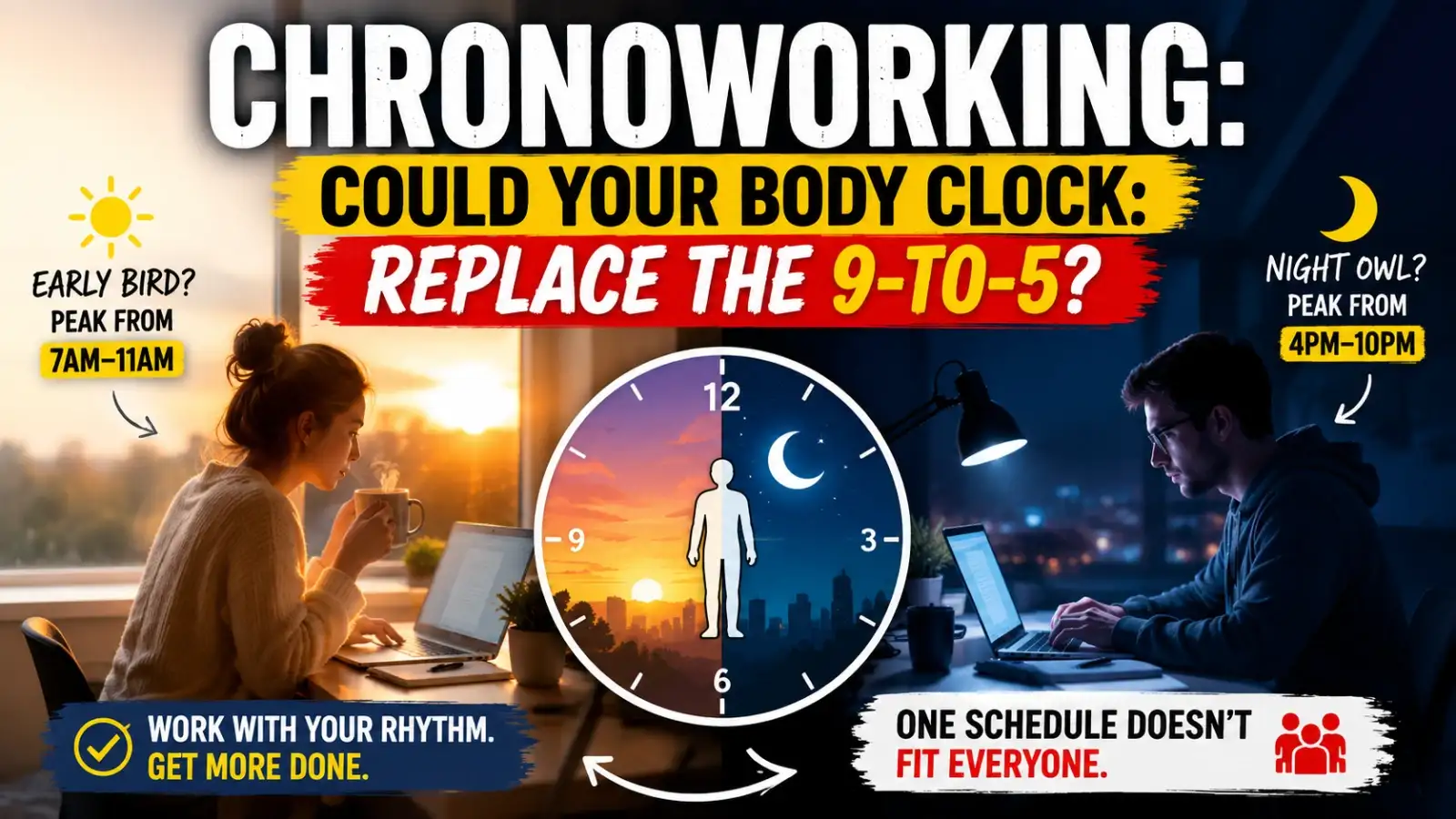
For years, those who struggled to get up early were often labelled as unmotivated or disorganised. But research on circadian rhythms suggests that our internal clocks differ from person to person. Some people naturally feel alert early in the morning; others peak later in the day. And neither is better automatically; they're just different.
A New Perspective on Productivity
Chronoworking is not about working less or not doing your job. It’s a surprisingly practical idea: if your schedule allows, try to do your most demanding work during the hours when your energy and concentration are naturally at their peak.
For a writer, that might mean drafting articles early in the morning. For a designer, creative ideas may come more easily after lunch. Administrative tasks can often be moved to quieter periods, while complex work is saved for the time when the mind feels most alert. It's less about changing the amount of work and more about changing when it's done.
Employers noticed something too. In many roles, results mattered far more than whether someone answered an email at exactly 9:03 a.m. That shift encouraged businesses to rethink whether productivity should always be measured by hours spent at a desk rather than by the quality of the work itself.
It's Not a One-Size-Fits-All Rule
Of course, chronoworking is not possible everywhere. Fixed schedules are essential to hospitals, schools, airlines, shops, emergency services and many other workplaces. Those jobs rely on people being there when they need to be, regardless of their own body clocks.
Total freedom doesn’t always make sense, even in flexible workplaces. We still need common hours for meetings, collaboration and decision-making. Chronoworking is best as an option, not a replacement for all traditional schedules.
The answer won't be the same for everyone. Some people will always prefer early mornings. Others will continue to do their best thinking later in the day. Perhaps the future of work isn't about replacing the 9-to-5 altogether. It's about recognising that productivity isn't measured by the hands of a clock as much as by what we do with the hours when we're at our best.
The 9-to-5 Was Never Built Around Biology
The modern workday wasn't designed because every human brain performs best between nine in the morning and five in the evening. It came out of industrial timetables, when factories and offices and schools all needed people to be on the same timetable. Uniform life was more easy to live, though not equally adapted to all.For years, those who struggled to get up early were often labelled as unmotivated or disorganised. But research on circadian rhythms suggests that our internal clocks differ from person to person. Some people naturally feel alert early in the morning; others peak later in the day. And neither is better automatically; they're just different.
A New Perspective on Productivity
Chronoworking is not about working less or not doing your job. It’s a surprisingly practical idea: if your schedule allows, try to do your most demanding work during the hours when your energy and concentration are naturally at their peak.
You may also like
- My Violin, Amar Akbar Anthony and the Music of India's Unity
- Who is Zarna Garg? The Indian-born comedian whose emotional Instagram post about mothers, dreams and second chances is touching millions
- Kangana Ranaut Celebrates National Handloom Day, Advocates for Indian Textile Heritage
- Preparations Underway to Impose New Levy on LPG Cylinders; Costs Likely to Rise
- Building a Healthy Workforce through Reproductive Healthcare Benefits
For a writer, that might mean drafting articles early in the morning. For a designer, creative ideas may come more easily after lunch. Administrative tasks can often be moved to quieter periods, while complex work is saved for the time when the mind feels most alert. It's less about changing the amount of work and more about changing when it's done.
Why People Are Paying Attention Now
Flexible and remote work opened a door that many people didn't realise existed. Without a daily commute or constant supervision, some employees quietly began arranging their day differently. They noticed they weren't necessarily producing more work; they were producing better work.Employers noticed something too. In many roles, results mattered far more than whether someone answered an email at exactly 9:03 a.m. That shift encouraged businesses to rethink whether productivity should always be measured by hours spent at a desk rather than by the quality of the work itself.
It's Not a One-Size-Fits-All Rule
Of course, chronoworking is not possible everywhere. Fixed schedules are essential to hospitals, schools, airlines, shops, emergency services and many other workplaces. Those jobs rely on people being there when they need to be, regardless of their own body clocks.
Total freedom doesn’t always make sense, even in flexible workplaces. We still need common hours for meetings, collaboration and decision-making. Chronoworking is best as an option, not a replacement for all traditional schedules.
Maybe the Real Question Isn't About Time
The growing interest in chronoworking reflects a broader change in how we think about work. For decades, showing up at the same time every day was often seen as proof of commitment. Today, more organisations are beginning to ask a different question: when do people actually produce their best work?The answer won't be the same for everyone. Some people will always prefer early mornings. Others will continue to do their best thinking later in the day. Perhaps the future of work isn't about replacing the 9-to-5 altogether. It's about recognising that productivity isn't measured by the hands of a clock as much as by what we do with the hours when we're at our best.






Loving Newspoint? Download the app now
