
Coral snakes: Size, habitat, diet and the facts behind their colourful warning bands


When people hear coral snake s, they think of something bad. These bright red, yellow or white and black coloured bands are easy to spot. However, there's a far more intriguing and less menacing story to the story of the coral snake. In reality, these snakes are very secretive and seldom encountered and hide under leaves, logs, and soil for the majority of their life. The bites of these animals are rare in humans. If they do feel threatened, they typically run away first.
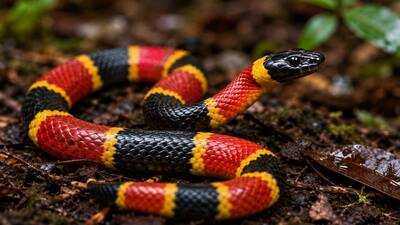
There are over 100 venomous species of coral snake found in America, Asia and Africa and each has a unique but important part to play in maintaining the balance of the ecosystems in which they live. For the inquisitive, here's all you need to know about these amazing and interesting creatures.
Coral snakes: Physical characteristics, venom, diet and more
Coral snakes physical characteristics: Body size, colour and tail
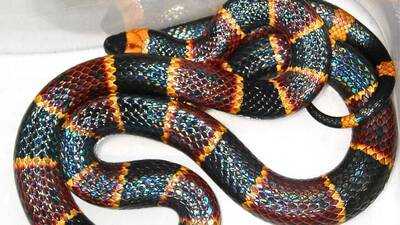
Body size: They are relatively small and slender, and grow to be 18-30 inches (45-76 centimetres) long in the adult state. Slim, smooth-scaled and light in appearance. They have small heads which taper nicely into the neck to provide a smooth profile.
Colour: The bands are brightly coloured, red, yellow or white and black, encircling the body. It is different from species to species.
Tail: It is typically short and is also banded as well.
Exceptions: Some South American species, like the Amazonian coral snake, can grow up to 60 inches long and that is much larger than most.
A simple trick to help distinguish a coral snake from a non-venomous snake is that the coral snake's front fangs are fixed, rather than the fangs found in pit vipers, which fold. They also have a smaller head and their heads are round rather than triangular like vipers. And, most importantly, scientists continue to refine the taxonomy of coral snakes based on discoveries about the relationships between species from DNA research.
Coral snakes: Where they live and what they eat
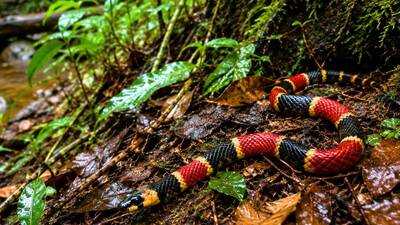
Coral snakes inhabit America primarily. World Atlas reports that the tropical and sub-tropical regions of the world, such as Brazil, Colombia, Peru and Ecuador, have the highest diversity of species. In America, they are found only in the Deep South and Southwest, principally in Florida, Georgia, Texas, Arizona and parts of New Mexico.
They like to live in forests such as pine flat woods and hardwood forests, rain forests and dry forests of the tropical region, scrub lands, and grasslands. Any place that has a lot of leaf litter, fallen logs, burrows or loose soil to hide in. Coral snakes prefer to stay hidden and be effective predators, so areas with little ground cover may not be as well suited as areas which have more ground cover. Coral snakes are finicky eaters of food. They feed mainly on:
Their venom is used to paralyze their prey. Coral snakes are one of the most shy snakes in the world in terms of behaviour. They are mainly active at dawn, dusk or at night time or after rain. In the daytime they hide. They are not immediately struck or rear up when threatened.
There are over 100 venomous species of coral snake found in America, Asia and Africa and each has a unique but important part to play in maintaining the balance of the ecosystems in which they live. For the inquisitive, here's all you need to know about these amazing and interesting creatures.
Coral snakes: Physical characteristics, venom, diet and more
Coral snakes physical characteristics: Body size, colour and tail
Body size: They are relatively small and slender, and grow to be 18-30 inches (45-76 centimetres) long in the adult state. Slim, smooth-scaled and light in appearance. They have small heads which taper nicely into the neck to provide a smooth profile.
Colour: The bands are brightly coloured, red, yellow or white and black, encircling the body. It is different from species to species.
Tail: It is typically short and is also banded as well.
Exceptions: Some South American species, like the Amazonian coral snake, can grow up to 60 inches long and that is much larger than most.
A simple trick to help distinguish a coral snake from a non-venomous snake is that the coral snake's front fangs are fixed, rather than the fangs found in pit vipers, which fold. They also have a smaller head and their heads are round rather than triangular like vipers. And, most importantly, scientists continue to refine the taxonomy of coral snakes based on discoveries about the relationships between species from DNA research.
Coral snakes: Where they live and what they eat
Coral snakes inhabit America primarily. World Atlas reports that the tropical and sub-tropical regions of the world, such as Brazil, Colombia, Peru and Ecuador, have the highest diversity of species. In America, they are found only in the Deep South and Southwest, principally in Florida, Georgia, Texas, Arizona and parts of New Mexico.
They like to live in forests such as pine flat woods and hardwood forests, rain forests and dry forests of the tropical region, scrub lands, and grasslands. Any place that has a lot of leaf litter, fallen logs, burrows or loose soil to hide in. Coral snakes prefer to stay hidden and be effective predators, so areas with little ground cover may not be as well suited as areas which have more ground cover. Coral snakes are finicky eaters of food. They feed mainly on:
- Other snakes, particularly earth snakes, blind snakes and other small, slim snakes and
- Lizards, especially skinks and small ground-dwelling lizards
- The use of Amphibians (frogs and salamanders, if available).
- Every now and then the offspring of other small vertebrates (animals with backs).
Their venom is used to paralyze their prey. Coral snakes are one of the most shy snakes in the world in terms of behaviour. They are mainly active at dawn, dusk or at night time or after rain. In the daytime they hide. They are not immediately struck or rear up when threatened.
Next Story