
How Octopuses Have Adapted to Survive in the Ocean

An octopus has no skeleton, no shell, and no armour. By every obvious measure, it should be easy prey. Instead, it has outlasted the dinosaurs and colonised every ocean on earth, from warm tropical shallows to the near-freezing deep. The secret is not one adaptation but a layered set of them, each solving a different problem the sea throws at a soft-bodied animal.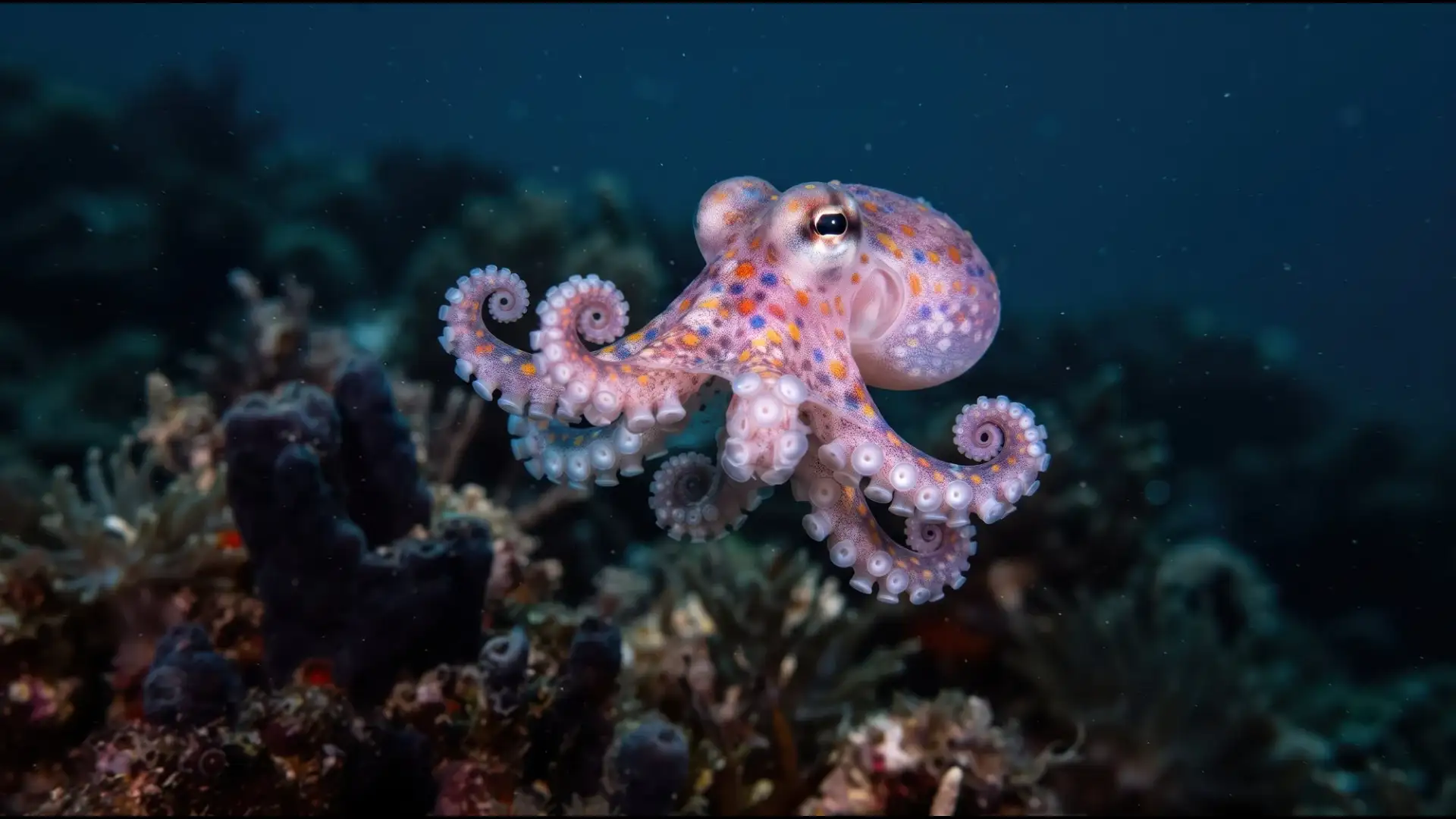
The octopus can cycle through patterns in under a second, matching sand, rock, coral, or the dappled light of a reef with a precision that no human camouflage technology has matched. Below the chromatophores sit iridophores, cells that reflect light structurally rather than through pigment.
They produce the iridescent shimmer that makes an octopus look wet even when it is still. Below those, papillae, small muscular bumps, can be raised or flattened to mimic the texture of a surface, so the disguise works in three dimensions. A resting octopus on a rocky ledge does not merely look like rock; it feels like rock to anything that brushes past it.
The circulatory system is equally unusual. Three hearts pump blood through the body: two push blood through the gills, one pushes oxygenated blood to the organs. The blood uses haemocyanin rather than haemoglobin to carry oxygen, which gives it a blue colour.
Haemocyanin works better in cold, low-oxygen water than haemoglobin does, which is part of why octopuses thrive at depth and in cold seas where other animals struggle.
The boneless body is the third part of this escape. An adult octopus can compress itself through any opening wider than its beak, the only rigid structure in its body. A large octopus has been documented squeezing through a gap the size of a coin. This ability lets it retreat into crevices where no predator with a skeleton can follow.
The octopus loses nothing permanent. This regenerative ability is not unique to octopuses among cephalopods, but octopuses use it more readily than most. Some species have been observed voluntarily detaching an arm as a decoy, leaving it writhing on the seafloor while the octopus retreats. The arm's independent neurons keep it moving long enough to hold a predator's attention.
This cognitive flexibility is rare in invertebrates and appears to have evolved independently of vertebrate intelligence.
The octopus and the crow arrived at problem-solving by completely different evolutionary routes. What they share is a life that demands improvisation: unpredictable environments, no fixed home, and predators that learn as fast as they do. The octopus's intelligence is not a luxury. It is the adaptation that ties all the others together, the ability to decide, in real time, which tool to use.
A Body Built to Disappear
The octopus skin contains thousands of chromatophores, pigment-filled sacs controlled by tiny muscles. When the muscles pull the sac open, colour floods the surface. When they relax, it closes.The octopus can cycle through patterns in under a second, matching sand, rock, coral, or the dappled light of a reef with a precision that no human camouflage technology has matched. Below the chromatophores sit iridophores, cells that reflect light structurally rather than through pigment.
They produce the iridescent shimmer that makes an octopus look wet even when it is still. Below those, papillae, small muscular bumps, can be raised or flattened to mimic the texture of a surface, so the disguise works in three dimensions. A resting octopus on a rocky ledge does not merely look like rock; it feels like rock to anything that brushes past it.
Eight Arms, Three Hearts, and Blue Blood
Each of an octopus's eight arms contains its own cluster of neurons. Roughly two-thirds of the animal's neurons live in the arms, not the brain. An arm can taste what it touches, decide whether to grip or release, and navigate around an obstacle, all without consulting the central brain. This distributed nervous system means the octopus can attend to eight separate tasks at once.You may also like
- Men's skincare beyond the beard: Why healthy skin is the new grooming essential
- 'Cinema has always been a mirror and a window. At the 31st EU film festival, it's also a bridge'
- Place these items nearby when lighting lamps on Diwali; it will bring happiness and prosperity to your home..
- Is Diwali on November 8 or 9? Find out the date, the Amavasya Tithi, and the auspicious timings for the worship..
- In 1992, two people began collecting Auroville's waste using a cycle rickshaw; more than three decades later, an 11-member team says it diverts almost 80% of collected rubbish from landfills by sorting it
The circulatory system is equally unusual. Three hearts pump blood through the body: two push blood through the gills, one pushes oxygenated blood to the organs. The blood uses haemocyanin rather than haemoglobin to carry oxygen, which gives it a blue colour.
Haemocyanin works better in cold, low-oxygen water than haemoglobin does, which is part of why octopuses thrive at depth and in cold seas where other animals struggle.
Ink, Jet, and the Art of the Exit
When camouflage fails, the octopus has two escape mechanisms that work together. It ejects a cloud of ink, a mixture of melanin and mucus, that obscures the predator's vision and dulls its sense of smell. Simultaneously, it fires a jet of water through a muscular tube called the siphon, propelling itself backward at speed. The combination gives it a head start in almost any direction.The boneless body is the third part of this escape. An adult octopus can compress itself through any opening wider than its beak, the only rigid structure in its body. A large octopus has been documented squeezing through a gap the size of a coin. This ability lets it retreat into crevices where no predator with a skeleton can follow.
Regrowing What Is Lost
If a predator catches an arm, the octopus can shed it deliberately, a process called autotomy, and regrow a functional replacement over several weeks. The new arm rebuilds its nerve connections, its suckers, and its ability to taste and grip.The octopus loses nothing permanent. This regenerative ability is not unique to octopuses among cephalopods, but octopuses use it more readily than most. Some species have been observed voluntarily detaching an arm as a decoy, leaving it writhing on the seafloor while the octopus retreats. The arm's independent neurons keep it moving long enough to hold a predator's attention.
Intelligence as a Survival Tool
Octopuses are remarkable problem-solvers. They can open jars, learn to navigate certain mazes, distinguish between individual humans, and even use tools. Some species have been observed carrying coconut shell halves across the seafloor, later assembling them into portable shelters. These behaviours go beyond simple reflexes. Octopuses can learn from experience and adapt their approach when a familiar solution no longer works, demonstrating an impressive degree of behavioural flexibility.This cognitive flexibility is rare in invertebrates and appears to have evolved independently of vertebrate intelligence.
The octopus and the crow arrived at problem-solving by completely different evolutionary routes. What they share is a life that demands improvisation: unpredictable environments, no fixed home, and predators that learn as fast as they do. The octopus's intelligence is not a luxury. It is the adaptation that ties all the others together, the ability to decide, in real time, which tool to use.






Loving Newspoint? Download the app now
