
10 Creative Reading Activities to Inspire Kids at Home

A child who loves reading does not usually arrive that way by accident. Someone made books feel like an invitation rather than an obligation, and more often than not, that someone did it through play.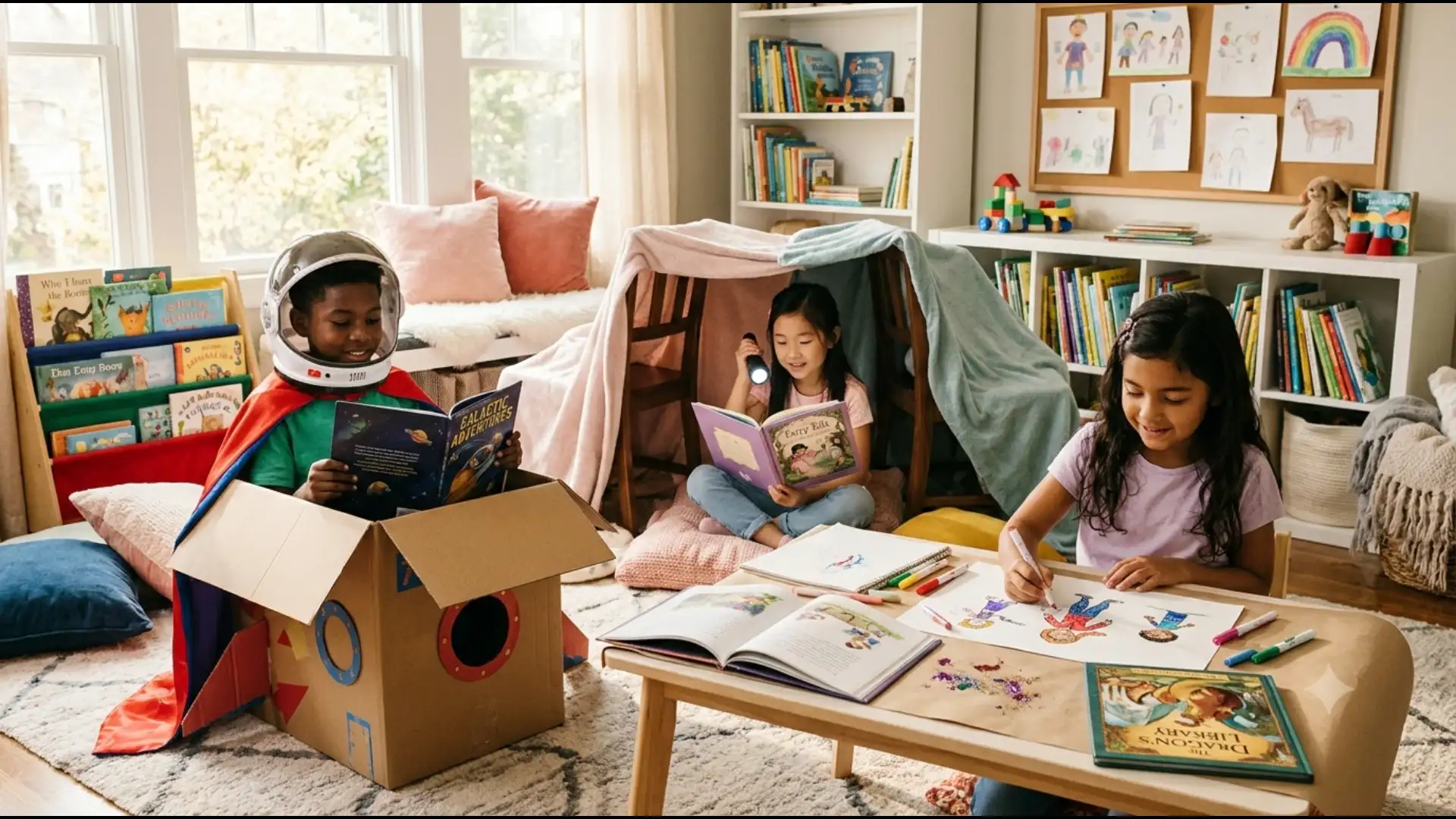
These ten activities work across age groups and need nothing beyond books you already own, a little time, and a willingness to be slightly silly alongside your child.
The act of drawing forces the child to hold the whole story in mind and notice details they half-remembered. It also gives a quiet child a way to process a book without being asked to talk about it immediately.
None of these activities require a reading corner, a subscription, or a large collection of books. They require attention, the kind that tells a child their imagination is worth taking seriously. That is, in the end, what turns a child into a reader.
These ten activities work across age groups and need nothing beyond books you already own, a little time, and a willingness to be slightly silly alongside your child.
1. Story Mapping
After finishing a chapter or a short book, ask your child to draw a map of where the story happened. Where did the character live? Which direction did they travel? What was on the other side of the forest? This works especially well with adventure and fantasy stories.The act of drawing forces the child to hold the whole story in mind and notice details they half-remembered. It also gives a quiet child a way to process a book without being asked to talk about it immediately.
2. Character Hot Seat
One person sits in a chair and becomes a character from the book. Everyone else asks them questions, not questions about the plot, but questions the book never answered. What did you eat for breakfast the morning it happened? Were you scared? Do you regret it? The child playing the character has to think from inside the story rather than about it. This single shift in perspective does more for comprehension than most worksheets.You may also like
- Ramayana Box Office Collection Day 4: Ranbir Kapoor's Film Earns ₹238.85 Crore in India, Nears ₹500 Crore Worldwide
- Gold Exchange: Exchanging old ornaments for new jewellery? Find out if you are getting the right price for your gold..
- SIP Calculator: How much of an SIP is needed to build a ₹1 crore fund in 30 years? Understand the full breakdown..
- Alia Bhatt remembers Rishi Kapoor in Diwali post, shares special family pictures
- Gmail Storage Tips: Increase Your Digital Space Without Spending a Penny! These Gmail Tricks Will Help
3. Book Tasting
Set out five or six books on a table, one per place setting, as if it were a meal. Give each child a few minutes with each book before rotating. The only rule: no one has to finish anything. The point is to sample, to notice what pulls you in and what doesn't, and to talk about why. Children who feel they have chosen their own reading are far more likely to follow through on it.4. Read-Aloud with Voices
Take turns reading aloud and commit to a different voice for every character. Exaggerate. Be ridiculous. A child who hears their parent doing a terrible pirate accent for a villain is a child who associates books with laughter. The voices do not need to be good. They need to be enthusiastic. Once a child has heard a story performed, they begin to perform it themselves, silently, in their head, every time they read.5. Story Dice
Make or buy a set of simple picture dice, each face shows a rough drawing of an object, a place, or a character type. Roll three dice and build a story together using whatever comes up. This is not directly about reading, but it is about the structure of narrative: beginning, complication, resolution. A child who understands how stories are built reads them faster and with more confidence.6. Rewrite the Ending
Pick a book with an ending your child found unsatisfying, surprising, or unfair. Ask them to write or dictate a different one. What should have happened? What would have been better? This works at any age, a five-year-old can dictate while you write it down, a ten-year-old can write their own. The argument that follows, about which ending is actually better, is the most productive literary discussion you will have all week.7. The Book-to-Snack Connection
Cook or prepare something that appears in whatever your child is reading. Dal and rice for a story set in a village kitchen. Laddoos for a festival scene. Bread and jam for an English countryside tale. The food does not need to be elaborate, it needs to be connected. Children who eat something from a book remember the book. The association is physical and it lasts.8. Illustrated Book Reports
Instead of a written summary, ask your child to create a poster for the book as if it were a film coming to theatres. What image would go on the poster? What would the tagline say? Who would they cast? This asks the child to identify what the book is really about, its core feeling, not its plot, and to represent that in a single image and a single line. It is harder than it sounds, and children take it seriously.9. Reading Treasure Hunt
Write clues on slips of paper, each one hidden at a location described in a short passage the child must read and decode. The final clue leads to a small reward, a new bookmark, a favourite snack, permission to stay up fifteen minutes later. The reading here has a purpose beyond itself, which is exactly the condition under which reluctant readers begin to read willingly.10. The Family Book Club
Everyone reads the same book, or the same chapter, and meets at the dinner table to discuss it. The rules are simple: no one is wrong, every opinion needs a reason, and the adults participate as readers, not teachers. When a child sees that the adults in their home are genuinely curious about a story, reading stops being a school activity and becomes something people do because they want to.None of these activities require a reading corner, a subscription, or a large collection of books. They require attention, the kind that tells a child their imagination is worth taking seriously. That is, in the end, what turns a child into a reader.






Loving Newspoint? Download the app now
