
Hidden for Centuries: Europe’s Largest Underground Thermal Lake Discovered Beneath Albanian Mountains

For years, the mountains along the Albania-Greece border gave little hint of what lay beneath them. Occasional warm springs and rising steam were the only visible signs of unusual activity below the surface. Yet deep underground, a vast thermal lake had remained completely hidden for an unknown span of time.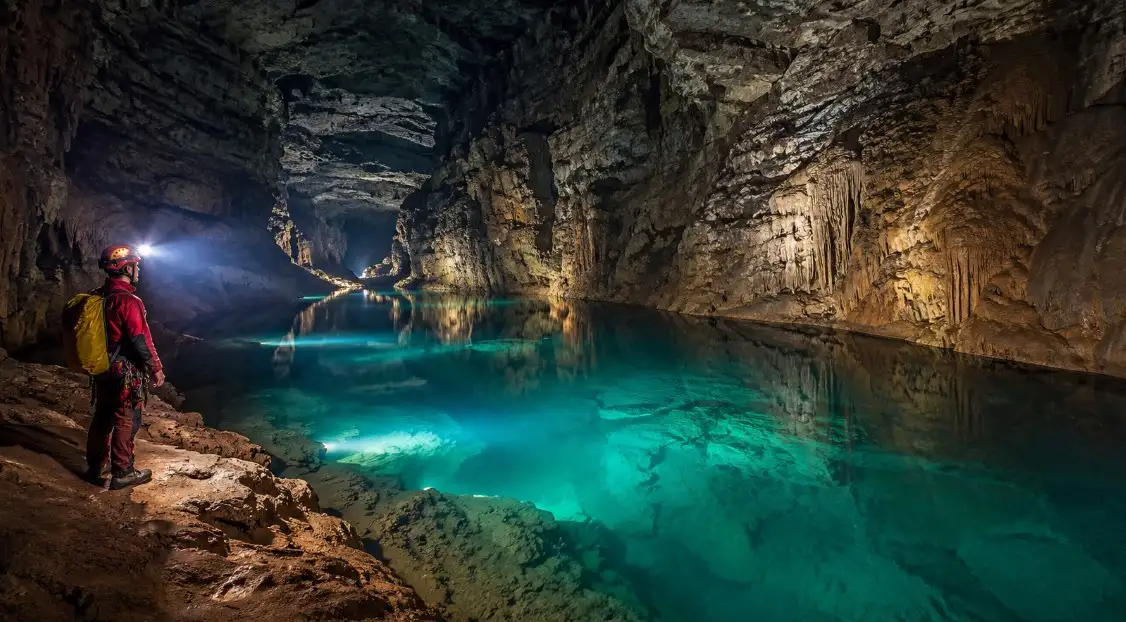
According to a report by an Albanian magazine, the discovery eventually came after Czech speleologists explored the remote region and traced unusual geothermal activity to its source. What began as surface-level curiosity soon turned into one of the most remarkable cave discoveries ever recorded.
A Clue Hidden in the Steam
The discovery began when speleologists studying southern Albania noticed unusual geothermal activity. Warm mineral springs and rising vapour hinted that a much larger source of heated water could be lurking beneath the surface.
Following these clues, the team located a deep vertical shaft that plunged nearly 100 metres underground. After a careful descent through the narrow opening, they entered a hidden cavern untouched by daylight. Waiting inside was a vast body of warm water unlike anything they had expected.
A Lake Deep Underground
The explorers immediately realized the lake was significant, but determining its true size was another challenge altogether. The remote location, difficult access, and hydrogen sulphide-rich air made detailed measurements nearly impossible during the first expedition.
For several years, the underground wonder remained only partially understood.
Advanced Technology Reveals Its True Scale
When researchers returned with sophisticated scanning equipment, the results were remarkable. The underground lake measured more than 138 metres in length and about 42 metres across at its widest point.
Scientists estimated that it contains over 8,000 cubic metres of water, officially making it the largest underground thermal lake ever identified.
The scans also revealed that the surrounding cavern was much larger than initially believed, extending beyond the areas explored during the first visits.
A Cave Shaped by Powerful Chemistry
What makes the discovery even more fascinating is the unique chemistry inside the cave.
The lake contains high levels of hydrogen sulphide, a gas known for its strong smell. Over thousands of years, this gas has helped shape the cavern itself. As hydrogen sulphide mixes with oxygen, it can produce sulphuric acid, which gradually dissolves the surrounding limestone.
Unlike many caves formed mainly by rainwater erosion, this underground chamber owes much of its development to ongoing chemical reactions beneath the Earth's surface.
A Living Laboratory in Total Darkness
The lake exists in complete darkness, far beyond the reach of sunlight. Without light, plants cannot survive, creating an ecosystem very different from those found on the surface.
Scientists believe the waters may host specialised microorganisms that obtain energy from chemical reactions rather than sunlight. Similar life forms have been found in other geothermal and sulphur-rich cave systems around the world.
Researchers are particularly interested in discovering whether this hidden environment contains previously unknown microbial species adapted to its extreme conditions.
A Discovery with Global Scientific Value
The Albanian thermal lake is more than a geological curiosity. Its immense size, unusual chemistry, and isolated ecosystem make it a valuable site for scientific research.
As further explorations continue, this hidden world beneath the mountains could provide new insights into cave formation, geothermal processes, and life in some of Earth's most extreme environments.
According to a report by an Albanian magazine, the discovery eventually came after Czech speleologists explored the remote region and traced unusual geothermal activity to its source. What began as surface-level curiosity soon turned into one of the most remarkable cave discoveries ever recorded.
A Clue Hidden in the Steam
The discovery began when speleologists studying southern Albania noticed unusual geothermal activity. Warm mineral springs and rising vapour hinted that a much larger source of heated water could be lurking beneath the surface.Following these clues, the team located a deep vertical shaft that plunged nearly 100 metres underground. After a careful descent through the narrow opening, they entered a hidden cavern untouched by daylight. Waiting inside was a vast body of warm water unlike anything they had expected.
A Lake Deep Underground
The explorers immediately realized the lake was significant, but determining its true size was another challenge altogether. The remote location, difficult access, and hydrogen sulphide-rich air made detailed measurements nearly impossible during the first expedition.For several years, the underground wonder remained only partially understood.
Advanced Technology Reveals Its True Scale
When researchers returned with sophisticated scanning equipment, the results were remarkable. The underground lake measured more than 138 metres in length and about 42 metres across at its widest point. Scientists estimated that it contains over 8,000 cubic metres of water, officially making it the largest underground thermal lake ever identified.
The scans also revealed that the surrounding cavern was much larger than initially believed, extending beyond the areas explored during the first visits.
You may also like
- “You cannot raise two children alone”: How Suvendu Sarkar who never got a parent's love became both mother and father to his kids
- How UAE running communities inspired a new limited-edition sneaker
- Railways: Traveling on a train without a ticket will now prove costly; the Railways has increased the fine to ₹500..
- Major announcement regarding the 7th Pay Commission in the budget... Great news for lakhs of government employees..
- Wondering what your child's future will look like in an AI-dominated world? Join TOI's New Age Careers in the Era of AI Masterclass today
A Cave Shaped by Powerful Chemistry
What makes the discovery even more fascinating is the unique chemistry inside the cave. The lake contains high levels of hydrogen sulphide, a gas known for its strong smell. Over thousands of years, this gas has helped shape the cavern itself. As hydrogen sulphide mixes with oxygen, it can produce sulphuric acid, which gradually dissolves the surrounding limestone.
Unlike many caves formed mainly by rainwater erosion, this underground chamber owes much of its development to ongoing chemical reactions beneath the Earth's surface.
A Living Laboratory in Total Darkness
The lake exists in complete darkness, far beyond the reach of sunlight. Without light, plants cannot survive, creating an ecosystem very different from those found on the surface. Scientists believe the waters may host specialised microorganisms that obtain energy from chemical reactions rather than sunlight. Similar life forms have been found in other geothermal and sulphur-rich cave systems around the world.
Researchers are particularly interested in discovering whether this hidden environment contains previously unknown microbial species adapted to its extreme conditions.
A Discovery with Global Scientific Value
The Albanian thermal lake is more than a geological curiosity. Its immense size, unusual chemistry, and isolated ecosystem make it a valuable site for scientific research. As further explorations continue, this hidden world beneath the mountains could provide new insights into cave formation, geothermal processes, and life in some of Earth's most extreme environments.






More from our partners


Loving Newspoint? Download the app now
