
Hidden for Centuries: Europe’s Largest Underground Thermal Lake Discovered Beneath Albanian Mountains

For years, the mountains along the Albania-Greece border gave little hint of what lay beneath them. Occasional warm springs and rising steam were the only visible signs of unusual activity below the surface. Yet deep underground, a vast thermal lake had remained completely hidden for an unknown span of time.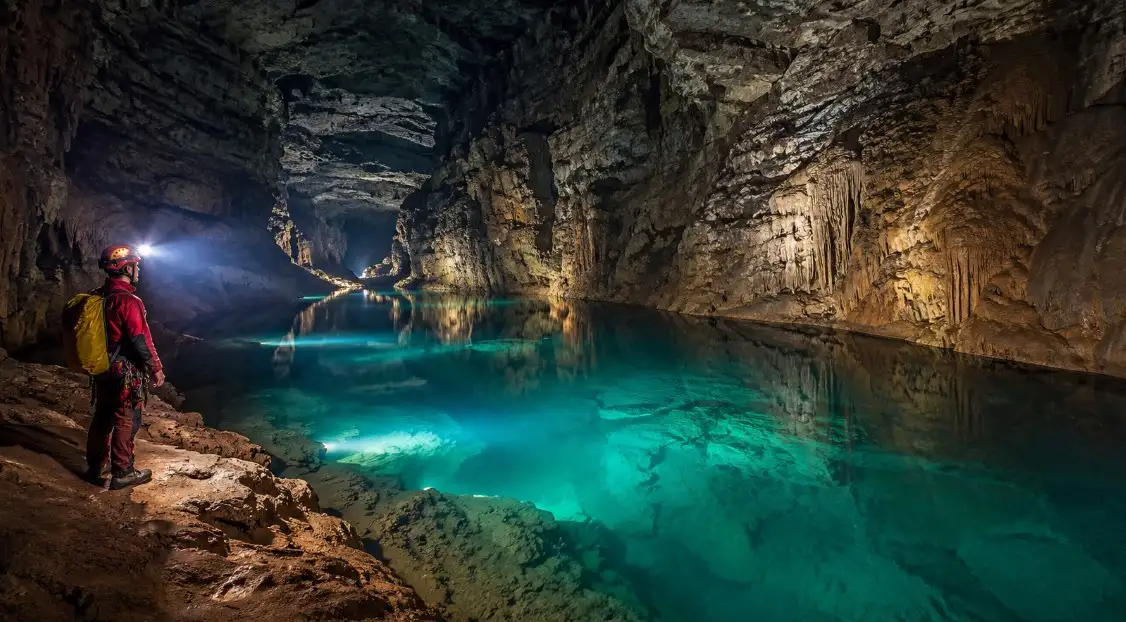
According to a report by an Albanian magazine, the discovery eventually came after Czech speleologists explored the remote region and traced unusual geothermal activity to its source. What began as surface-level curiosity soon turned into one of the most remarkable cave discoveries ever recorded.
A Clue Hidden in the Steam
The discovery began when speleologists studying southern Albania noticed unusual geothermal activity. Warm mineral springs and rising vapour hinted that a much larger source of heated water could be lurking beneath the surface.
Following these clues, the team located a deep vertical shaft that plunged nearly 100 metres underground. After a careful descent through the narrow opening, they entered a hidden cavern untouched by daylight. Waiting inside was a vast body of warm water unlike anything they had expected.
A Lake Deep Underground
The explorers immediately realized the lake was significant, but determining its true size was another challenge altogether. The remote location, difficult access, and hydrogen sulphide-rich air made detailed measurements nearly impossible during the first expedition.
For several years, the underground wonder remained only partially understood.
Advanced Technology Reveals Its True Scale
When researchers returned with sophisticated scanning equipment, the results were remarkable. The underground lake measured more than 138 metres in length and about 42 metres across at its widest point.
Scientists estimated that it contains over 8,000 cubic metres of water, officially making it the largest underground thermal lake ever identified.
The scans also revealed that the surrounding cavern was much larger than initially believed, extending beyond the areas explored during the first visits.
According to a report by an Albanian magazine, the discovery eventually came after Czech speleologists explored the remote region and traced unusual geothermal activity to its source. What began as surface-level curiosity soon turned into one of the most remarkable cave discoveries ever recorded.
A Clue Hidden in the Steam
The discovery began when speleologists studying southern Albania noticed unusual geothermal activity. Warm mineral springs and rising vapour hinted that a much larger source of heated water could be lurking beneath the surface.Following these clues, the team located a deep vertical shaft that plunged nearly 100 metres underground. After a careful descent through the narrow opening, they entered a hidden cavern untouched by daylight. Waiting inside was a vast body of warm water unlike anything they had expected.
A Lake Deep Underground
The explorers immediately realized the lake was significant, but determining its true size was another challenge altogether. The remote location, difficult access, and hydrogen sulphide-rich air made detailed measurements nearly impossible during the first expedition.For several years, the underground wonder remained only partially understood.
Advanced Technology Reveals Its True Scale
When researchers returned with sophisticated scanning equipment, the results were remarkable. The underground lake measured more than 138 metres in length and about 42 metres across at its widest point. Scientists estimated that it contains over 8,000 cubic metres of water, officially making it the largest underground thermal lake ever identified.
The scans also revealed that the surrounding cavern was much larger than initially believed, extending beyond the areas explored during the first visits.
Next Story