
Hyena vs wolf: Strength, intelligence, hunting ability and the fight for survival between two apex predators


Few wild animals are as misunderstood as the hyena , and few have captured the human imagination quite like the wolf . One is often associated with the African savanna, the other with forests, mountains and frozen landscapes across the Northern Hemisphere . Despite belonging to different animal families, both are highly intelligent carnivores that rely on cooperation, communication and social bonds to survive. They occupy similar ecological roles in their respective environments, yet they have evolved very different ways of hunting, raising young and defending territory. Looking beyond popular myths reveals two remarkably successful predators, each adapted to a distinct world. Comparing them side by side offers a clearer picture of how nature can arrive at different solutions to similar challenges.
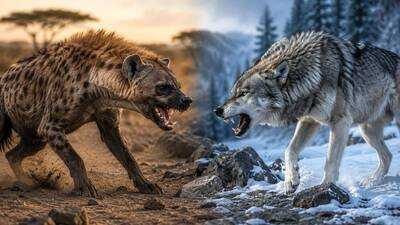
Hyena and wolf: Comparing strength, habitat and hunting skills
Understanding the differences between a hyena and a wolf
Physical build and strength
At first glance, a wolf appears more athletic. Its body is streamlined, with long legs designed for covering large distances. Wolves are endurance specialists. They can travel many kilometres in search of prey and maintain a steady pace for long periods.
A spotted hyena is built differently. The front half of its body is heavily developed, giving it a sloping profile. This shape supports powerful neck and shoulder muscles that help drag carcasses and crush bones. While wolves look faster and more agile, hyenas possess one of the strongest bites among land mammals relative to body size.
Strength and speed are not always measured the same way. Wolves excel in pursuit, whereas hyenas are designed for force.
Habitat and range
Grey wolves once occupied vast areas across the Northern Hemisphere and remain one of the world's most widely distributed large predators. Their adaptability allows them to survive in snowy tundra, dense forests, open plains and rugged mountain regions.
Hyenas have a much narrower geographical range. Most populations are found across sub-Saharan Africa, although striped hyenas extend into parts of the Middle East and South Asia. They thrive in dry grasslands and open savannas where visibility is good and prey is plentiful.
The wolf is the more geographically flexible animal. The hyena, meanwhile, is highly specialised for conditions common across many African landscapes.
Social structure
Both animals are social, but their societies operate in surprisingly different ways. Wolf packs are usually built around a breeding pair and their offspring. Younger members often remain with the group for a period before leaving to establish territories of their own. Leadership tends to be stable, and cooperation within the pack is central to hunting and pup-rearing.
Hyena clans can be far larger. In productive habitats, a clan may contain dozens of individuals. Their social systems are complex and often dominated by females. High-ranking females generally enjoy priority access to food and pass status advantages to their offspring.
A wolf pack resembles an extended family. A hyena clan functions more like a large social network with shifting relationships and competition.
Hunting and feeding behaviour
The image of hyenas surviving only on leftovers is outdated. Spotted hyenas regularly hunt their own food and can be highly efficient predators. They pursue antelope, wildebeest calves and other prey, often working together to wear animals down.
Wolves also depend heavily on teamwork. They target deer, elk, moose and other large herbivores. Rather than relying on raw power alone, wolves often succeed through coordination and persistence, separating vulnerable individuals from a herd.
The biggest difference appears after the kill. Wolves consume meat and organs but generally leave some remains behind. Hyenas waste very little. Their digestive systems can process bones, skin and other tough materials that many predators cannot utilise.
Intelligence and communication
Both species demonstrate advanced social intelligence. Wolves communicate through howls that can travel considerable distances. A howl may help reunite pack members, advertise territory or coordinate movement. Facial expressions, body posture and scent also play important roles.
Hyenas possess an equally impressive communication system. Their famous "laugh" is only one of many vocal sounds. Whoops, groans and other calls carry information about identity, location and social status. Researchers studying hyena behaviour have long noted their ability to recognise individuals and navigate complicated social relationships.
Neither animal should be considered more intelligent in a simple sense. Their intelligence has evolved to suit different lifestyles.
Lifespan and survival
Wild wolves often face difficult conditions. Harsh winters, territorial conflicts, disease and human pressures contribute to relatively short average lifespans in many populations.
Hyenas frequently live longer. In favourable environments, individuals may survive for two decades or more in the wild. Their ability to consume nearly every part of a carcass gives them access to food sources that would be unavailable to many competitors.
Hyena and wolf: Comparing strength, habitat and hunting skills
Understanding the differences between a hyena and a wolf
Physical build and strength
At first glance, a wolf appears more athletic. Its body is streamlined, with long legs designed for covering large distances. Wolves are endurance specialists. They can travel many kilometres in search of prey and maintain a steady pace for long periods.
A spotted hyena is built differently. The front half of its body is heavily developed, giving it a sloping profile. This shape supports powerful neck and shoulder muscles that help drag carcasses and crush bones. While wolves look faster and more agile, hyenas possess one of the strongest bites among land mammals relative to body size.
Strength and speed are not always measured the same way. Wolves excel in pursuit, whereas hyenas are designed for force.
Habitat and range
Grey wolves once occupied vast areas across the Northern Hemisphere and remain one of the world's most widely distributed large predators. Their adaptability allows them to survive in snowy tundra, dense forests, open plains and rugged mountain regions.
Hyenas have a much narrower geographical range. Most populations are found across sub-Saharan Africa, although striped hyenas extend into parts of the Middle East and South Asia. They thrive in dry grasslands and open savannas where visibility is good and prey is plentiful.
Social structure
Both animals are social, but their societies operate in surprisingly different ways. Wolf packs are usually built around a breeding pair and their offspring. Younger members often remain with the group for a period before leaving to establish territories of their own. Leadership tends to be stable, and cooperation within the pack is central to hunting and pup-rearing.
A wolf pack resembles an extended family. A hyena clan functions more like a large social network with shifting relationships and competition.
Hunting and feeding behaviour
The image of hyenas surviving only on leftovers is outdated. Spotted hyenas regularly hunt their own food and can be highly efficient predators. They pursue antelope, wildebeest calves and other prey, often working together to wear animals down.
Wolves also depend heavily on teamwork. They target deer, elk, moose and other large herbivores. Rather than relying on raw power alone, wolves often succeed through coordination and persistence, separating vulnerable individuals from a herd.
Intelligence and communication
Both species demonstrate advanced social intelligence. Wolves communicate through howls that can travel considerable distances. A howl may help reunite pack members, advertise territory or coordinate movement. Facial expressions, body posture and scent also play important roles.
Neither animal should be considered more intelligent in a simple sense. Their intelligence has evolved to suit different lifestyles.
Lifespan and survival
Wild wolves often face difficult conditions. Harsh winters, territorial conflicts, disease and human pressures contribute to relatively short average lifespans in many populations.
Hyenas frequently live longer. In favourable environments, individuals may survive for two decades or more in the wild. Their ability to consume nearly every part of a carcass gives them access to food sources that would be unavailable to many competitors.
Next Story