
In 1979, the income tax officer who left his job to turn remote Arunachal villages into living libraries: Uncle Moosa's quiet reading revolution


In the hill stretches of what is now the eastern edge of India, reading does not always arrive in neat, predictable ways. In villages scattered across the valleys of Arunachal Pradesh, books have often been rare visitors, carried in bags, trunks, sometimes even in borrowed suitcases that had already seen too many journeys. Against that backdrop, a quiet and slightly unusual figure began appearing in the late 20th century, not with grand declarations, but with boxes of children’s books and an idea that felt almost out of place in remote settlements. Sathyanarayan Mundayoor , known more widely as Uncle Moosa, in the Lohit region did not fit the usual image of development work or formal schooling. It unfolded slowly, through schools, courtyards, and eventually small libraries that seemed to grow out of everyday rooms rather than institutional planning. The work stretched across decades, shaped less by a single plan and more by repeated return visits to the same question: how does reading take root where it has never quite settled.
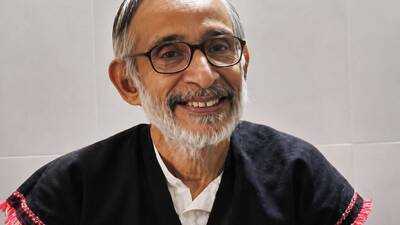
Uncle Mundayoor’s shift from income tax service to teaching in the North-East
Before the hills, there was a government office job in income tax, stable in the way such positions tend to be. As reported by Better India, Mundayoor left it in 1979, not with a dramatic break, but a quiet exit that led him towards teaching spaces connected to Vivekananda Kendra Vidyalaya in the north-east. The organisation’s schools were still spreading across the region at the time, and he became part of that early phase, moving through classrooms where teaching methods were still being tested against local realities.
In those years, the work was mostly inside school systems. Lessons, routines, the usual structure of education. But the distance between formal schooling and actual reading habits among children became harder to ignore. A classroom could exist without necessarily producing readers. That gap lingered in his thinking long after he moved on from full-time teaching roles in 1996.
From informal book carriers to early experiments in rural learning spaces
What followed did not resemble a programme at first. Books were carried into villages in whatever way transport allowed. Sometimes stacked in trunks, sometimes bundled in cloth, moving across roads that were unreliable at best. The idea was simple enough: place books where children could reach them without needing permission or formal access.
There were experiments along the way. Non-formal education efforts came and went. At one point, even cultivation projects and other livelihood ideas were explored, as if the reading work needed to sit beside something more immediate. But books kept returning to the centre of attention.
The region around Lohit in Arunachal Pradesh was not short on curiosity, but access remained uneven. So exhibitions of children’s literature began appearing in unlikely places. Temporary displays would be set up in schools or community halls, and then packed away again, leaving behind a few donated copies and the faint outline of something that could be repeated.
How donated books became local reading hubs in the mid-2000s
The shift towards something more lasting began around the mid-2000s, when collaboration with Association of Writers and Illustrators for Children helped turn scattered book collections into small but functioning libraries. One of the earliest anchors appeared in Tezu, followed by another in Wakro.
These were not grand buildings. Some were rooms within existing structures, others modest spaces adjusted to hold shelves, mats, and reading corners. The naming was informal too, often reflecting local materials or simple associations. Over time, a cluster of such spaces formed across the Lohit valley, each one carrying donated books that arrived through networks of supporters and publishers.
There was a sense that the libraries were less about ownership and more about circulation. Books stayed in place, but the readers moved freely through them.
How children became custodians of local library spaces
A detail that often stood out was how little the libraries depended on adult supervision once they settled. Children who visited regularly began taking responsibility for arranging books, keeping track of borrowing, and guiding newer readers. They were often referred to as “library activists”, though the term was never used formally in the spaces themselves.
The rhythm inside these rooms was not quiet in the usual sense of a library. There were conversations, small disputes over books, group reading sessions that turned into storytelling, and occasional performances drawn from what had been read. Responsibility developed almost indirectly, without structured instruction.
In places like Anjaw, where access to educational resources remained limited, these habits created a kind of informal learning environment that extended beyond school hours. Not a replacement for classrooms, but something running alongside them.
Workshops, visits and unexpected audiences
Over time, visiting educators and writers began conducting sessions in these libraries, often focused on storytelling and reading aloud. One of the more widely remembered moments came when children from the Lohit libraries travelled to New Delhi for a conference on children’s libraries in 2009. There, they performed short plays and readings, including work inspired by well-known children’s literature.
Among those present was A. P. J. Abdul Kalam, whose interactions with the children were later recalled in local accounts as a rare moment where the small library movement briefly intersected with national attention.
The libraries by then had grown into a loose network rather than isolated projects. What linked them was not uniform design or funding, but repetition of the same idea across different locations: books placed within reach, and children allowed to organise their own engagement with them.
Uncle Mundayoor’s shift from income tax service to teaching in the North-East
Before the hills, there was a government office job in income tax, stable in the way such positions tend to be. As reported by Better India, Mundayoor left it in 1979, not with a dramatic break, but a quiet exit that led him towards teaching spaces connected to Vivekananda Kendra Vidyalaya in the north-east. The organisation’s schools were still spreading across the region at the time, and he became part of that early phase, moving through classrooms where teaching methods were still being tested against local realities.
In those years, the work was mostly inside school systems. Lessons, routines, the usual structure of education. But the distance between formal schooling and actual reading habits among children became harder to ignore. A classroom could exist without necessarily producing readers. That gap lingered in his thinking long after he moved on from full-time teaching roles in 1996.
From informal book carriers to early experiments in rural learning spaces
What followed did not resemble a programme at first. Books were carried into villages in whatever way transport allowed. Sometimes stacked in trunks, sometimes bundled in cloth, moving across roads that were unreliable at best. The idea was simple enough: place books where children could reach them without needing permission or formal access.
There were experiments along the way. Non-formal education efforts came and went. At one point, even cultivation projects and other livelihood ideas were explored, as if the reading work needed to sit beside something more immediate. But books kept returning to the centre of attention.
The region around Lohit in Arunachal Pradesh was not short on curiosity, but access remained uneven. So exhibitions of children’s literature began appearing in unlikely places. Temporary displays would be set up in schools or community halls, and then packed away again, leaving behind a few donated copies and the faint outline of something that could be repeated.
How donated books became local reading hubs in the mid-2000s
The shift towards something more lasting began around the mid-2000s, when collaboration with Association of Writers and Illustrators for Children helped turn scattered book collections into small but functioning libraries. One of the earliest anchors appeared in Tezu, followed by another in Wakro.
These were not grand buildings. Some were rooms within existing structures, others modest spaces adjusted to hold shelves, mats, and reading corners. The naming was informal too, often reflecting local materials or simple associations. Over time, a cluster of such spaces formed across the Lohit valley, each one carrying donated books that arrived through networks of supporters and publishers.
There was a sense that the libraries were less about ownership and more about circulation. Books stayed in place, but the readers moved freely through them.
How children became custodians of local library spaces
A detail that often stood out was how little the libraries depended on adult supervision once they settled. Children who visited regularly began taking responsibility for arranging books, keeping track of borrowing, and guiding newer readers. They were often referred to as “library activists”, though the term was never used formally in the spaces themselves.
The rhythm inside these rooms was not quiet in the usual sense of a library. There were conversations, small disputes over books, group reading sessions that turned into storytelling, and occasional performances drawn from what had been read. Responsibility developed almost indirectly, without structured instruction.
In places like Anjaw, where access to educational resources remained limited, these habits created a kind of informal learning environment that extended beyond school hours. Not a replacement for classrooms, but something running alongside them.
Workshops, visits and unexpected audiences
Over time, visiting educators and writers began conducting sessions in these libraries, often focused on storytelling and reading aloud. One of the more widely remembered moments came when children from the Lohit libraries travelled to New Delhi for a conference on children’s libraries in 2009. There, they performed short plays and readings, including work inspired by well-known children’s literature.
Among those present was A. P. J. Abdul Kalam, whose interactions with the children were later recalled in local accounts as a rare moment where the small library movement briefly intersected with national attention.
The libraries by then had grown into a loose network rather than isolated projects. What linked them was not uniform design or funding, but repetition of the same idea across different locations: books placed within reach, and children allowed to organise their own engagement with them.
Next Story