
Over 350 years after Galileo Galilei's death, his fingers and teeth remain displayed as museum treasures


When most people think of Galileo Galilei, they imagine a brilliant scientist who stood up for the truth, even when the Church condemned him. What many don’t know is that his physical remains also became part of the legend.
After his death, admirers removed parts of his body, not in horror, but in reverence, preserving them as relics of science itself.
Today, one of his fingers sits in a glass case in Florence, surrounded by the very instruments he used to change how humanity sees the universe.
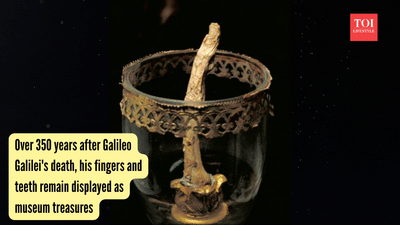
The story of those body parts, where they went, how they were lost, and how they were found again, seems to be all like a strange, almost gothic chase through museums, family homes, and auction houses.
How did his fingers reach here?
In 1737, 95 years after Galileo’s death, his body was moved from a small side chapel to a grand new tomb in Florence’s Santa Croce Basilica, opposite Michelangelo’s resting place. According to historical accounts, a group of admirers cut off three fingers, a tooth, and a vertebra as the coffin was opened, treating the body like a sacred relic of science.
The vertebra was later donated to the University of Padua, where Galileo had taught for many years, and it has remained there as a curious piece of academic history.
According to an AP report, the fingers and tooth, meanwhile, were placed in a small container topped with a wooden bust of Galileo and passed down through one family for generations.
But the tooth and two fingers from the scientist’s right hand, the thumb and middle finger, were kept by one of his admirers, an Italian marquis, and later put in a container that was passed down from generation to generation in the same family, Paolo Galluzzi, the museum’s director, told The Associated Press.
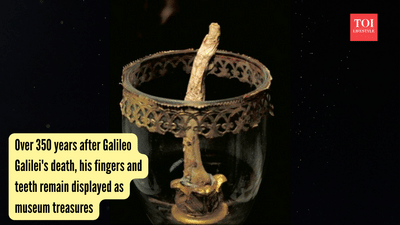
"But with time, the generations lost knowledge of what was actually inside the container," and the family sold it, Galluzzi said. By 1905, all traces of the relics had disappeared, "leading scholars to hypothesize that these singular specimens had been definitely lost," the museum said in a statement.
For decades, they vanished from public view, but in 2009 the container turned up at an auction, where museum experts used old documents and family records to confirm that these were indeed Galileo’s remains.
Galileo’ s middle finger
The most famous single relic is Galileo’s middle finger, carefully removed by the Florentine scholar and antiquary Anton Francesco Gori on 12 March 1737 during the transfer of the body to the new mausoleum in Santa Croce. According to museum sources, the finger was later acquired by the librarian Angelo M. Bandini and displayed for years in Florence’s Biblioteca Laurenziana.
By 1841 it had moved to the Tribuna di Galileo, a special gallery built inside the former Museo di Fisica e Storia Naturale on via Romana, where it joined telescopes and other instruments later kept in the Museo di Storia della Scienza, which is now the Galileo Museum.
The long‑lost fingers and tooth that turned up again
According to the Galileo Museum in Florence, the rediscovered parts were reunited with the middle finger and a section of the vertebra, making it one of the few places where the public can see physical fragments of Galileo’s person alongside his instruments. The museum now calls the finger “a celebration of Galileo as a hero and martyr of science”.
The instruments that changed the universe
The room displaying Galileo’s body parts also keeps the only surviving instruments designed and built by him, including two telescopes and a lens he used to discover Jupiter’s moons.
These tools helped prove that Earth was not the centre of everything, directly contradicting the Church’s geocentric teaching and earning Galileo condemnation as a heretic.
After his death, admirers removed parts of his body, not in horror, but in reverence, preserving them as relics of science itself.
Today, one of his fingers sits in a glass case in Florence, surrounded by the very instruments he used to change how humanity sees the universe.
The story of those body parts, where they went, how they were lost, and how they were found again, seems to be all like a strange, almost gothic chase through museums, family homes, and auction houses.
How did his fingers reach here?
In 1737, 95 years after Galileo’s death, his body was moved from a small side chapel to a grand new tomb in Florence’s Santa Croce Basilica, opposite Michelangelo’s resting place. According to historical accounts, a group of admirers cut off three fingers, a tooth, and a vertebra as the coffin was opened, treating the body like a sacred relic of science.
The vertebra was later donated to the University of Padua, where Galileo had taught for many years, and it has remained there as a curious piece of academic history.
According to an AP report, the fingers and tooth, meanwhile, were placed in a small container topped with a wooden bust of Galileo and passed down through one family for generations.
But the tooth and two fingers from the scientist’s right hand, the thumb and middle finger, were kept by one of his admirers, an Italian marquis, and later put in a container that was passed down from generation to generation in the same family, Paolo Galluzzi, the museum’s director, told The Associated Press.
"But with time, the generations lost knowledge of what was actually inside the container," and the family sold it, Galluzzi said. By 1905, all traces of the relics had disappeared, "leading scholars to hypothesize that these singular specimens had been definitely lost," the museum said in a statement.
For decades, they vanished from public view, but in 2009 the container turned up at an auction, where museum experts used old documents and family records to confirm that these were indeed Galileo’s remains.
Galileo’ s middle finger
The most famous single relic is Galileo’s middle finger, carefully removed by the Florentine scholar and antiquary Anton Francesco Gori on 12 March 1737 during the transfer of the body to the new mausoleum in Santa Croce. According to museum sources, the finger was later acquired by the librarian Angelo M. Bandini and displayed for years in Florence’s Biblioteca Laurenziana.
By 1841 it had moved to the Tribuna di Galileo, a special gallery built inside the former Museo di Fisica e Storia Naturale on via Romana, where it joined telescopes and other instruments later kept in the Museo di Storia della Scienza, which is now the Galileo Museum.
The long‑lost fingers and tooth that turned up again
According to the Galileo Museum in Florence, the rediscovered parts were reunited with the middle finger and a section of the vertebra, making it one of the few places where the public can see physical fragments of Galileo’s person alongside his instruments. The museum now calls the finger “a celebration of Galileo as a hero and martyr of science”.
The instruments that changed the universe
The room displaying Galileo’s body parts also keeps the only surviving instruments designed and built by him, including two telescopes and a lens he used to discover Jupiter’s moons.
These tools helped prove that Earth was not the centre of everything, directly contradicting the Church’s geocentric teaching and earning Galileo condemnation as a heretic.
Next Story