
Peacock feathers are actually brown, not blue or green: Science behind the optical illusion that makes them look so colourful


Next time you find a peacock feather, hold it up to the light and turn it slowly. Watch what happens. The same feather flips from bright blue to shiny green to a dull brown, and nothing about the feather itself is changing. Because peacock feathers don't actually have blue or green colour in them at all. What looks like paint is really a trick of light, and scientists have spent years figuring out exactly how the bird pulls it off.
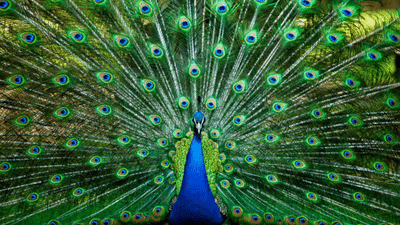
There's no blue colour hiding inside the feather
Here's the surprising part. If you crushed up a peacock feather and looked at the powder, it would look brown, not blue. That's because the feather is made mostly of melanin, the same brownish substance that colours human hair and skin. A well-known study published in the science journal PNAS found that the colours on a peacock's feather come from its structure, not from any actual blue or green pigment. To prove it, the scientists soaked the feathers in a thick liquid called glycerin, which fills up tiny gaps inside the feather. Once they did that, the colours shifted and changed, which only happens if the colour was being created by structure and not by a dye.
So the blue and green aren't sitting there like paint. They're being created on the spot, by the way light bounces off something built almost entirely out of brown.
So how does a brown feather turn into rainbow colours
This is the fun part, and it's basically nature doing tiny engineering. Inside each thin strand of the feather, the brown melanin isn't spread out evenly. It's arranged in tiny rod shapes, lined up in neat rows, with little pockets of air in between, almost like a microscopic brick wall. A detailed study in Physics Today found that these rows are spaced about 150 nanometres apart in green feathers, and slightly closer together, around 140 nanometres, in blue ones, stacked many layers deep. That tiny gap is what decides the colour. Light hits this pattern, bounces around, and only certain colours make it back out to your eyes while the rest cancel each other out.
Move those rows just a tiny bit closer together or further apart, and the colour completely changes. Research from the Royal Society found that the blue feathers on a peacock's neck get their colour from exactly this kind of tightly packed grid of melanin and air. Space the rows wider, and you get green or yellow instead. Squeeze them tighter, and you get blue or purple. The peacock isn't growing different colours. It's just building the same material in slightly different patterns.
There's no blue colour hiding inside the feather
Here's the surprising part. If you crushed up a peacock feather and looked at the powder, it would look brown, not blue. That's because the feather is made mostly of melanin, the same brownish substance that colours human hair and skin. A well-known study published in the science journal PNAS found that the colours on a peacock's feather come from its structure, not from any actual blue or green pigment. To prove it, the scientists soaked the feathers in a thick liquid called glycerin, which fills up tiny gaps inside the feather. Once they did that, the colours shifted and changed, which only happens if the colour was being created by structure and not by a dye.
So the blue and green aren't sitting there like paint. They're being created on the spot, by the way light bounces off something built almost entirely out of brown.
So how does a brown feather turn into rainbow colours
This is the fun part, and it's basically nature doing tiny engineering. Inside each thin strand of the feather, the brown melanin isn't spread out evenly. It's arranged in tiny rod shapes, lined up in neat rows, with little pockets of air in between, almost like a microscopic brick wall. A detailed study in Physics Today found that these rows are spaced about 150 nanometres apart in green feathers, and slightly closer together, around 140 nanometres, in blue ones, stacked many layers deep. That tiny gap is what decides the colour. Light hits this pattern, bounces around, and only certain colours make it back out to your eyes while the rest cancel each other out.
Move those rows just a tiny bit closer together or further apart, and the colour completely changes. Research from the Royal Society found that the blue feathers on a peacock's neck get their colour from exactly this kind of tightly packed grid of melanin and air. Space the rows wider, and you get green or yellow instead. Squeeze them tighter, and you get blue or purple. The peacock isn't growing different colours. It's just building the same material in slightly different patterns.
Next Story