
Why Travellers Trek for Hours to Visit This Remote Monastery in Ladakh

In an age where roads lead to almost every tourist attraction, Phugtal Monastery stands apart. Perched dramatically on a cliff in the remote mountains of Ladakh’s Zanskar region, this centuries-old Buddhist monastery remains accessible only by trekking. With no direct road, no bustling crowds, and no mobile network, it offers a rare opportunity to disconnect from modern life and experience the Himalayas in their purest form.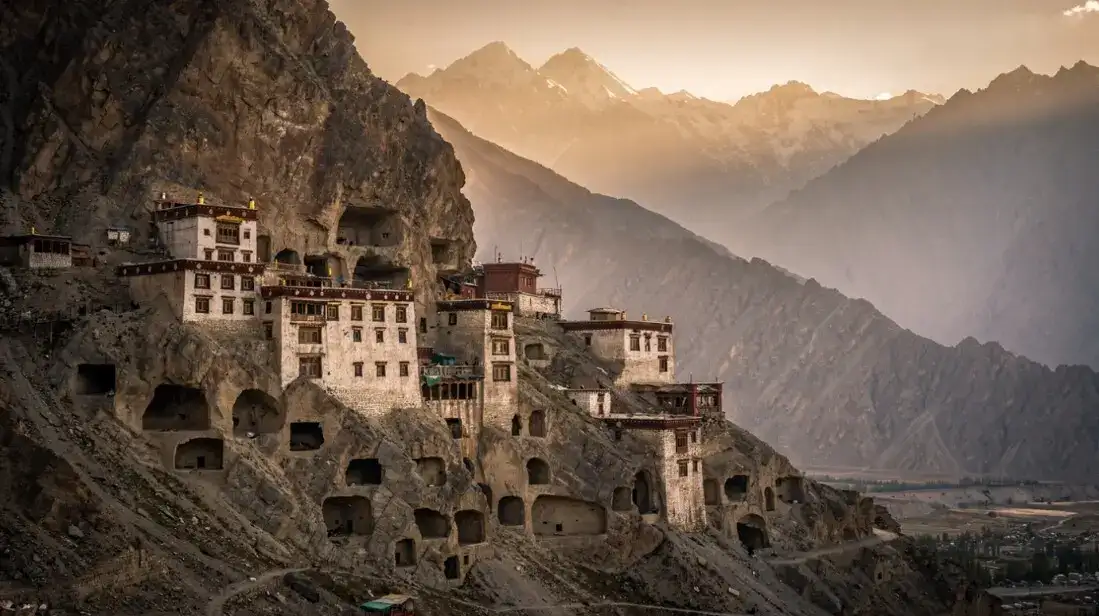
A Monastery Carved into the Mountains
Nestled in the secluded Lungnak Valley of Zanskar, Phugtal Monastery sits at an altitude of around 3,850 metres above sea level. What makes it extraordinary is its location inside a natural cave overlooking the Tsarap River.
The monastery’s name reflects its unique setting. “Phug” means cave, while “Tal” signifies liberation, earning it the title “Cave of Liberation.” From a distance, its whitewashed structures appear like a honeycomb clinging to the cliffside, creating one of the most striking sights in the Himalayas.
Why No Road Leads to Phugtal
Unlike many famous monasteries in Ladakh , Phugtal cannot be reached by vehicle. The reason lies in its fragile environment. Built into a steep cliff within a narrow gorge, the monastery is surrounded by rugged terrain that makes road construction extremely challenging.
Any large-scale development could damage the ancient cave and threaten the stability of the monastery’s traditional mud-and-wood structures. As a result, the final stretch remains a trekking route, helping preserve both the site’s heritage and its peaceful atmosphere.
The Journey to Reach Phugtal
Most visitors begin their adventure from Leh or Kargil before travelling to Padum, the main town in Zanskar.
From Padum, travellers drive to Purne, the most common starting point for the trek. The walk to the monastery covers around 5 to 6 kilometres and usually takes two to three hours.
The trail follows the Tsarap River through a spectacular canyon landscape. Along the way, trekkers cross a suspension bridge and pass towering cliffs, dramatic rock formations, and crystal-clear waters before reaching the monastery perched above the gorge.
A Spiritual Legacy Spanning Centuries
Phugtal’s history stretches far beyond the monastery visible today. The natural cave at its centre is believed to have attracted meditators and spiritual seekers for more than 2,000 years.
According to local traditions, revered Buddhist figures, including Guru Padmasambhava, are linked to the cave. The present monastery was formally established in the early 15th century by Jangsem Sherap Zangpo, a respected teacher of the Gelug school of Tibetan Buddhism.
For centuries, it has served as a centre for meditation, learning, and prayer, and continues to be home to a community of monks.
What Awaits Visitors
The first glimpse of Phugtal is unforgettable. The monastery appears to emerge naturally from the mountainside, blending seamlessly with the surrounding rock.
Inside, visitors can explore prayer halls adorned with traditional paintings, sacred texts, and prayer wheels. At the heart of the complex lies the original cave, where a natural spring flows year-round and is considered sacred by monks and local residents.
Accommodation and facilities are simple. Electricity can be limited, and comforts are basic, but that simplicity is part of the experience. Visitors come here not for luxury, but for peace, reflection, and a chance to witness a way of life that has endured for generations.
Best Time to Visit
The ideal time to visit Phugtal Monastery is between June and September. During these months, roads into Zanskar are generally open, temperatures are comfortable, and trekking conditions are favourable.
Winter presents a far greater challenge. Heavy snowfall often isolates the region, while temperatures drop well below freezing, making travel difficult and suitable only for highly experienced adventurers.
Trekking Safely at High Altitude
Although the trek itself is considered moderate, the altitude requires careful preparation.
Spend a few days acclimatising in Leh or another high-altitude destination before heading to Zanskar. Walk at a comfortable pace, stay well hydrated, and pay attention to symptoms such as headaches, dizziness, fatigue, or shortness of breath, which may indicate altitude sickness.
Carrying warm clothing, snacks, water, and a basic first-aid kit is essential, as services along the route are limited.
A Rare Himalayan Escape
Phugtal Monastery is more than a destination, it is an experience. Hidden among Zanskar’s rugged peaks, it rewards travellers with breathtaking scenery, rich spiritual heritage, and a sense of isolation that is increasingly difficult to find.
For those willing to leave the road behind and embrace the journey on foot, this remarkable monastery offers one of the most memorable adventures in the Indian Himalayas.
A Monastery Carved into the Mountains
Nestled in the secluded Lungnak Valley of Zanskar, Phugtal Monastery sits at an altitude of around 3,850 metres above sea level. What makes it extraordinary is its location inside a natural cave overlooking the Tsarap River. The monastery’s name reflects its unique setting. “Phug” means cave, while “Tal” signifies liberation, earning it the title “Cave of Liberation.” From a distance, its whitewashed structures appear like a honeycomb clinging to the cliffside, creating one of the most striking sights in the Himalayas.
Why No Road Leads to Phugtal
Unlike many famous monasteries in Ladakh , Phugtal cannot be reached by vehicle. The reason lies in its fragile environment. Built into a steep cliff within a narrow gorge, the monastery is surrounded by rugged terrain that makes road construction extremely challenging. Any large-scale development could damage the ancient cave and threaten the stability of the monastery’s traditional mud-and-wood structures. As a result, the final stretch remains a trekking route, helping preserve both the site’s heritage and its peaceful atmosphere.
The Journey to Reach Phugtal
Most visitors begin their adventure from Leh or Kargil before travelling to Padum, the main town in Zanskar. From Padum, travellers drive to Purne, the most common starting point for the trek. The walk to the monastery covers around 5 to 6 kilometres and usually takes two to three hours.
The trail follows the Tsarap River through a spectacular canyon landscape. Along the way, trekkers cross a suspension bridge and pass towering cliffs, dramatic rock formations, and crystal-clear waters before reaching the monastery perched above the gorge.
A Spiritual Legacy Spanning Centuries
Phugtal’s history stretches far beyond the monastery visible today. The natural cave at its centre is believed to have attracted meditators and spiritual seekers for more than 2,000 years.According to local traditions, revered Buddhist figures, including Guru Padmasambhava, are linked to the cave. The present monastery was formally established in the early 15th century by Jangsem Sherap Zangpo, a respected teacher of the Gelug school of Tibetan Buddhism.
For centuries, it has served as a centre for meditation, learning, and prayer, and continues to be home to a community of monks.
What Awaits Visitors
The first glimpse of Phugtal is unforgettable. The monastery appears to emerge naturally from the mountainside, blending seamlessly with the surrounding rock. Inside, visitors can explore prayer halls adorned with traditional paintings, sacred texts, and prayer wheels. At the heart of the complex lies the original cave, where a natural spring flows year-round and is considered sacred by monks and local residents.
Accommodation and facilities are simple. Electricity can be limited, and comforts are basic, but that simplicity is part of the experience. Visitors come here not for luxury, but for peace, reflection, and a chance to witness a way of life that has endured for generations.
You may also like
- Top Family Vacation Destinations for Memorable Experiences
- Indian Railways: Can a 4-year-old child travel for free? Know the rules
- Essential Financial Planning for Your Child's Future
- 8.7 km-long tunnel to be built in India at a cost of ₹2,300 crore; mega river-linking project launched
- India's first 8-lane tunnel beneath a tiger reserve is set to open on June 20; everything travellers need to know
Best Time to Visit
The ideal time to visit Phugtal Monastery is between June and September. During these months, roads into Zanskar are generally open, temperatures are comfortable, and trekking conditions are favourable. Winter presents a far greater challenge. Heavy snowfall often isolates the region, while temperatures drop well below freezing, making travel difficult and suitable only for highly experienced adventurers.
Trekking Safely at High Altitude
Although the trek itself is considered moderate, the altitude requires careful preparation. Spend a few days acclimatising in Leh or another high-altitude destination before heading to Zanskar. Walk at a comfortable pace, stay well hydrated, and pay attention to symptoms such as headaches, dizziness, fatigue, or shortness of breath, which may indicate altitude sickness.
Carrying warm clothing, snacks, water, and a basic first-aid kit is essential, as services along the route are limited.
A Rare Himalayan Escape
Phugtal Monastery is more than a destination, it is an experience. Hidden among Zanskar’s rugged peaks, it rewards travellers with breathtaking scenery, rich spiritual heritage, and a sense of isolation that is increasingly difficult to find. For those willing to leave the road behind and embrace the journey on foot, this remarkable monastery offers one of the most memorable adventures in the Indian Himalayas.






More from our partners


Loving Newspoint? Download the app now
