
Reclaiming phulkari, one stitch at a time


Gurmeet Kaur , 26, is dressed in a phulkari kurta she designed herself, jhumkas, clear block heels and aviator-style glasses. Just before the camera comes up, she pauses. “Wait,” she says, taking off the glasses before posing.
For Gurmeet, who comes from a village near Nabha in Punjab, the moment is more than a photograph. She is among the women artisans associated with The Nabha Foundation who brought hand-embroidered phulkari to the foundation’s recent two-week exhibition at The Kunj.
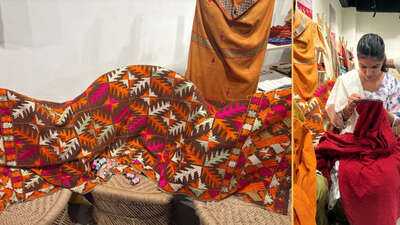
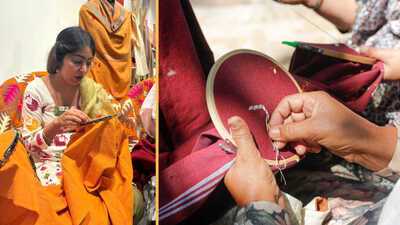
Gurmeet Kaur, who is a master phulkari artisan with Nabha Foundation, is also making a phulkari for her own wedding. It carries the things that “speak” to her: lassi glasses, the word “Punjaban” embroidered in Gurmukhi script, and a man on the moon hoisting a flag. “It has taken me two years, but it is still a work in progress,” she says. She does not expect to inherit a phulkari from her mother or grandmother. So this one, she says, will be “a gift to myself”
“This phone, my scooter – I bought them with my embroidery earnings. I also paid for my Master’s in political science from Punjabi University, Patiala,” says Gurmeet, who has been learning the craft for 12 years while pursuing her studies. She is now a master trainer and says she earns up to `15,000 a month – about as much as her brother. The income, she says, has won her a “little respect” at home. “They allowed me to come to Delhi. I am so excited to be here at The Kunj to showcase Nabha phulkari. I also got to see the city, which I would never have been able to do otherwise. My parents are very conservative. Most girls in my village cannot dream of this,” she says.
For Gurmeet, who comes from a village near Nabha in Punjab, the moment is more than a photograph. She is among the women artisans associated with The Nabha Foundation who brought hand-embroidered phulkari to the foundation’s recent two-week exhibition at The Kunj.
Gurmeet Kaur, who is a master phulkari artisan with Nabha Foundation, is also making a phulkari for her own wedding. It carries the things that “speak” to her: lassi glasses, the word “Punjaban” embroidered in Gurmukhi script, and a man on the moon hoisting a flag. “It has taken me two years, but it is still a work in progress,” she says. She does not expect to inherit a phulkari from her mother or grandmother. So this one, she says, will be “a gift to myself”
“This phone, my scooter – I bought them with my embroidery earnings. I also paid for my Master’s in political science from Punjabi University, Patiala,” says Gurmeet, who has been learning the craft for 12 years while pursuing her studies. She is now a master trainer and says she earns up to `15,000 a month – about as much as her brother. The income, she says, has won her a “little respect” at home. “They allowed me to come to Delhi. I am so excited to be here at The Kunj to showcase Nabha phulkari. I also got to see the city, which I would never have been able to do otherwise. My parents are very conservative. Most girls in my village cannot dream of this,” she says.
Next Story