
The Return of Hobbies: Why Young Adults Are Taking Up Pottery and Knitting

Pottery studios are booked weeks in advance. Knitting and crochet communities are growing. Young adults who grew up surrounded by smartphones and social media are voluntarily choosing activities that are slow, repetitive, and, frankly, a little inconvenient.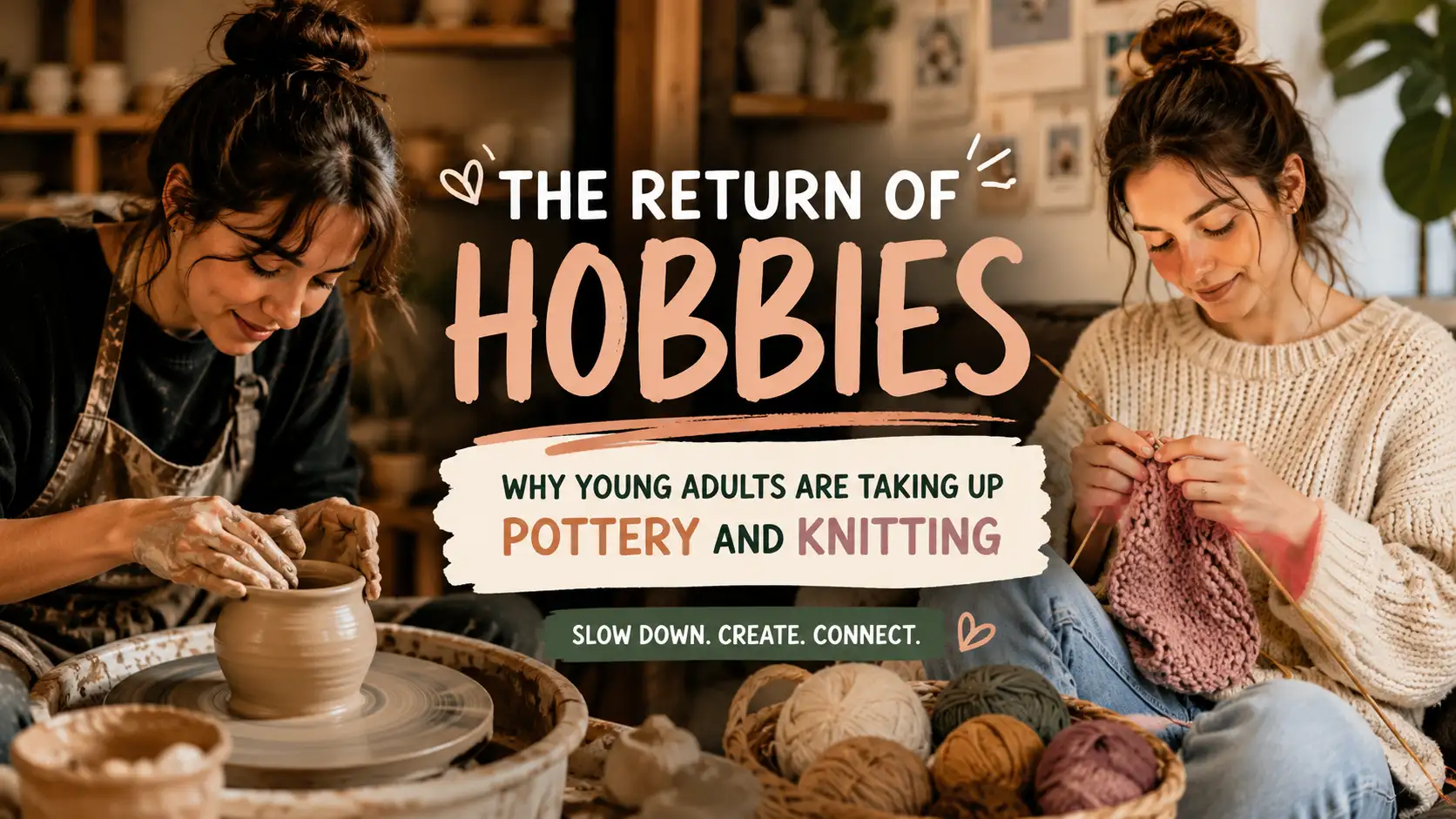
The question isn't why these hobbies are becoming popular. The real question is: what are people looking for that they're not finding elsewhere?
For a generation raised on productivity hacks, career advice videos, and social media algorithms, even relaxation started feeling like something that needed to produce results. Doing something badly, slowly, and purely for fun almost started to feel irresponsible. Maybe that's why traditional hobbies suddenly feel so appealing.
And for the first time all day, your brain has nowhere else to go. There is only the clay in your hands. Only the next stitch. Only the present moment. It's a simple feeling, but perhaps that's what makes it so powerful.
Why Pottery Feels Different
Nobody goes to a pottery class expecting perfection. The bowl might collapse. The mug might turn out crooked. The plate might crack in the kiln. And somehow, that's okay.
In fact, that's part of the appeal. We spend so much of our lives trying not to make mistakes that there's something deeply comforting about an activity where mistakes are expected. Pottery doesn't reward speed or efficiency. It rewards patience, attention, and a willingness to start over. Not many things in modern life do that anymore.
More Than Just a Trend
It’s easy to dismiss pottery, knitting, and crochet as just another social media trend. But that doesn’t seem to tell the whole story. Maybe these hobbies are becoming popular because they offer something that a lot of young adults are craving: slowness, creativity, and the ability to do something without it becoming content, income, or achievement.
Maybe that's why so many people are returning to these old-fashioned hobbies. Not because they want to go backward. But because, for a few hours, they want to step outside a world that never seems to stop moving.
The question isn't why these hobbies are becoming popular. The real question is: what are people looking for that they're not finding elsewhere?
When Did Hobbies Become Work?
At some point, we stopped allowing ourselves to enjoy things just because we enjoyed them. If you liked taking photographs, someone told you to start a photography page. If you enjoyed baking, you should probably sell cakes. If you painted, maybe you could turn it into a side hustle. Somewhere along the way, hobbies became projects.For a generation raised on productivity hacks, career advice videos, and social media algorithms, even relaxation started feeling like something that needed to produce results. Doing something badly, slowly, and purely for fun almost started to feel irresponsible. Maybe that's why traditional hobbies suddenly feel so appealing.
You may also like
- Alia Bhatt receives a roaring welcome in Pune, says 'Being in Pune feels like coming home'
- Proverb of the day by J.G. Holland: "God gives every bird its food, but He does not .." is a reminder that opportunity still requires effort
- Understanding Parental Attention: The Impact on Sibling Dynamics
- Natural Remedies for Skin Care During Monsoon: Turmeric and Sandalwood
- Essential Skincare Tips for the Monsoon Season
Looking for a Life That Moves More Slowly
Most young adults today live in a state of low-level exhaustion. There are deadlines, notifications, messages to reply to, reels to scroll through, and the constant feeling that everyone else is somehow doing better than you. Even our free time often happens through a screen. Then you sit at a pottery wheel. Or pick up knitting needles.And for the first time all day, your brain has nowhere else to go. There is only the clay in your hands. Only the next stitch. Only the present moment. It's a simple feeling, but perhaps that's what makes it so powerful.
Why Pottery Feels Different
Nobody goes to a pottery class expecting perfection. The bowl might collapse. The mug might turn out crooked. The plate might crack in the kiln. And somehow, that's okay. In fact, that's part of the appeal. We spend so much of our lives trying not to make mistakes that there's something deeply comforting about an activity where mistakes are expected. Pottery doesn't reward speed or efficiency. It rewards patience, attention, and a willingness to start over. Not many things in modern life do that anymore.
More Than Just a Trend
It’s easy to dismiss pottery, knitting, and crochet as just another social media trend. But that doesn’t seem to tell the whole story. Maybe these hobbies are becoming popular because they offer something that a lot of young adults are craving: slowness, creativity, and the ability to do something without it becoming content, income, or achievement. Maybe that's why so many people are returning to these old-fashioned hobbies. Not because they want to go backward. But because, for a few hours, they want to step outside a world that never seems to stop moving.






More from our partners


Loving Newspoint? Download the app now
