
Rice Starch and Handloom Cotton: The Maand Tradition That Keeps Fabric Crisp

Pull a freshly starched handloom cotton saree from a weaver's shelf and you will feel something that machine-finished fabric rarely delivers: a stiffness that has give in it, a surface that holds its fold without feeling brittle.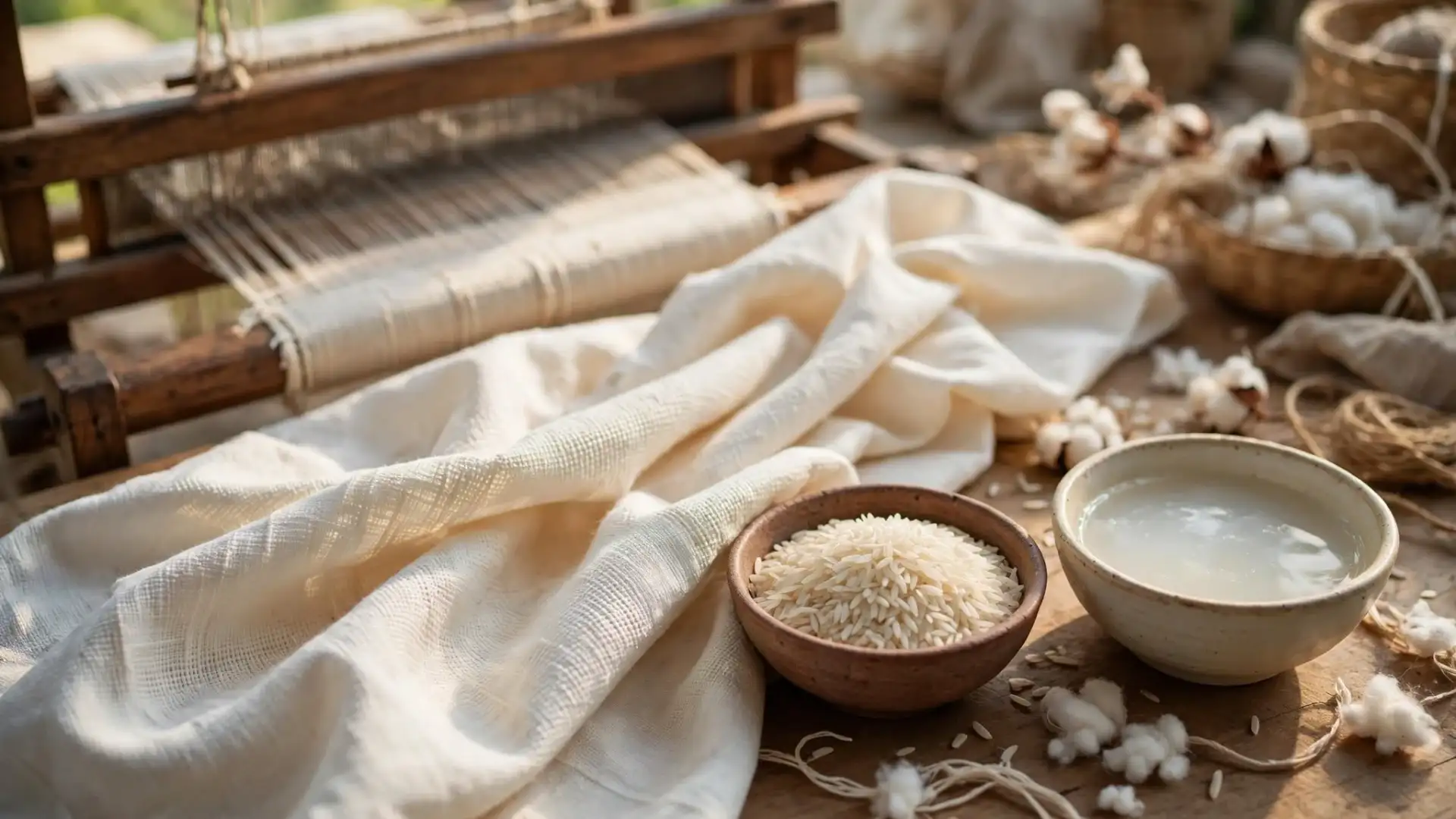
That quality comes from rice starch, and the tradition of applying it, called maand in Hindi and by close variants across weaving belts from Varanasi to Pochampally, is one of the oldest finishing steps in Indian textile craft.
Weavers collect the cloudy liquid drained from boiled rice, sometimes thicken it slightly by simmering it down, and apply it to grey cloth before the final drying and pressing step. In some regions the starch is made by soaking raw rice overnight and grinding it into a thin paste, which gives a finer, more even coat.
Both methods deliver the same active ingredient: amylose and amylopectin, the two chain-molecule components of rice starch, which form a film around each cotton fibre as the cloth dries.
The result is body: the fabric holds a shape rather than falling limp. Rice starch is particularly well suited to this because its amylose content is high enough to form a firm film but its granule size is small, smaller than wheat or corn starch, which means it penetrates the weave rather than sitting on top of it.
The finish feels part of the cloth, not a coating over it. Heat from an iron then gelatinises the starch further, pressing the film flat and producing the characteristic sheen that a freshly ironed handloom cotton carries.
Handloom cotton, woven on a pit loom or a frame loom at low tension, has a slightly irregular surface. The yarns are not as tightly twisted, the weave has more open space between threads, and the cloth has not been chemically sized.
That openness is exactly what makes maand work so well on it: the rice starch solution wicks into the weave, coats the fibres evenly, and when dried gives the cloth a structure it did not have off the loom. The same treatment on a tightly finished mill cloth would sit on the surface and flake.
Once dry, the cloth is folded and pressed with a heavy iron, often a coal iron in older workshops, which sets the starch and flattens the weave.
In a domestic setting, the same logic applies to a washed cotton saree or kurta: a bowl of cooled rice water, a dip, a firm wring, drying on a line in the shade, and a hot iron. No measuring, no timing, the hand knows when the cloth is stiff enough to hold a crease.
Neither replicates what maand does to an open handloom weave, which is to become structurally part of the cloth for the life of that wash cycle.
The knowledge that is actually at risk is not the existence of rice starch, every household that cooks rice has it, but the calibration: how thick to make the solution for a fine chanderi versus a coarser khadi, how long to soak, how hard to wring, how much heat to apply.
That calibration lives in the hands of weavers and older household members, and it is not written down anywhere that a search engine can find. The starch itself will outlast every aerosol can. What it needs is someone who remembers how to use it.
That quality comes from rice starch, and the tradition of applying it, called maand in Hindi and by close variants across weaving belts from Varanasi to Pochampally, is one of the oldest finishing steps in Indian textile craft.
What Maand Actually Is
The word maand simply means the starchy water left after rice is cooked or soaked. In a weaving household it is not a byproduct, it is the finishing agent.Weavers collect the cloudy liquid drained from boiled rice, sometimes thicken it slightly by simmering it down, and apply it to grey cloth before the final drying and pressing step. In some regions the starch is made by soaking raw rice overnight and grinding it into a thin paste, which gives a finer, more even coat.
Both methods deliver the same active ingredient: amylose and amylopectin, the two chain-molecule components of rice starch, which form a film around each cotton fibre as the cloth dries.
The Chemistry Behind the Crispness
Cotton fibre is cellulose, long, flexible chains that slide against each other when wet and collapse into a soft drape when dry. Starch molecules, when dissolved in hot water and then cooled, form a gel. As that gel dries on cloth, it cross-links with the cellulose surface and locks adjacent fibres into a slightly more rigid arrangement.The result is body: the fabric holds a shape rather than falling limp. Rice starch is particularly well suited to this because its amylose content is high enough to form a firm film but its granule size is small, smaller than wheat or corn starch, which means it penetrates the weave rather than sitting on top of it.
The finish feels part of the cloth, not a coating over it. Heat from an iron then gelatinises the starch further, pressing the film flat and producing the characteristic sheen that a freshly ironed handloom cotton carries.
Why Handloom Responds Better Than Mill Cloth
Mill-woven cotton is finished in the factory with synthetic sizing agents, often polyvinyl alcohol or modified starches, applied under tension on industrial padders. By the time it reaches a household, its surface is already chemically treated and relatively smooth.Handloom cotton, woven on a pit loom or a frame loom at low tension, has a slightly irregular surface. The yarns are not as tightly twisted, the weave has more open space between threads, and the cloth has not been chemically sized.
That openness is exactly what makes maand work so well on it: the rice starch solution wicks into the weave, coats the fibres evenly, and when dried gives the cloth a structure it did not have off the loom. The same treatment on a tightly finished mill cloth would sit on the surface and flake.
How Weavers and Households Apply It
In a weaving cluster, grey cloth, fabric that has been woven but not yet finished, is dipped in a bucket of warm maand, wrung out firmly by hand, and then spread flat in sunlight to dry. The drying step matters: slow drying in shade produces a softer finish, fast drying in direct sun produces a stiffer one.Once dry, the cloth is folded and pressed with a heavy iron, often a coal iron in older workshops, which sets the starch and flattens the weave.
In a domestic setting, the same logic applies to a washed cotton saree or kurta: a bowl of cooled rice water, a dip, a firm wring, drying on a line in the shade, and a hot iron. No measuring, no timing, the hand knows when the cloth is stiff enough to hold a crease.
What Is Lost When the Tradition Skips a Generation
Spray starch from an aerosol can is convenient, but it delivers a surface coat rather than a penetrating one. The crispness it gives washes out in the first rinse. Synthetic fabric conditioners work in the opposite direction, they coat fibres with a lubricant to reduce friction, which softens the hand but removes body entirely.Neither replicates what maand does to an open handloom weave, which is to become structurally part of the cloth for the life of that wash cycle.
The knowledge that is actually at risk is not the existence of rice starch, every household that cooks rice has it, but the calibration: how thick to make the solution for a fine chanderi versus a coarser khadi, how long to soak, how hard to wring, how much heat to apply.
That calibration lives in the hands of weavers and older household members, and it is not written down anywhere that a search engine can find. The starch itself will outlast every aerosol can. What it needs is someone who remembers how to use it.