
Sadhguru Jaggi Vasudev's 'Disappearing Faces' captures faces and lives of the Himalayas


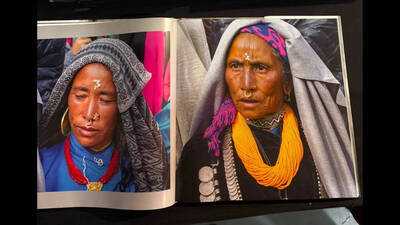
In his new photo-essay book , Disappearing Faces , Sadhguru Jaggi Vasudev turns his camera towards the people of the Himalayas , capturing lives shaped by the rhythms of nature and untouched by the noise of modernity. There are landscapes that one sees, and there are landscapes that look back at you. For Sadhguru Jaggi Vasudev, the Himalayas have been both.
Over decades of journeys through the remote regions of Nepal and Tibet , he has encountered people whose faces carry something that modern life is steadily erasing — an intimacy with nature, with the elements, and with the simple immediacy of experience. His new photo-essay book brings these faces into focus.
 The book was launched on Monday at the India International Centre , New Delhi, in the presence of Union Minister Mansukh Mandaviya. The launch was followed by a conversation between Sadhguru Jaggi Vasudev and author and commentator Anand Ranganathan, who explored the stories and experiences behind the photographs.
Carrying a camera on his journeys, Sadhguru Jaggi Vasudev began recording the people he encountered along the way. The resulting photographs are more than portraits. They are glimpses into ways of living that are increasingly disappearing from the modern world.
“These faces represent an era that will soon disappear,” Sadhguru Jaggi Vasudev said during the conversation. He described them as faces shaped by direct sensory experiences of “light and darkness, heat and cold, of springs and winters” — experiences not mediated by an endless flow of information disconnected from the senses.
For Sadhguru Jaggi Vasudev, the faces of the Himalayas are inseparable from the landscape that shaped them. “These are the visages that represent life that seems rudimentary but is rich with strong experiences of the land, the winds, the waters and the people,” he said.
His relationship with the Himalayas goes back decades. He first journeyed to Manasarovar and Mount Kailash in 2006 and returned repeatedly, including leading seekers on Himalayan pilgrimages. In 2025, he undertook his first motorcycle journey to Kailash and is set to return this year on a motorcycle.
But Disappearing Faces is not merely a photographic record of a place. It raises a quieter question: what happens to the human face when our relationship with the natural world changes? The people in these photographs belong to an existence where seasons, mountains, rivers and winds are not merely scenery but lived realities. Their faces bear the imprint of such an existence.
As the world becomes increasingly saturated with information, distraction and manufactured experience, these faces remind us of another possibility — of a life experienced directly, through the senses, and rooted in the earth. For Sadhguru Jaggi Vasudev, the Himalayas have long been a space for such an encounter — with nature, with people and, ultimately, with oneself. Disappearing Faces captures that encounter before some of these faces, and the worlds they embody, become memories.
Over decades of journeys through the remote regions of Nepal and Tibet , he has encountered people whose faces carry something that modern life is steadily erasing — an intimacy with nature, with the elements, and with the simple immediacy of experience. His new photo-essay book brings these faces into focus.
Carrying a camera on his journeys, Sadhguru Jaggi Vasudev began recording the people he encountered along the way. The resulting photographs are more than portraits. They are glimpses into ways of living that are increasingly disappearing from the modern world.
For Sadhguru Jaggi Vasudev, the faces of the Himalayas are inseparable from the landscape that shaped them. “These are the visages that represent life that seems rudimentary but is rich with strong experiences of the land, the winds, the waters and the people,” he said.
But Disappearing Faces is not merely a photographic record of a place. It raises a quieter question: what happens to the human face when our relationship with the natural world changes? The people in these photographs belong to an existence where seasons, mountains, rivers and winds are not merely scenery but lived realities. Their faces bear the imprint of such an existence.
Next Story