
Winter Olympics 2026: Norwegian Biathlete Breaks Down on TV Admitting Infidelity After Medal Win

At the 2026 Milan-Cortina Winter Olympics, a remarkable moment unfolded that shifted headlines from sporting achievement to personal drama and raised broader questions about vulnerability, public confession, and accountability.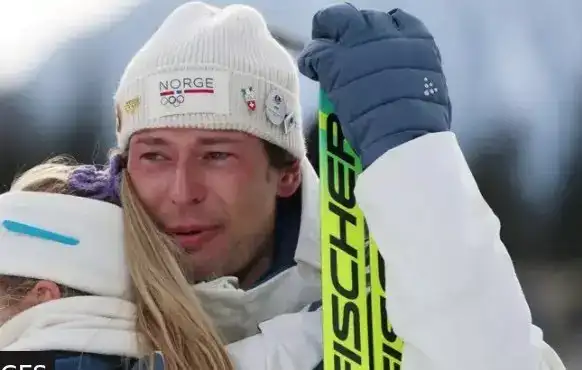
Norwegian biathlete Sturla Holm Lægreid , aged 28, had just secured a bronze medal in the highly competitive men’s 20 km individual biathlon event when he stunned the global audience by openly admitting to cheating on his girlfriend during a live post-race interview with Norwegian broadcaster NRK.
Lægreid, a decorated World Cup champion and one of Norway’s most respected winter athletes, spoke in emotional and reflective terms. “Six months ago I met the love of my life… and three months ago I made the biggest mistake of my life and cheated on her,” he said, visibly moved, recalling how he had informed his partner about the infidelity just a week prior to his Olympic performance. “It has been the worst week of my life,” he added, suggesting that his medal felt incomplete without her support.
The confession was unprompted by the interviewer and took many by surprise. Lægreid framed his decision to speak publicly as a step toward honesty and accountability, even acknowledging he might be risking what some have termed “social suicide” in a bid to show how seriously he regretted his actions. “I had a gold medal in life,” he said, “and there are probably many people now who see me in a different light… but I only have eyes for her.”
However, the public reaction was far from unanimous support. On social media, many viewers criticised both the timing and the nature of the confession. Some described it as manipulative, arguing that using a global platform to air a deeply personal issue could be a pressure tactic to influence his ex-girlfriend or win sympathy. Others suggested it was inappropriate to shift the focus from athletic achievement during an Olympic moment. Comments ranged from calling the act disrespectful to urging the athlete to have sought private reconciliation rather than public exposure.
Supporters of Lægreid’s decision to be open saw the gesture as a rare instance of vulnerability from a high-profile athlete, lauding his willingness to admit wrongdoing in front of the world. But critics highlighted the potential harm done to his former partner, whose privacy and feelings were thrust into the spotlight without her consent.
This episode has sparked a wider conversation about how public figures handle personal missteps, especially in an era where media exposure can amplify every moment. Some commentators pointed out that while accountability is important, there is also a fine line between transparency and performative display, particularly when personal issues are broadcast on global platforms.
Whether Lægreid’s emotionally charged statement will help repair his relationship or instead reinforce public scepticism remains unclear. What is certain is that this Olympic moment will be remembered not just for a bronze medal, but for the vulnerability, controversy, and debate it ignited across social media and beyond.
Norwegian biathlete Sturla Holm Lægreid , aged 28, had just secured a bronze medal in the highly competitive men’s 20 km individual biathlon event when he stunned the global audience by openly admitting to cheating on his girlfriend during a live post-race interview with Norwegian broadcaster NRK.
Lægreid, a decorated World Cup champion and one of Norway’s most respected winter athletes, spoke in emotional and reflective terms. “Six months ago I met the love of my life… and three months ago I made the biggest mistake of my life and cheated on her,” he said, visibly moved, recalling how he had informed his partner about the infidelity just a week prior to his Olympic performance. “It has been the worst week of my life,” he added, suggesting that his medal felt incomplete without her support.
You may also like
- Quote of the day by Steve Jobs: "Coming back to America was, for me, much more of a cultural shock than going to India"; how one journey changed his life forever
- Sarnath is now India's 45th UNESCO World Heritage Site but what happens when a monument gets UNESCO status?
- Unique Baby Names Inspired by Zodiac Signs
- The Path to Inner Wisdom Begins with True Education
- Quote of the Day by Pythagoras, "Do not go to bed until you have gone over the day three times in your mind. What wrong...."
The confession was unprompted by the interviewer and took many by surprise. Lægreid framed his decision to speak publicly as a step toward honesty and accountability, even acknowledging he might be risking what some have termed “social suicide” in a bid to show how seriously he regretted his actions. “I had a gold medal in life,” he said, “and there are probably many people now who see me in a different light… but I only have eyes for her.”
However, the public reaction was far from unanimous support. On social media, many viewers criticised both the timing and the nature of the confession. Some described it as manipulative, arguing that using a global platform to air a deeply personal issue could be a pressure tactic to influence his ex-girlfriend or win sympathy. Others suggested it was inappropriate to shift the focus from athletic achievement during an Olympic moment. Comments ranged from calling the act disrespectful to urging the athlete to have sought private reconciliation rather than public exposure.
Supporters of Lægreid’s decision to be open saw the gesture as a rare instance of vulnerability from a high-profile athlete, lauding his willingness to admit wrongdoing in front of the world. But critics highlighted the potential harm done to his former partner, whose privacy and feelings were thrust into the spotlight without her consent.
This episode has sparked a wider conversation about how public figures handle personal missteps, especially in an era where media exposure can amplify every moment. Some commentators pointed out that while accountability is important, there is also a fine line between transparency and performative display, particularly when personal issues are broadcast on global platforms.
Whether Lægreid’s emotionally charged statement will help repair his relationship or instead reinforce public scepticism remains unclear. What is certain is that this Olympic moment will be remembered not just for a bronze medal, but for the vulnerability, controversy, and debate it ignited across social media and beyond.






Loving Newspoint? Download the app now
