
The Dalai Lama at 91: What Compassion Now Requires


On 6 July, the Dalai Lama turns ninety-one. A year ago, days before his ninetieth birthday, he did something more consequential than accept the world's good wishes. After fourteen years of studied ambiguity, he ended it in a single statement: the institution of the Dalai Lama would continue, and only the Gaden Phodrang Trust, the body he created, would have authority to recognise his reincarnation. No outside authority, he said, could decide the matter. Beijing understood exactly whom that line was addressed to. Within hours, China's foreign ministry repeated its own claim: any successor must be chosen according to Chinese law, on Chinese soil.
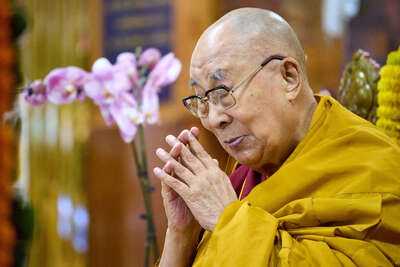 The Central Tibetan Administration named the year that followed a Year of Compassion, a fitting tribute to a life shaped by exile, non-violence and a refusal to let injury become hatred. But it was also, less gently, the year in which that declaration would be tested by a world in no mood to make anything easy.
The test did not make compassion easier to speak of. It made it more difficult, and for that reason more necessary. Gaza has shown how suffering can be visible to the world and still remain unprotected. Ukraine has shown how war, once prolonged, becomes a landscape of fatigue. Taiwan has lived, all year, under the pressure of the same larger power's claim that Beijing now presses on who may recognise the next Dalai Lama. Across the world, trust thins, public speech grows harsher, and power is defended as if restraint were weakness.
It is in such a time that the Dalai Lama's understanding of compassion must be rescued from softness. He has never used compassion as an escape from reality. It is not a decorative virtue, or a private kindness that leaves public life untouched. It is a discipline of perception. It asks us to see what anger, fear and ideology train us not to see: that the person before us is not merely a category, a nationality, a rival, a threat or an inconvenience, but a human being who seeks happiness and fears suffering.
The moment another person becomes less real to us, violence has already begun. The weapon may come later. The inward permission comes first. This, more than any doctrine of statecraft, is what the Gaden Phodrang statement was actually built on: the conviction that legitimacy rooted in inward trust cannot be manufactured by decree, however powerful the state making it.
This is why the Dalai Lama's phrase "wise selfish" remains important. It does not ask us to abolish self-interest. It asks us to examine it more honestly. A narrow self-interest may produce a quick advantage. A wiser self-interest recognises that security, dignity, ecological balance and social trust cannot be kept by one group alone. What we do to others returns to the conditions in which we ourselves must live.
This is not piety. It is a sober reading of the world. Climate disruption, migration, artificial intelligence, inequality and militarised nationalism do not remain within neat borders. They expose the limits of cleverness without moral training.
Tibet remains the ground from which the Dalai Lama speaks. His life cannot be separated from the fate of a people whose culture, language and spiritual institutions have endured pressure for decades. Yet his response has not been revenge. He has never asked Tibetans to forget Tibet, nor to hate the Chinese people. That distinction is the moral labour of a lifetime, and it is also the quieter argument beneath his succession statement: that the difference between control and legitimacy is not a legal technicality but a spiritual one. A state may manage offices and enforce obedience. It cannot manufacture trust in the conscience of those who believe.
The year has not been gentle to that distinction. Chinese officials have accused the Dalai Lama of "flip-flopping," revived Qing-dynasty precedent for approving reincarnations, and named a monastery in Lhasa as capable of finding a rival fifteenth Dalai Lama of its own, an outcome Tibetan Buddhists elsewhere would never recognise but Beijing could enforce within its own borders regardless. Analysts now discuss, without much embarrassment, the prospect of two Dalai Lamas: one of the Tibetan heart, one of the Chinese state.
The response to that claim has been unusually pointed. In July, five United Nations experts wrote to Beijing raising grave concern, and asked again where Gedhun Choekyi Nyima is, the boy recognised as the Panchen Lama in 1995 and disappeared within days. More than three decades later, there is still no independently verified answer. The United States Senate passed a resolution that same month, unanimously, affirming Tibetans' religious freedom and rejecting any Chinese role in choosing his successor; the Czech Senate followed in March. None of it has moved Beijing, and none of it was likely to. What it has done is deny China the silence it has usually been able to count on.
If the Dalai Lama's philosophy asked for restraint when Tibet's situation was merely difficult, it asks for more now that the alternative on offer, quite openly, is a state-appointed rival and a monastery repurposed for the search. That he has still not asked Tibetans to hate the people behind this, only to withhold recognition from it, is not a smaller act of compassion than it was a year ago. It is a harder one, made under harder conditions, which is presumably why it still counts.
India has a special place in this story. Since 1959, it has given the Dalai Lama refuge; Tibetan monasteries and settlements took root here, and Dharamshala became not only a place of exile but a centre of renewal. He has often described India as the land of the gurus and Tibetans as the chelas who preserved the learning of Nalanda. In that there is gratitude, but also a gentle challenge: to recognise something of India's own inheritance reflected back through Tibet, the study of mind, the use of reason, and the cultivation of compassion as an educated human faculty.
At ninety-one, the Dalai Lama no longer travels as he once did. But the relevance of his warning has not diminished, and the year since his last birthday has shown that his authority does not depend on travel to be felt. The great systems of our age, states, markets and technologies, will not become humane by themselves. They will carry the quality of the minds that direct them.
The question his birthday places before us is not whether we admire him. Admiration is easy, and a Senate resolution costs little. The harder question is whether institutions that praise compassion can still meet its political demands: restraint of speech, examined motive, refused hatred, protection of the vulnerable, and a readiness to see beyond immediate victory, in Tibet's case as in any other.
The test did not make compassion easier to speak of. It made it more difficult, and for that reason more necessary. Gaza has shown how suffering can be visible to the world and still remain unprotected. Ukraine has shown how war, once prolonged, becomes a landscape of fatigue. Taiwan has lived, all year, under the pressure of the same larger power's claim that Beijing now presses on who may recognise the next Dalai Lama. Across the world, trust thins, public speech grows harsher, and power is defended as if restraint were weakness.
It is in such a time that the Dalai Lama's understanding of compassion must be rescued from softness. He has never used compassion as an escape from reality. It is not a decorative virtue, or a private kindness that leaves public life untouched. It is a discipline of perception. It asks us to see what anger, fear and ideology train us not to see: that the person before us is not merely a category, a nationality, a rival, a threat or an inconvenience, but a human being who seeks happiness and fears suffering.
Tibet remains the ground from which the Dalai Lama speaks. His life cannot be separated from the fate of a people whose culture, language and spiritual institutions have endured pressure for decades. Yet his response has not been revenge. He has never asked Tibetans to forget Tibet, nor to hate the Chinese people. That distinction is the moral labour of a lifetime, and it is also the quieter argument beneath his succession statement: that the difference between control and legitimacy is not a legal technicality but a spiritual one. A state may manage offices and enforce obedience. It cannot manufacture trust in the conscience of those who believe.
Next Story