
Why Some Rivers Run Two Colors at Once, The Science Explained

Where two rivers meet, their waters do not always shake hands immediately. Sometimes they flow side by side for kilometers, each keeping its own color, its own chemistry, and its own temperature, separated by nothing more than the physics of the water itself.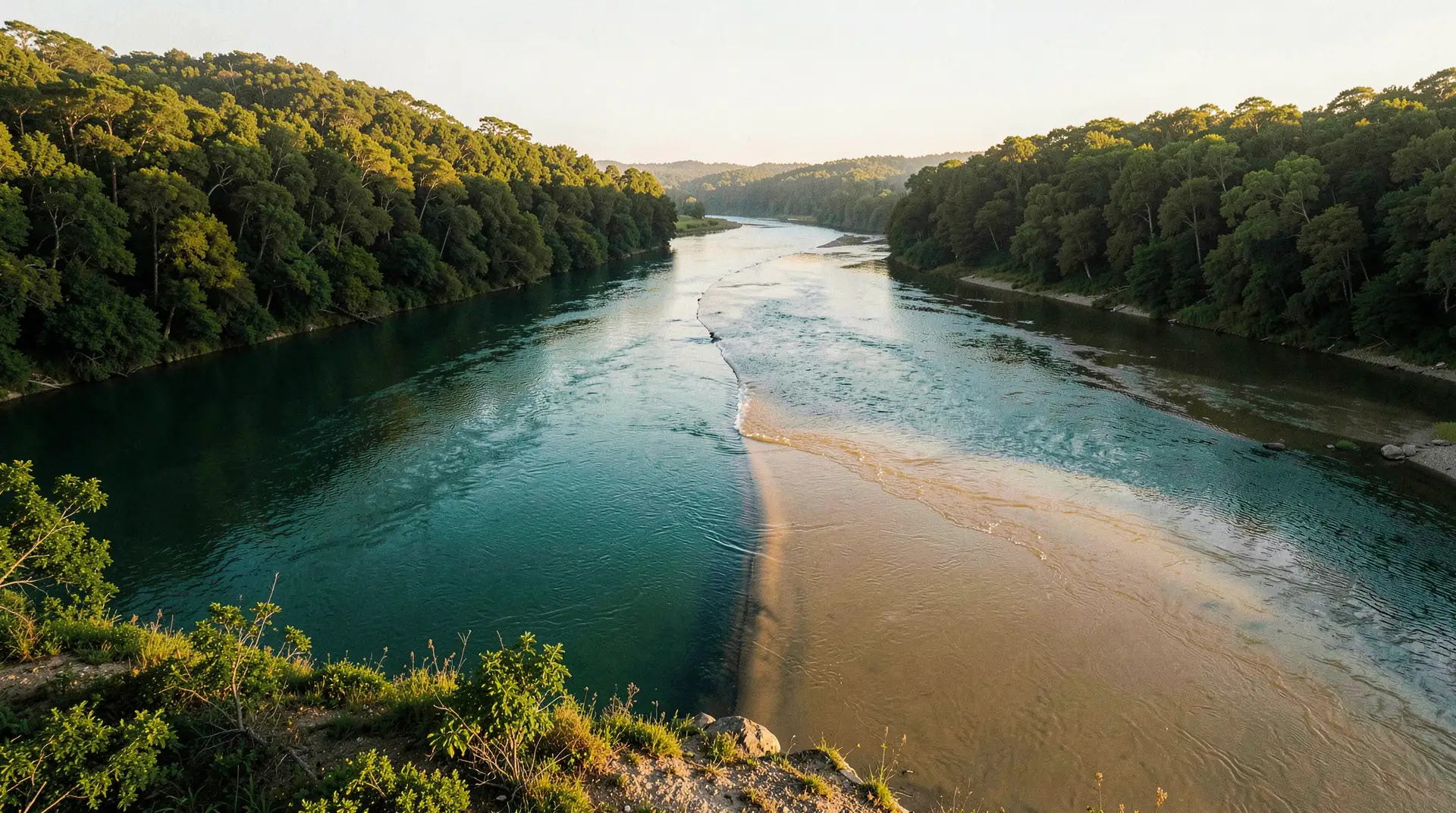
The most photographed example is where the Rio Negro meets the Amazon near Manaus, Brazil. The Negro runs black-brown, stained by tannins from decaying forest leaves. The Amazon runs pale and sandy, heavy with Andean silt. The two flow alongside each other for roughly 6 kilometers before they finally blend. The line between them is sharp enough to step across.
Temperature plays a similar role. Cold water is denser than warm water. If one tributary drains a glacier and the other drains a warm lowland forest, the cold stream will hug the riverbed while the warm stream rides above it. From the surface, this looks like two rivers in one channel, each ignoring the other.
Turbulence eventually breaks the boundary down. The longer the combined channel, the more the currents swirl and fold, and the more the two waters blend. But for a stretch, sometimes a few hundred meters, sometimes several kilometers, the seam holds.
The Devprayag confluence in Uttarakhand, where the Bhagirathi and Alaknanda rivers join to form the Ganga, is another: the Bhagirathi runs greener and the Alaknanda runs grey-white with glacial flour, and the two tones are visible in the water for a short distance downstream.
The color difference at Devprayag is not permanent. It shifts with the season, with rainfall upstream, and with how much meltwater the glaciers are releasing. In the monsoon, both rivers run brown and the seam disappears. In the dry months, the contrast returns.
The Amazon-Rio Negro boundary exists because one river drains ancient, nutrient-poor rock and the other drains young, sediment-rich Andean slopes. Neither is damaged. Both are doing exactly what their catchments produce.
Pollution can create a similar visual effect at a different kind of confluence: where a factory outfall or a sewage channel meets a clean river. The color difference there is real and it does signal a problem. But the mechanism is the same, two bodies of water with different chemistry resisting immediate mixing. The visual is identical. The cause is not.
The way to tell them apart is context: a natural confluence sits where two named rivers meet on a map, usually far from industrial areas. An industrial discharge point sits at a pipe or a drain mouth, and the discolored water typically smells, carries foam, or shows dead aquatic life downstream.
What makes a natural confluence worth understanding is that it makes visible something rivers do everywhere and invisibly: they carry the fingerprint of their entire upstream catchment.
Every tributary that joins a main river brings its own chemistry, temperature, and sediment load. Most of the time the mixing happens fast enough that we never see the seam. When it doesn't, the river hands us a cross-section of two different landscapes flowing side by side, a reminder that a river is never just one thing.
What Is a Two-Colored River?
The technical name for this meeting point is a confluence. At a confluence, two bodies of water join at a single channel. When those two bodies carry different sediment loads, different temperatures, or different densities, they resist mixing. The result is a visible seam, one side dark and murky, the other clear and blue or green, running down the middle of the same river.The most photographed example is where the Rio Negro meets the Amazon near Manaus, Brazil. The Negro runs black-brown, stained by tannins from decaying forest leaves. The Amazon runs pale and sandy, heavy with Andean silt. The two flow alongside each other for roughly 6 kilometers before they finally blend. The line between them is sharp enough to step across.
Why Don't the Waters Mix Right Away?
Water mixing depends on three things: temperature, density, and velocity. When two rivers arrive at a confluence at different speeds, the faster current tends to push the slower one to one side rather than folding into it. When they carry different amounts of dissolved minerals or suspended particles, their densities differ, and denser water sinks under lighter water rather than mixing horizontally.Temperature plays a similar role. Cold water is denser than warm water. If one tributary drains a glacier and the other drains a warm lowland forest, the cold stream will hug the riverbed while the warm stream rides above it. From the surface, this looks like two rivers in one channel, each ignoring the other.
Turbulence eventually breaks the boundary down. The longer the combined channel, the more the currents swirl and fold, and the more the two waters blend. But for a stretch, sometimes a few hundred meters, sometimes several kilometers, the seam holds.
Where Does This Happen in India?
India has its own confluences where the effect is visible. The Sangam at Prayagraj, where the Ganga and Yamuna meet, shows a color difference at certain times of year, the Yamuna running clearer and the Ganga carrying more silt from its upper course.The Devprayag confluence in Uttarakhand, where the Bhagirathi and Alaknanda rivers join to form the Ganga, is another: the Bhagirathi runs greener and the Alaknanda runs grey-white with glacial flour, and the two tones are visible in the water for a short distance downstream.
The color difference at Devprayag is not permanent. It shifts with the season, with rainfall upstream, and with how much meltwater the glaciers are releasing. In the monsoon, both rivers run brown and the seam disappears. In the dry months, the contrast returns.
You may also like
- Meet Hong Haoxuan, 'the smallest wedding and birthday host on the internet'; the 12-year-old emcee with a 1.3 million following on social media who travels across China to entertain at celebrations
- Psychology says people who start explaining a film's story when someone says they haven't watched it may find it difficult to keep exciting information to themselves
- 'Look, madam ji is cutting her birthday cake up in the sky'; woman cuts birthday cake and sings for herself mid-air while paragliding at Bir Billing; viral video raises safety questions
- Salman Khan's Soft Side Comes Alive As He Gives Little Fan A Sweet Forehead Kiss At Airport
- Aditya Dhar calls Yami Gautam his “Biggest Strength” in emotional birthday note, shares romantic photos
Is This a Sign of Pollution or Environmental Damage?
The two-color effect at a natural confluence is not a sign of pollution. It is a sign of geology, of two rivers draining different kinds of landscape, picking up different minerals, and arriving at different temperatures.The Amazon-Rio Negro boundary exists because one river drains ancient, nutrient-poor rock and the other drains young, sediment-rich Andean slopes. Neither is damaged. Both are doing exactly what their catchments produce.
Pollution can create a similar visual effect at a different kind of confluence: where a factory outfall or a sewage channel meets a clean river. The color difference there is real and it does signal a problem. But the mechanism is the same, two bodies of water with different chemistry resisting immediate mixing. The visual is identical. The cause is not.
The way to tell them apart is context: a natural confluence sits where two named rivers meet on a map, usually far from industrial areas. An industrial discharge point sits at a pipe or a drain mouth, and the discolored water typically smells, carries foam, or shows dead aquatic life downstream.
What makes a natural confluence worth understanding is that it makes visible something rivers do everywhere and invisibly: they carry the fingerprint of their entire upstream catchment.
Every tributary that joins a main river brings its own chemistry, temperature, and sediment load. Most of the time the mixing happens fast enough that we never see the seam. When it doesn't, the river hands us a cross-section of two different landscapes flowing side by side, a reminder that a river is never just one thing.






Loving Newspoint? Download the app now
