
Rosogolla's Origin: The Bengal-Odisha Debate That Never Ended

Few sweets have generated as much argument as the rosogolla. A simple thing to look at, white, round, trembling in syrup, it became the subject of competing GI tags, state government press releases, and decades of food historians trading evidence. At its centre sits one man from Kolkata and one temple from Puri, and the question of which story you believe often depends on where you grew up.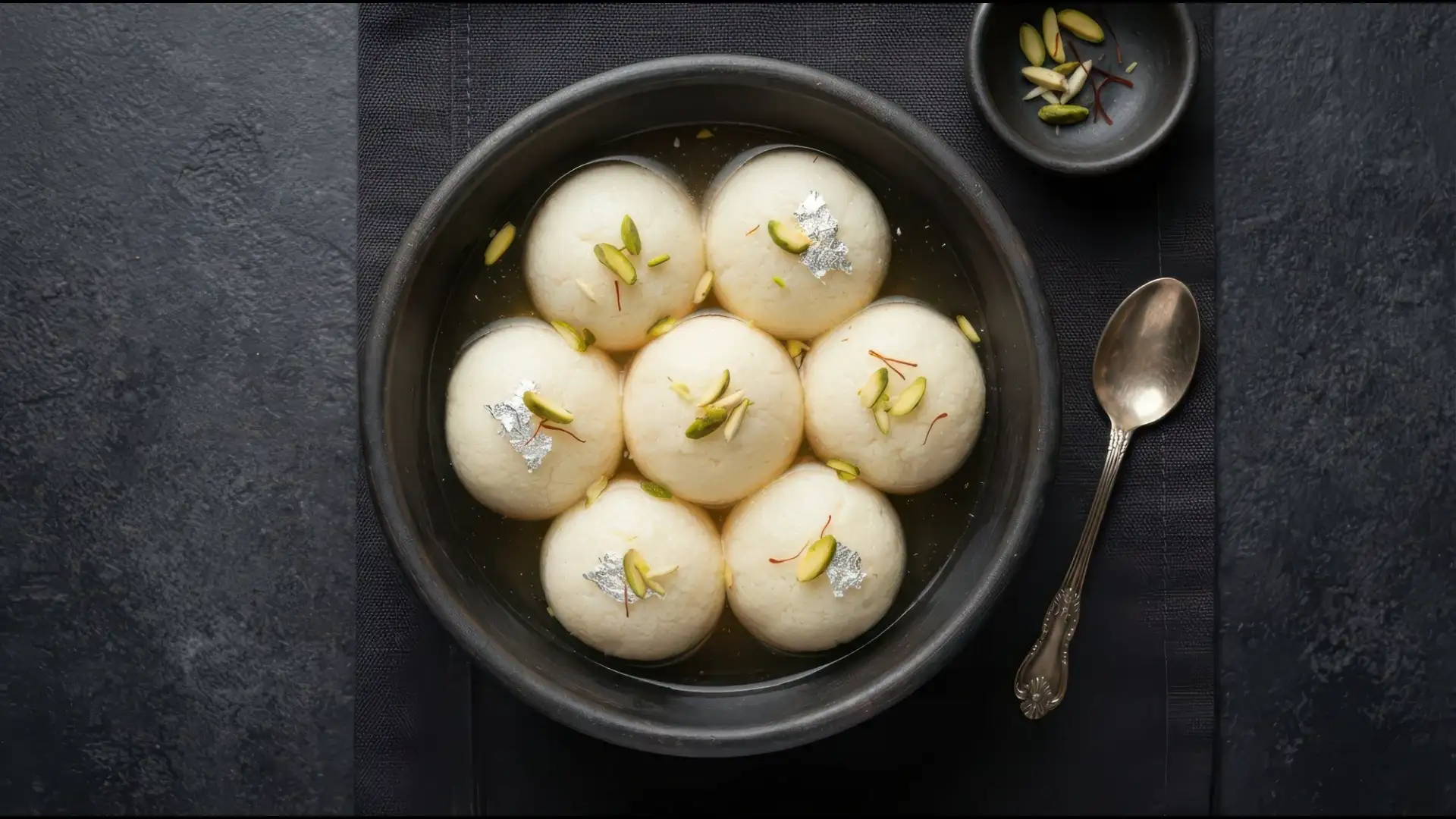
The rosogolla debate will not be resolved, and that is probably the right outcome. What it leaves behind is a more complete picture of how Indian sweets actually develop, not in a single inventor's kitchen, but across centuries of temple offerings, street stalls, family recipes, and commercial ambition, each layer adding something the next generation inherits without knowing quite where it came from.
The Man from Bagbazar
The Bengali claim rests on Nobin Chandra Das, a confectioner who ran a shop in Bagbazar, north Kolkata, in the latter half of the nineteenth century. The family tradition, carried forward by his descendants and documented in accounts of old Kolkata, holds that Nobin Chandra developed the spongy chhena rosogolla, the light, bouncy version that became a Bengali staple, around 1868. Before him, chhena-based sweets were not a significant part of Bengal's confectionery tradition, which leaned heavily on khoya and milk-solid preparations. The achievement attributed to him is specific: learning to knead chhena until it was smooth enough to hold its shape in boiling sugar syrup without falling apart. His grandson K.C. Das later industrialised the sweet and made it shelf-stable in tins, which is how the rosogolla travelled across India and eventually the world. The GI tag Bengal received for "Banglar Rosogolla" in 2017 recognised this lineage.The Puri Claim and the Pahala Connection
Odisha's argument is older and more devotional in character. Scholars and temple priests in Puri point to records suggesting that chhena-based offerings, including a sweet called "kheer mohana" or a preparation close to it, were part of the Rath Yatra rituals at the Jagannath temple long before 1868. The argument holds that Goddess Lakshmi was appeased with this sweet after being left behind during the chariot procession, and that this ritual continuity makes Odisha's claim the deeper root. Odisha received its own GI tag for "Odisha Rasagola" in 2019, with the state government presenting archival evidence of temple records. The Pahala village near Bhubaneswar, famous for its roadside rasagola stalls, became a symbol of this parallel tradition, its version slightly denser and less uniform than the Kolkata kind, made by families who have sold nothing else for generations.You may also like
- Baba Vanga's prediction: Goddess Lakshmi will be kind to these 3 zodiac signs, there will be a rain of money on Diwali
- He knew he could never defeat Ravana, yet 60,000-year-old Jatayu risked his life to save Sita; centuries later, the legendary bird's sacrifice lives on through a gigantic 200-ft sculpture in Kerala
- He left India in 1972 with just $8 and worked as a salesman to survive; 54 years later, the Hyderabad-born investor known as 'Canada's Warren Buffett' is making a ₹52,878 crore bank deal
- Why Do Babies Sneeze So Often?
- Hair Loss Shampoos Under Scrutiny as Experts Highlight the Importance of Scalp Health
Why Both Claims Can Be Partly True
The dispute becomes more interesting once you stop treating it as a courtroom argument. The two sweets are genuinely different objects. The Kolkata rosogolla is engineered for uniform sponginess, Nobin Chandra's contribution may well have been a specific technique for working the chhena. The Odisha rasagola is a different texture, a different tradition, and possibly a different lineage entirely. It is plausible that chhena-based sweets existed in Odishan temple kitchens before Nobin Chandra's shop, and equally plausible that what Nobin Chandra made was a distinct new preparation, not a copy. Food rarely has a single inventor. It has a long, tangled history of parallel experiments in different kitchens, and the version that gets documented and distributed is the one that gets the credit.What the Debate Reveals About Food and Identity
The rosogolla argument is not really about a sweet. It is about what a food means to the people who grew up eating it. For Bengalis, the rosogolla is tied to Durga Puja, to mishti doi and sandesh, to a particular idea of what Bengali confectionery represents. For Odias, the rasagola is tied to Jagannath, to Rath Yatra, to a devotional tradition that predates modern commerce. Both investments are real. A GI tag settles a legal question about a name; it does not settle the emotional question of belonging. The sweet that arrives on a banana leaf at a Puri temple stall and the one that comes in a K.C. Das tin are both genuinely themselves, and a person who has eaten both knows they are not quite the same thing.The rosogolla debate will not be resolved, and that is probably the right outcome. What it leaves behind is a more complete picture of how Indian sweets actually develop, not in a single inventor's kitchen, but across centuries of temple offerings, street stalls, family recipes, and commercial ambition, each layer adding something the next generation inherits without knowing quite where it came from.






Loving Newspoint? Download the app now
