
The Reader Who Was Never There: How The Mind Creates Readers, Snakes, And Sorrows


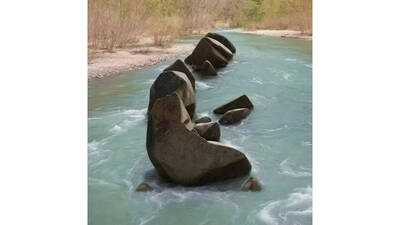
At first glance, the photograph appears extraordinary. A person seems to be sitting in the middle of a flowing river, quietly reading a book. The image evokes a sense of serenity, concentration, and detachment from the world's noise. Many viewers instantly perceive a human figure absorbed in reading amidst the currents of life.
But when we look more carefully, something surprising happens. There is no person, no book, no reading. What seemed so obvious was merely an arrangement of rocks shaped by nature and interpreted by the mind. The "reader" existed nowhere except in our perception.
 Our minds are meaning-making machines. Faced with incomplete information, they fill the gaps. They create stories, assumptions, expectations, fears, and judgments. Often, we are so convinced by these mental creations that we mistake them for reality itself. Like the imagined reader in the river, many of our worries exist only because the mind has assembled fragments into a convincing narrative.
Ancient spiritual traditions have long pointed toward this tendency. They teach that suffering often arises not from reality itself, but from our interpretation of reality. Between what is and what we think is lies a vast territory filled with assumptions.
The Upanishads offer a striking illustration of this phenomenon through the famous example of mistaking a rope for a snake in dim light. A person walking at dusk sees a coiled rope on the ground and immediately imagines it to be a snake. Fear arises, the heart races, and the mind prepares for danger. Yet the snake never existed. The fear was real, but its cause was imagined. The moment a lamp is brought, and the rope is seen clearly, the illusion vanishes.
The sages used this example to explain how ignorance, avidya, creates false perceptions. Reality remains unchanged, just as the rope remains a rope throughout. What changes is our understanding. Much of human suffering arises in a similar manner. We react not to things as they are, but to the stories, assumptions, and projections we superimpose upon them.
The image of the ‘reader in the river’ resembles this ancient teaching. From a distance, the mind sees a person reading a book. Upon closer examination, only rocks and flowing water remain. The reader was never there, just as the snake was never there. Awareness does not create reality; it simply reveals what has always been present.
The mind constantly projects. It remembers the past, anticipates the future, and comments endlessly on the present. Most of the time, we are so immersed in this internal commentary that we forget to examine it.
Awareness changes everything. The moment we observe our thoughts rather than automatically believing them, a space opens up. In that space, we begin to distinguish facts from interpretations, reality from imagination, and observation from projection.
The illusion disappears not through effort, argument, or analysis, but simply through closer attention. What looked like a reader is revealed to be rock and water. Similarly, many mental burdens dissolve when illuminated by awareness. We discover that some fears have no foundation; some resentments are based on misunderstanding, and some anxieties are built upon scenarios that exist nowhere except in the mind.
This does not mean that every concern is imaginary. Life presents genuine challenges. Yet a significant portion of our suffering comes from stories we create about those challenges rather than from the challenges themselves.
But when we look more carefully, something surprising happens. There is no person, no book, no reading. What seemed so obvious was merely an arrangement of rocks shaped by nature and interpreted by the mind. The "reader" existed nowhere except in our perception.
Ancient spiritual traditions have long pointed toward this tendency. They teach that suffering often arises not from reality itself, but from our interpretation of reality. Between what is and what we think is lies a vast territory filled with assumptions.
The Upanishads offer a striking illustration of this phenomenon through the famous example of mistaking a rope for a snake in dim light. A person walking at dusk sees a coiled rope on the ground and immediately imagines it to be a snake. Fear arises, the heart races, and the mind prepares for danger. Yet the snake never existed. The fear was real, but its cause was imagined. The moment a lamp is brought, and the rope is seen clearly, the illusion vanishes.
The sages used this example to explain how ignorance, avidya, creates false perceptions. Reality remains unchanged, just as the rope remains a rope throughout. What changes is our understanding. Much of human suffering arises in a similar manner. We react not to things as they are, but to the stories, assumptions, and projections we superimpose upon them.
The mind constantly projects. It remembers the past, anticipates the future, and comments endlessly on the present. Most of the time, we are so immersed in this internal commentary that we forget to examine it.
The illusion disappears not through effort, argument, or analysis, but simply through closer attention. What looked like a reader is revealed to be rock and water. Similarly, many mental burdens dissolve when illuminated by awareness. We discover that some fears have no foundation; some resentments are based on misunderstanding, and some anxieties are built upon scenarios that exist nowhere except in the mind.
Next Story