
This microscopic creature has lived on your face for years; now scientists say it's almost out of genes


Scientists sequenced the genome of Demodex folliculorum , the microscopic mite living in nearly every human's hair follicles, and found it's shedding genes so fast it may eventually stop existing outside our bodies entirely, according to a 2022 study from the University of Reading and Bangor University.
The mite, which lives in eyelash and facial hair follicles and mates on human skin at night, showing the smallest gene count of any of the fifteen arachnid species compared in the study. Researchers say that's the result of thousands of generations spent doing almost nothing but eating sebum, mating and living inside a single host's pores, cut off from other mite lineages and slowly losing DNA it no longer needs.
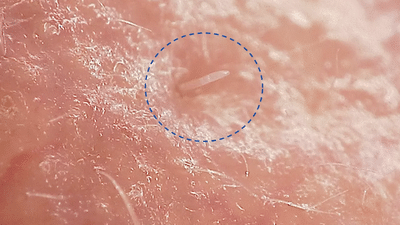
"We found these mites have a different arrangement of body part genes to other similar species due to them adapting to a sheltered life inside pores," said Dr. Alejandra Perotti, an invertebrate biologist at the University of Reading who co-led the research. "These changes to their DNA have resulted in some unusual body features and behaviours."
Why researchers say the mites are headed toward extinction, or something like it
More than 90% of people carry these mites, and most of us got them from our mothers during or shortly after birth. Adults measure around 0.3 millimeters and have fewer than 1,000 cells total, compared to over 600,000 in a fruit fly. The genome data shows a pattern researchers associate with organisms drifting away from independent life and toward permanent reliance on a host — the same trajectory some bacteria have taken, though scientists say they've never documented it happening in an animal before.
Part of what's driving that shift is inbreeding. Because these mites rarely encounter mites from outside their host's own population, each generation mates with close relatives, and that steadily erodes the genome over time. The study's authors describe D. folliculorum as sitting in a transitional stage between an external parasite and something closer to an internal symbiont, something that lives inside its host rather than on it.
The findings also settled a smaller, weirder debate. Scientists had long assumed the mites lacked an anus and simply accumulated waste in their bodies until death. Using electron microscopy, the research team confirmed the mites do, in fact, have one, which means they've been excreting waste normally the whole time.
They're probably not out to get you
Despite the reputation mites have picked up over the years, the study points toward a more neutral, maybe even helpful relationship. Researchers suggest the mites could play a role in keeping pores clear of dead skin cells and other debris, provided their numbers stay in a normal range. Problems tend to show up only when populations spike, which has been linked in some cases to skin conditions like rosacea and blepharitis, inflammation around the eyelids.
The research was a collaboration between Bangor University, the University of Reading, the University of Valencia, the University of Vienna and Argentina's National University of San Juan, and it was published in the journal Molecular Biology and Evolution. Perotti's team spent years working with samples too small to see without specialized microscopy, piecing together a genome from an organism most people don't know is living on their face at all.
The mite, which lives in eyelash and facial hair follicles and mates on human skin at night, showing the smallest gene count of any of the fifteen arachnid species compared in the study. Researchers say that's the result of thousands of generations spent doing almost nothing but eating sebum, mating and living inside a single host's pores, cut off from other mite lineages and slowly losing DNA it no longer needs.
"We found these mites have a different arrangement of body part genes to other similar species due to them adapting to a sheltered life inside pores," said Dr. Alejandra Perotti, an invertebrate biologist at the University of Reading who co-led the research. "These changes to their DNA have resulted in some unusual body features and behaviours."
Why researchers say the mites are headed toward extinction, or something like it
Part of what's driving that shift is inbreeding. Because these mites rarely encounter mites from outside their host's own population, each generation mates with close relatives, and that steadily erodes the genome over time. The study's authors describe D. folliculorum as sitting in a transitional stage between an external parasite and something closer to an internal symbiont, something that lives inside its host rather than on it.
The findings also settled a smaller, weirder debate. Scientists had long assumed the mites lacked an anus and simply accumulated waste in their bodies until death. Using electron microscopy, the research team confirmed the mites do, in fact, have one, which means they've been excreting waste normally the whole time.
They're probably not out to get you
Despite the reputation mites have picked up over the years, the study points toward a more neutral, maybe even helpful relationship. Researchers suggest the mites could play a role in keeping pores clear of dead skin cells and other debris, provided their numbers stay in a normal range. Problems tend to show up only when populations spike, which has been linked in some cases to skin conditions like rosacea and blepharitis, inflammation around the eyelids.
The research was a collaboration between Bangor University, the University of Reading, the University of Valencia, the University of Vienna and Argentina's National University of San Juan, and it was published in the journal Molecular Biology and Evolution. Perotti's team spent years working with samples too small to see without specialized microscopy, piecing together a genome from an organism most people don't know is living on their face at all.
Next Story