
This rare Florida butterfly has two 'heads' to escape predators; study finds


Some butterflies have a clever way of protecting themselves from predators. They appear to have two heads, but one of them is fake. The Bartram's scrub-hairstreak butterfly , which lives only in Florida 's pine rocklands, is one of these butterflies. This habitat is one of the world's most critically endangered places. These markings can fool predators into attacking the wrong end of the butterfly’s body. Scientists are learning more about how this trick helps butterflies survive. A new study of more than 900 butterfly species is also helping explain how these fake heads evolved.
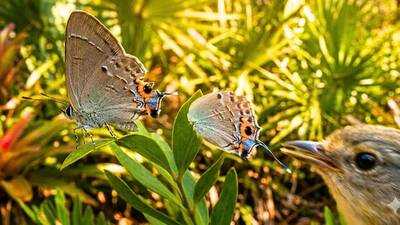
What the fake head on the butterfly looks like
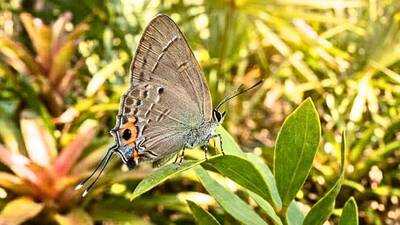
The study published in The Royal Society Publishing, titled 'Correlated evolution of multiple traits gives butterflies a false head'; they studied more than 900 butterfly species to understand this fake head feature. The Bartram's scrub-hairstreak has markings on the back of its hind wings that look like a real head. Five features work together to create this illusion. These include a bright patch of colour, fake antennae, an eyespot, head-shaped wing edges and lines that point towards the fake head. Together, they make the back of the butterfly look like its front.
This helps protect the butterfly from predators. If a predator attacks what looks like the butterfly's head, it actually bites the back of the wings instead. The butterfly may lose a small part of its wing, but it can still fly, survive and reproduce. As Yumnam explained, "butterflies may suffer some wing tear but are able to continue to live, fly, and reproduce." A damaged wing is much less dangerous than an attack on the butterfly's real head.
What the study of more than 900 butterfly species found
The study also helped scientists understand how this survival trick developed over time. The researchers found that four of the five fake head features evolved together instead of appearing one by one. These include the bright colour patch, fake antennae, eyespot, head-shaped wing edges and converging lines.
This suggests that the same survival pressure helped shape these features together. In other words, the fake head was not created step by step. Instead, these features appear to have developed together because they helped butterflies avoid predators.
The researchers also suggested another interesting idea. Yumnam believes that some butterflies may make the fake head look even more convincing by rubbing their hind wings together. This movement may make the fake antennae appear to move like real ones. If that is true, the butterfly is not only using markings on its wings but also using movement to make the fake head look more realistic to predators.
What the fake head on the butterfly looks like
The study published in The Royal Society Publishing, titled 'Correlated evolution of multiple traits gives butterflies a false head'; they studied more than 900 butterfly species to understand this fake head feature. The Bartram's scrub-hairstreak has markings on the back of its hind wings that look like a real head. Five features work together to create this illusion. These include a bright patch of colour, fake antennae, an eyespot, head-shaped wing edges and lines that point towards the fake head. Together, they make the back of the butterfly look like its front.
This helps protect the butterfly from predators. If a predator attacks what looks like the butterfly's head, it actually bites the back of the wings instead. The butterfly may lose a small part of its wing, but it can still fly, survive and reproduce. As Yumnam explained, "butterflies may suffer some wing tear but are able to continue to live, fly, and reproduce." A damaged wing is much less dangerous than an attack on the butterfly's real head.
What the study of more than 900 butterfly species found
The study also helped scientists understand how this survival trick developed over time. The researchers found that four of the five fake head features evolved together instead of appearing one by one. These include the bright colour patch, fake antennae, eyespot, head-shaped wing edges and converging lines.
This suggests that the same survival pressure helped shape these features together. In other words, the fake head was not created step by step. Instead, these features appear to have developed together because they helped butterflies avoid predators.
The researchers also suggested another interesting idea. Yumnam believes that some butterflies may make the fake head look even more convincing by rubbing their hind wings together. This movement may make the fake antennae appear to move like real ones. If that is true, the butterfly is not only using markings on its wings but also using movement to make the fake head look more realistic to predators.
Next Story