
Do Mirrors Really Reverse Left and Right? Here's What Actually Happens

Every morning, most of us look into a mirror without giving much thought to what we are actually seeing. Yet mirrors create one of the most common optical puzzles in everyday life. Raise your right hand, and your reflection appears to raise its left. But if mirrors reverse left and right, why do they not swap up and down as well? It is a question that has puzzled children, philosophers and even scientists for centuries. The answer is surprisingly simple once you understand how reflections work. Rather than reversing directions, mirrors reveal something much more fascinating about the way our brains interpret the world.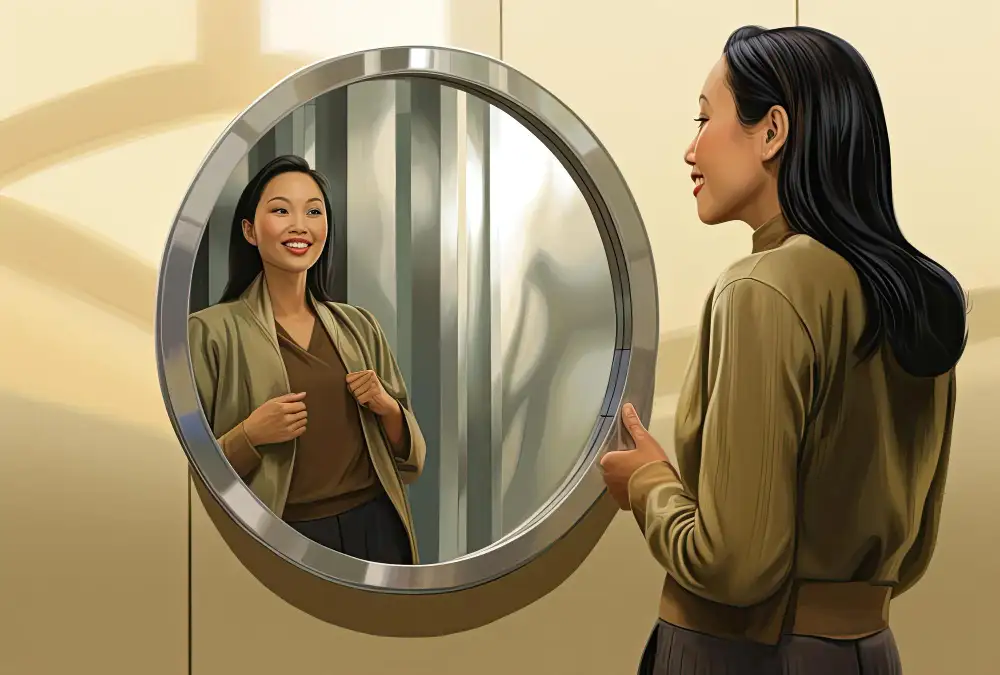
A flat mirror reflects light straight back at the same angle at which it arrives. This means the mirror only reverses one direction: front to back. In other words, it swaps the direction that points towards the mirror with the direction that points away from it.
If you stand facing a mirror, the part of your body closest to the mirror remains closest in the reflection, while the back of your body appears hidden behind the reflected image. The mirror does not physically exchange your left and right sides.
When you look at your reflection, your brain instinctively treats it as someone standing opposite you. If a real person turned to face you, their right hand would line up with your left hand. Your reflection appears to behave in exactly the same way.
However, try tilting your head to one side. Your reflection tilts in the same direction rather than upside down. This simple observation shows that mirrors are not reversing left and right in the way many people assume.
Instead, they faithfully reflect every point directly back towards your eyes.
Modern mirrors use a thin coating of aluminium or silver behind a sheet of glass. This highly reflective layer sends back most of the incoming light, producing the clear images we see every day.
Scientists also use specialised mirrors in telescopes, lasers and spacecraft. Some observatories rely on mirrors several metres wide to collect faint light from galaxies billions of light-years away, allowing astronomers to study the distant universe.
This principle extends far beyond mirrors. Similar visual processes influence photography, driving, architecture, virtual reality and even medical imaging, where accurately interpreting reflections and spatial orientation is essential.
The next time you glance into a mirror, remember that it is not playing tricks with left and right. Instead, it is performing a simple and precise reflection of light. The real illusion exists not in the mirror itself, but in the remarkable way the human brain makes sense of the image looking back at us.
Mirrors Do Not Actually Reverse Left and Right
The biggest misconception is that mirrors reverse left and right. In reality, they do not.A flat mirror reflects light straight back at the same angle at which it arrives. This means the mirror only reverses one direction: front to back. In other words, it swaps the direction that points towards the mirror with the direction that points away from it.
If you stand facing a mirror, the part of your body closest to the mirror remains closest in the reflection, while the back of your body appears hidden behind the reflected image. The mirror does not physically exchange your left and right sides.
Why It Looks Like Left and Right Are Swapped
The illusion comes from the way we imagine ourselves turning around to face another person.You may also like
- How celebrity moms are reinventing post-pregnancy fashion in 2026
- Microsoft engineer earning Rs 1.9 crore recalls the Rs 15,000 college fee his family couldn't afford: 'My father sold my mother's jewellery'
- 116-year-old grandma climbed Tirumala on foot; reminds millions that dream and devotion never grow old
- Expensive birthday party or a holiday with kids? This family chose the latter and explains why it became the best parenting formula
- Kids can 'drown' in sleep hours after their swimming lesson: Australian mom shares warning every parent should know
When you look at your reflection, your brain instinctively treats it as someone standing opposite you. If a real person turned to face you, their right hand would line up with your left hand. Your reflection appears to behave in exactly the same way.
However, try tilting your head to one side. Your reflection tilts in the same direction rather than upside down. This simple observation shows that mirrors are not reversing left and right in the way many people assume.
Instead, they faithfully reflect every point directly back towards your eyes.
Lesser-Known Facts About Mirrors
One interesting fact is that the earliest mirrors were not made from glass at all. Ancient civilisations polished pieces of obsidian, copper and bronze until they became reflective enough to show a person's image.Modern mirrors use a thin coating of aluminium or silver behind a sheet of glass. This highly reflective layer sends back most of the incoming light, producing the clear images we see every day.
Scientists also use specialised mirrors in telescopes, lasers and spacecraft. Some observatories rely on mirrors several metres wide to collect faint light from galaxies billions of light-years away, allowing astronomers to study the distant universe.
Why This Everyday Illusion Matters
Understanding why mirrors reverse left and right but not up and down teaches an important lesson about perception. Our brains constantly interpret visual information using experience and assumptions rather than simply recording what our eyes see.This principle extends far beyond mirrors. Similar visual processes influence photography, driving, architecture, virtual reality and even medical imaging, where accurately interpreting reflections and spatial orientation is essential.
The next time you glance into a mirror, remember that it is not playing tricks with left and right. Instead, it is performing a simple and precise reflection of light. The real illusion exists not in the mirror itself, but in the remarkable way the human brain makes sense of the image looking back at us.






Loving Newspoint? Download the app now
