
Korvai Explained: How a Kanjeevaram's Border Is Woven Into the Saree

Pull a Kanjeevaram saree to the light and look where the border meets the body. The colours shift cleanly, sometimes dramatically, a deep red body giving way to a green border, or a gold zari field meeting a contrasting silk. What you are looking at is not a dye boundary. It is a join. The border was woven on a separate shuttle, in a separate colour, and locked to the body thread by thread as the weaver worked. This technique is called korvai, and it is one of the things that separates a true Kanjeevaram from every imitation of it.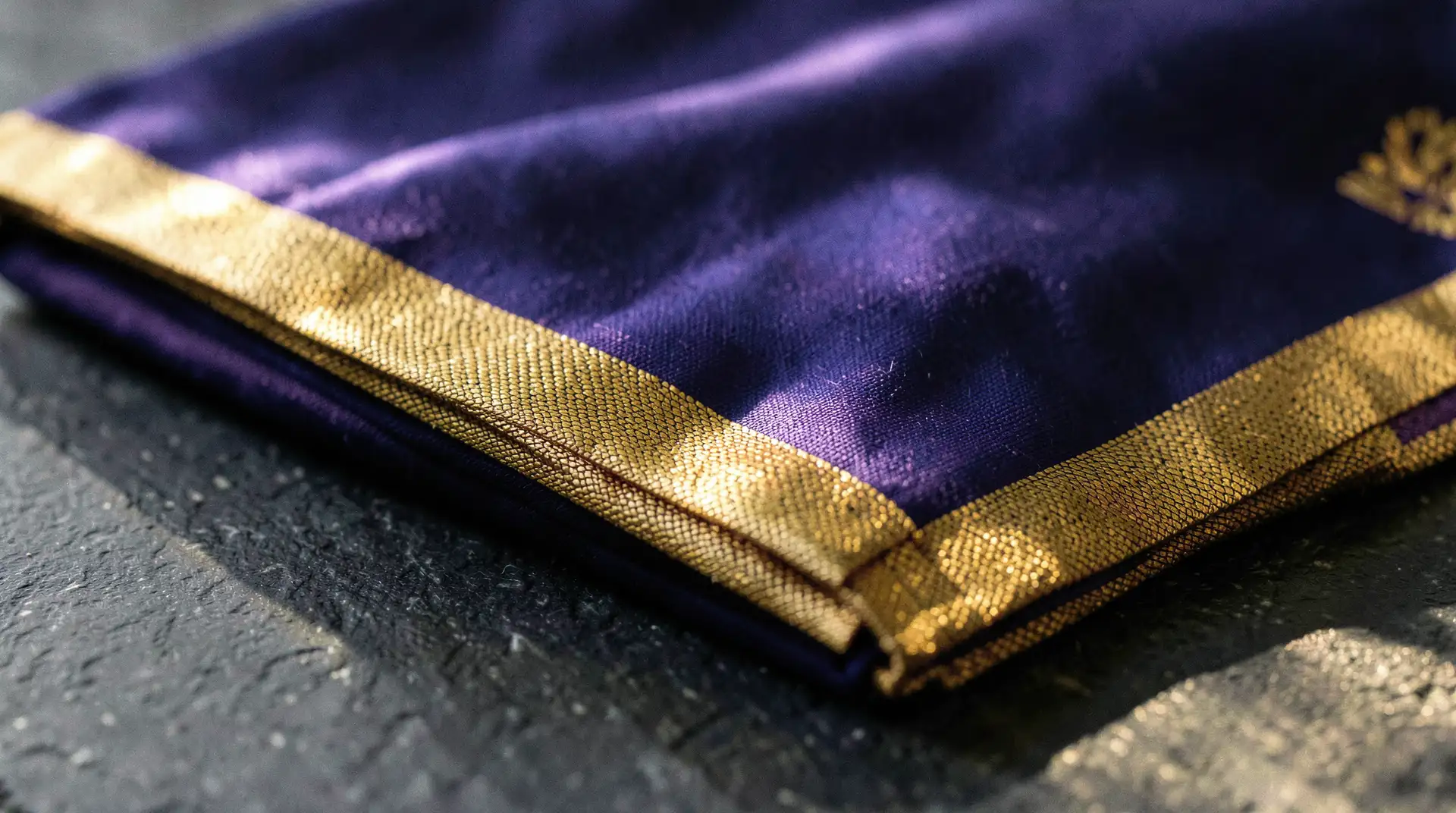
Two Silks, One Loom
In most woven textiles, a single weft thread runs the full width of the fabric from selvedge to selvedge. Korvai breaks this rule. The weaver works with at least two separate weft shuttles simultaneously, one carrying the silk for the body of the saree, another carrying the silk for the border. Each shuttle lays its thread only in its own zone. Where the two zones meet, the threads interlock in a figure-eight loop, one catching around the other before each returns to its own side. No knot. No overlap. Just a shared boundary that holds because of the geometry of the lock itself.Why the Colours Can Be So Different
Because the body silk and the border silk are wound separately before weaving begins, they can be dyed in entirely unrelated colours. This is the practical gift of korvai: a saree can carry a body and border that would be impossible to achieve with a single thread. The contrast combinations that Kanjeevaram is famous for, colours that seem to argue with each other until they suddenly agree, exist because of this structural separation. The pallav, the decorative end panel, is often woven with a third shuttle, which is why it can carry yet another colour entirely.How a Weaver Reads the Join
A trained eye can find the korvai line without any tools. Run a finger along the inside of the border where it meets the body. On a genuine korvai weave, the join has a faint ridge, not a seam, but a slight thickening where the interlocked loops sit. The two silk sections will also have a different hand if you press them separately: the body and the border were wound under different tensions and may have different thread counts. On a saree where the border colour has been printed or where a separately woven border has been stitched on by machine, the join will be flat and the back of the fabric will show either a colour bleed or a line of stitching.What It Costs in Time
A single Kanjeevaram saree woven with korvai takes two weavers working a pit loom between five and fifteen days, depending on how elaborate the zari work is. Managing two or three shuttles in coordination, keeping the interlocking loops even across hundreds of picks, and maintaining consistent tension across zones of different silk weights is skilled work that cannot be meaningfully accelerated. This is also why the technique is increasingly rare even within Kanchipuram itself: fewer young weavers are trained in it, and the market pressure toward faster production pushes workshops toward simpler constructions.The Detail That Holds Everything Together
Korvai is not an ornament added to a Kanjeevaram. It is the method by which the saree is built. The border's colour, its weight, and its ability to drape differently from the body, all of this follows from the decision to weave it separately and join it on the loom. When a saree is described as a true Kanjeevaram, this is part of what the word is meant to guarantee: that the border did not arrive from somewhere else and get attached. It grew out of the same warp, locked to the body one thread at a time, and the line where they meet is the proof.Next Story