
How Bandhani Gets Its Dots: The Tie-and-Dye Craft of Gujarat and Rajasthan

Pull a Bandhani odhni flat and hold it to the light. What looks like a field of dots is actually a map of knots, each circle the ghost of a tiny bundle of cloth that was gathered, bound tight, and submerged in colour while still tied. The fabric was never touched by a brush or a block. Every dot is the record of a person's fingers.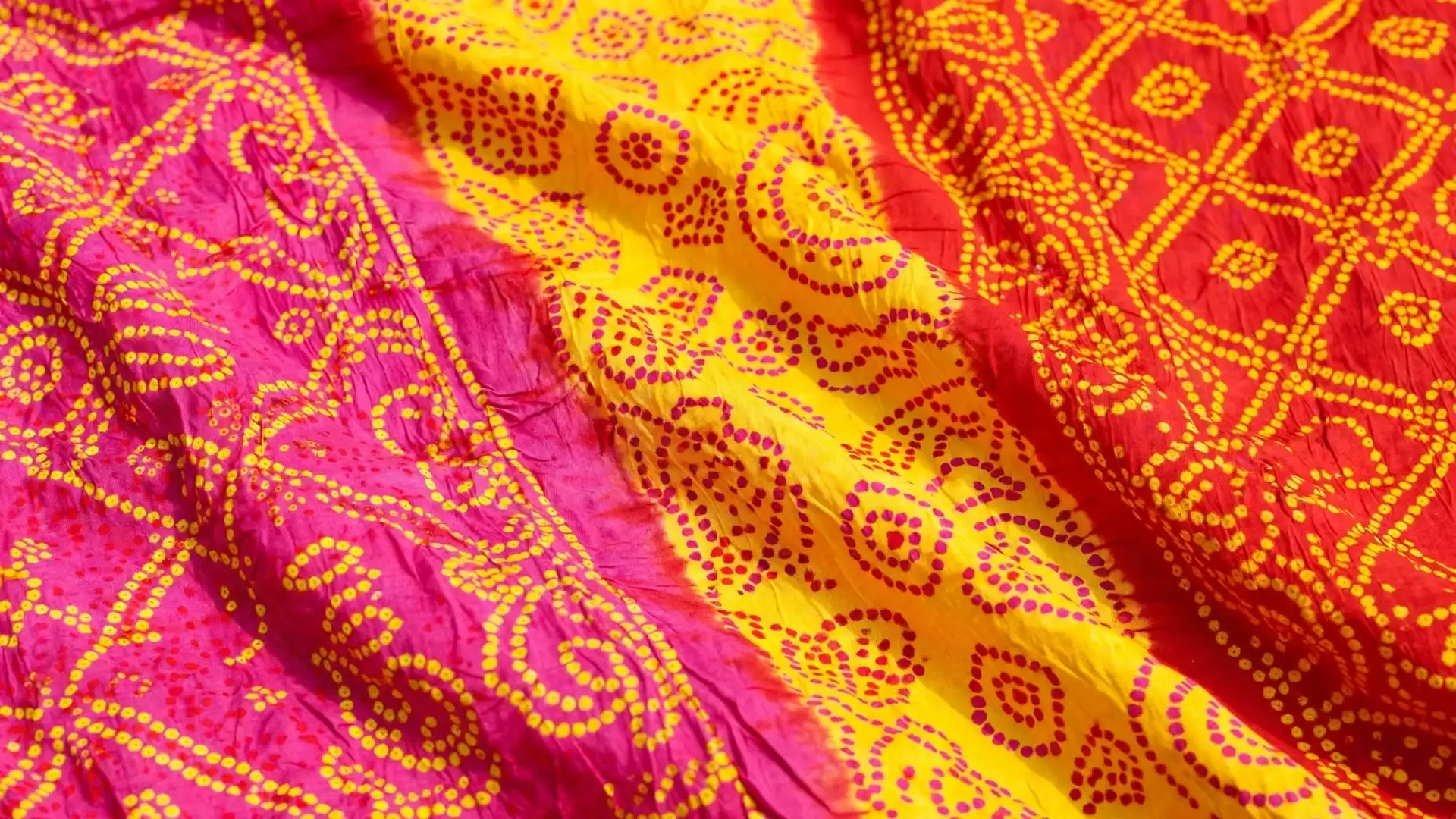
The bundle is perhaps two or three millimetres across. She moves to the next mark and does it again. A single dupatta can hold ten thousand of these knots. A fine wedding piece can hold many more. The tying of one cloth can take days.
Bandhani is almost always dyed in sequence, not in a single bath. A cloth might go into yellow first, then be retied in fresh places and lowered into red. The areas that were tied in the first round resist the second colour, the areas tied in the second round resist only that colour, and the areas left open absorb both. This layering is how a single piece of cloth carries several colours without them bleeding into each other at the edges.
The dyer reads the sequence before the tying begins, because every decision about which knot goes in first determines what colour survives underneath.
Larger motifs appear, flowers, peacocks, the outline of an elephant, each one built from clusters of dots rather than drawn as a continuous line. The Rajasthani palette leans toward the vivid: deep pink, saffron, royal blue. The cloth is often cotton rather than silk, made to travel and to wear hard.
Both traditions share one thing: the work of tying is done almost entirely by women, at home, piece by piece, while the dyeing is done by men in workshops. The two halves of the process have historically lived in separate spaces, joined only when the tied cloth passes from one hand to the other.
The sharpness of the dot's edge, how cleanly the dyed ground meets the undyed centre, tells you how tightly the knot was wound and how experienced the tier was.A smudged or irregular dot is not always a flaw. In older pieces, slight irregularities are the signature of hand work, the evidence that no two dots are exactly the same because no two moments of tying were exactly the same.
Machine-printed imitations, which flood the lower end of the market, have perfectly uniform dots with no texture variation. The real thing breathes a little.The knot, the sequence, the dye, the unwinding, Bandhani is a craft that hides its own method inside its result. The finished cloth shows you colour and pattern, but it does not show you the thousands of small decisions that preceded the first dye bath. Those decisions are only visible to someone who knows what a dot is made of.
The Knot Before the Colour
The process begins with undyed cloth, traditionally fine cotton or silk, stretched across a craftsperson's lap. A pattern is first transferred onto the fabric, sometimes with a wooden block dipped in chalk or ash, sometimes from memory alone in households where the designs have passed down without paper. Then the tying begins. A worker, most often a woman working at home as part of a family unit, pinches a tiny peak of cloth between thumb and forefinger. She winds thread around the base of that peak, pulling it tight enough to resist dye, and knots it off.The bundle is perhaps two or three millimetres across. She moves to the next mark and does it again. A single dupatta can hold ten thousand of these knots. A fine wedding piece can hold many more. The tying of one cloth can take days.
What Happens in the Dye Bath
Once tied, the cloth goes into the dye. The bound peaks resist the liquid, the thread holds the fabric compressed so the dye cannot reach the centre. When the cloth is lifted out and the knots eventually cut or unwound, those compressed centres emerge as undyed circles against the coloured ground. That is the dot.Bandhani is almost always dyed in sequence, not in a single bath. A cloth might go into yellow first, then be retied in fresh places and lowered into red. The areas that were tied in the first round resist the second colour, the areas tied in the second round resist only that colour, and the areas left open absorb both. This layering is how a single piece of cloth carries several colours without them bleeding into each other at the edges.
The dyer reads the sequence before the tying begins, because every decision about which knot goes in first determines what colour survives underneath.
The Regional Hands
Gujarat and Rajasthan share the craft but not the vocabulary of pattern. In Kutch and Jamnagar, the dominant Bandhani tradition belongs to the Khatri community, who have worked as dyers for generations. Their patterns tend toward dense fields of dots arranged in geometric grids, the classic Gharchola sari, associated with Gujarati weddings, carries rows of squares each filled with clusters of dots, often on a red or green ground.In Rajasthan, particularly around Jaipur and Sikar, the patterns open up.Larger motifs appear, flowers, peacocks, the outline of an elephant, each one built from clusters of dots rather than drawn as a continuous line. The Rajasthani palette leans toward the vivid: deep pink, saffron, royal blue. The cloth is often cotton rather than silk, made to travel and to wear hard.
Both traditions share one thing: the work of tying is done almost entirely by women, at home, piece by piece, while the dyeing is done by men in workshops. The two halves of the process have historically lived in separate spaces, joined only when the tied cloth passes from one hand to the other.
Reading a Finished Piece
A practiced eye can read a Bandhani cloth the way someone reads a woven pattern. The size of the dots tells you something about the fineness of the tying, smaller dots require a finer pinch and more thread, and they sit closer together. The regularity of the grid tells you whether the pattern was marked out or worked from memory.The sharpness of the dot's edge, how cleanly the dyed ground meets the undyed centre, tells you how tightly the knot was wound and how experienced the tier was.A smudged or irregular dot is not always a flaw. In older pieces, slight irregularities are the signature of hand work, the evidence that no two dots are exactly the same because no two moments of tying were exactly the same.
Machine-printed imitations, which flood the lower end of the market, have perfectly uniform dots with no texture variation. The real thing breathes a little.The knot, the sequence, the dye, the unwinding, Bandhani is a craft that hides its own method inside its result. The finished cloth shows you colour and pattern, but it does not show you the thousands of small decisions that preceded the first dye bath. Those decisions are only visible to someone who knows what a dot is made of.
Next Story