
5 Fascinating Facts About India's Ancient Stepwells You Didn't Know

They descend into the earth like inverted temples, their carved galleries stepping down toward water that may be thirty metres below the surface. India's ancient stepwells, called vav in Gujarat, baoli or bawdi across Rajasthan and Delhi, are among the most quietly extraordinary structures on the subcontinent. Most people know them as beautiful. Fewer know why they were built the way they were, or what they were actually used for.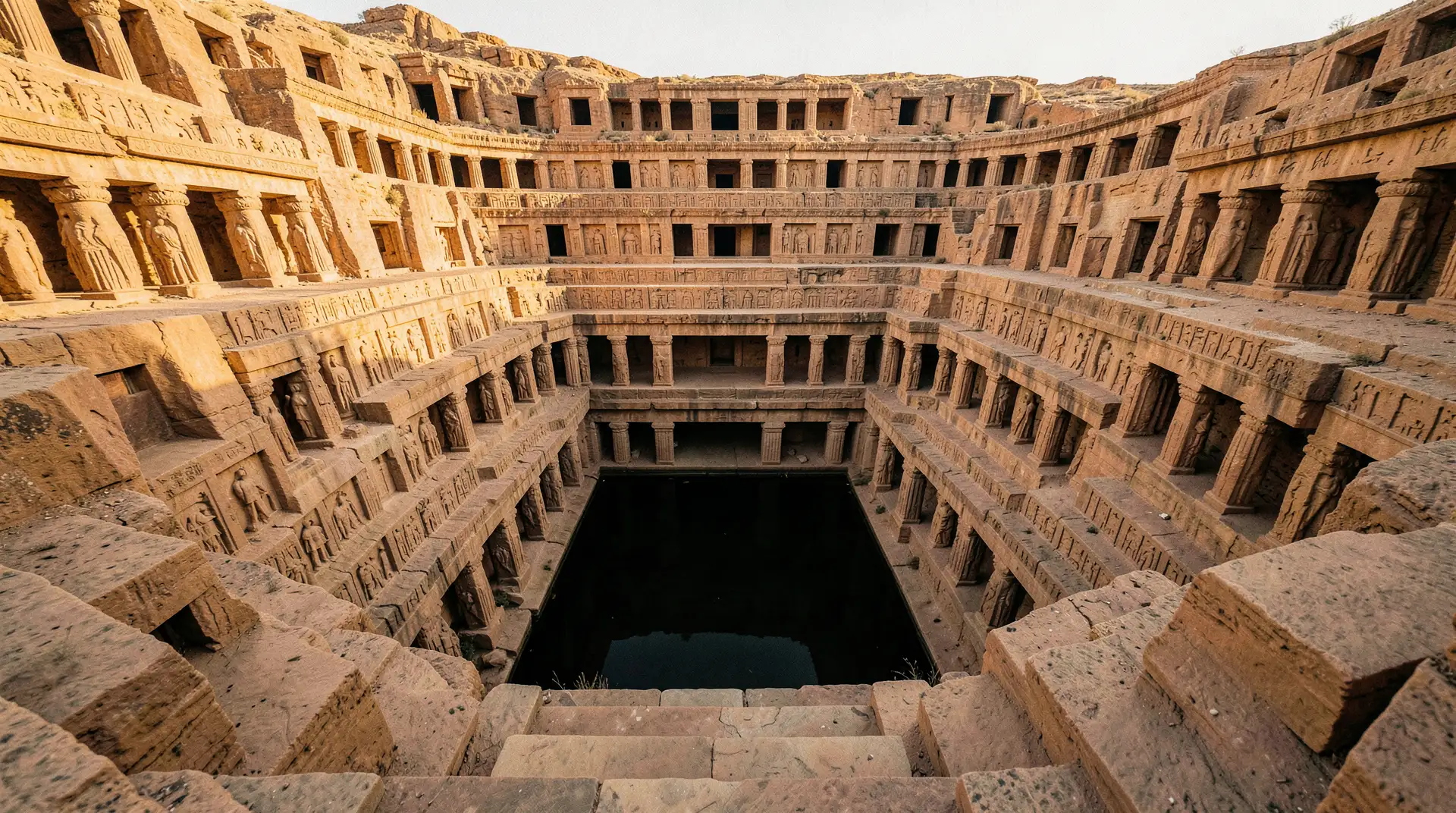
The thick stone walls absorbed very little heat. The water table at the bottom acted as a heat sink. On a day when the ground above was forty degrees, the lower platforms could sit fifteen to twenty degrees cooler. Communities used these shaded galleries as resting places through the hottest months, a function the structure served as reliably as it served the function of drawing water.
The imagery moves from the everyday at the top, attendants, women at their toilette, to the divine and cosmic at the bottom, where the water is. The descent into the stepwell was understood as a descent through layers of the world. Water, in the tradition that built these structures, was not merely useful. It was sacred, and the architecture of reaching it was meant to mark that.
Women gathered at the steps for the long daily work of drawing water, and the stepwell became one of the few public spaces where women moved freely, met, and talked. The steps themselves served as informal seating for travellers resting between journeys. A functioning stepwell was a social institution as much as an infrastructure one.
The recovery of these structures has been uneven. Some, like Agrasen ki Baoli in Delhi, sit in the middle of a busy city and are visited daily. Others remain partially excavated or entirely submerged under later construction.
The craftsmen who built stepwells understood the soil conditions, the water table, and the expansion and contraction of stone across seasons in ways that allowed structures to stand for centuries with minimal maintenance beyond keeping the water channel clear.
What makes a stepwell remarkable is the compression of problems it solves in a single form, water access, heat management, community space, and the ritual marking of something the builders considered worth marking. The structure did not separate these functions. It held them together in stone, and the stone has held.
The Architecture Was an Air-Conditioning System
The deeper you go into a stepwell, the cooler the air becomes. This was not accidental. Builders oriented many stepwells along an east-west axis so that the sun's movement would keep the lower galleries in shade through most of the day.The thick stone walls absorbed very little heat. The water table at the bottom acted as a heat sink. On a day when the ground above was forty degrees, the lower platforms could sit fifteen to twenty degrees cooler. Communities used these shaded galleries as resting places through the hottest months, a function the structure served as reliably as it served the function of drawing water.
The Carvings Were a Calendar and a Cosmology
The sculptures covering the walls of stepwells like Rani ki Vav in Patan are not decoration applied after the engineering was done. They are integrated into the structure's meaning. Rani ki Vav, built in the eleventh century and now a UNESCO World Heritage Site, carries hundreds of figures arranged across seven levels.The imagery moves from the everyday at the top, attendants, women at their toilette, to the divine and cosmic at the bottom, where the water is. The descent into the stepwell was understood as a descent through layers of the world. Water, in the tradition that built these structures, was not merely useful. It was sacred, and the architecture of reaching it was meant to mark that.
They Were Maintained by the Communities That Depended on Them
A stepwell was not a government project in the way a dam is today. Wealthy patrons, often queens, merchants, or guild leaders, funded construction, but the ongoing life of the stepwell belonged to the neighbourhood or village around it. Priests performed rituals at the water's edge.Women gathered at the steps for the long daily work of drawing water, and the stepwell became one of the few public spaces where women moved freely, met, and talked. The steps themselves served as informal seating for travellers resting between journeys. A functioning stepwell was a social institution as much as an infrastructure one.
Many Were Deliberately Buried or Filled In
Stepwells fell out of use across much of India after piped water arrived in towns and cities, but many were not simply abandoned, they were actively filled. Colonial-era public health campaigns identified standing water in old stepwells as a breeding ground for mosquitoes, and filling them in was considered sanitation policy. Others were buried under expanding cities, their existence forgotten until construction work broke through a roof and revealed galleries below.The recovery of these structures has been uneven. Some, like Agrasen ki Baoli in Delhi, sit in the middle of a busy city and are visited daily. Others remain partially excavated or entirely submerged under later construction.
The Engineering Required No Mortar in Many Cases
The stone-cutting traditions behind the finest stepwells used interlocking joints rather than mortar to hold carved blocks in place. This was not a limitation, it was a deliberate choice suited to structures that would be under constant stress from the weight of the earth around them and the movement of water below. Mortar-based joints crack under differential pressure. Interlocked dry-fit stone can shift slightly and settle without failing.The craftsmen who built stepwells understood the soil conditions, the water table, and the expansion and contraction of stone across seasons in ways that allowed structures to stand for centuries with minimal maintenance beyond keeping the water channel clear.
What makes a stepwell remarkable is the compression of problems it solves in a single form, water access, heat management, community space, and the ritual marking of something the builders considered worth marking. The structure did not separate these functions. It held them together in stone, and the stone has held.
Next Story