
Why Lucknow's Chikankari Uses White Thread on White Cotton

Walk through the old gullies of Chowk or Aminabad and you will find bolts of fabric hanging in doorways, almost colourless until someone holds them to the window. That is Chikankari as it was always meant to be seen, white on white, the pattern emerging only when light passes through or falls at an angle. The restraint is the whole point.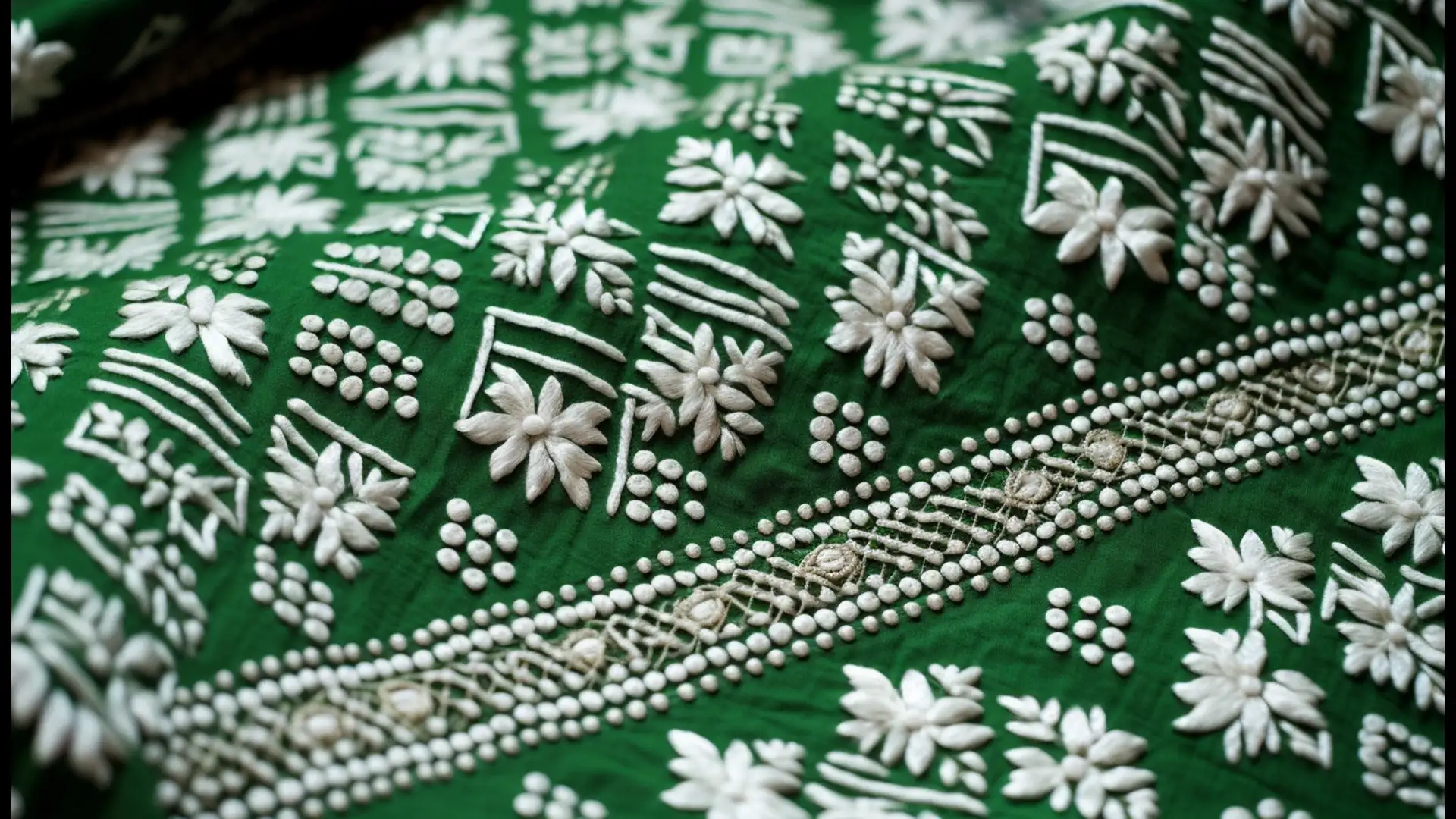
The white-on-white convention was not one decision made at one moment. It was the convergence of a court's idea of elegance, the physics of a very particular cloth, and the practical realities of a craft economy. Each of those three things reinforced the others, which is why the form held its shape across centuries and across the very different worlds of the Nawabi court and the artisan's home.
The Mughal Connection
Chikankari as a formal court craft took shape under the Nawabs of Awadh, who inherited and refined the aesthetic sensibility of the later Mughal courts. That court culture prized subtlety over declaration. Bright colour was available, the dyers of the region were skilled, but restraint in dress signalled a particular kind of refinement. White was not absence; it was the highest register of elegance. The embroidery was meant to be felt before it was seen, a texture discovered by touch or by a shift in light rather than announced from across the room.The Logic of the Fabric
The base cloth was traditionally tanzeb or mul mul, muslin so fine it was called woven air in the old accounts of the trade. A heavy thread or a contrasting colour on fabric this light would overwhelm it. White thread of a similar weight disappears into the weave and lets the stitch itself do the work. The craft has around thirty-six recognised stitch types, each creating a different texture and shadow. On coloured fabric, the shadow is lost. On white, every stitch reads as a small relief against the ground, which is exactly the effect the form was built around.You may also like
- Robert Pattinson will be the next James Bond, but at home he is just a dad in cargo shorts talking about daycare and enjoying how his daughter is the 'biggest trove of energy'
- Novak Djokovic: ATMA Miami: Discover: Aman Group New Hotel and Wellness Destination
- Farah Khan stepped inside Ananya Birla's Mumbai home and compared its grand living room to a James Bond film set; the new tour reveals an MF Husain painting, sculptures and a vast private garden
- Losing Muscle as You Age? How Strength Training Can Slow It Down
- Making these mistakes while opening an FD will reduce your returns! Understand the full math before investing your money..
What the Whiteness Actually Does
White thread on white fabric creates a surface that changes with the light. In shade, the cloth looks plain. Against a lamp or a window, the embroidery becomes visible as a pattern of raised and recessed stitches. This was a deliberate quality, the garment revealed itself gradually, which suited a court culture that valued things that rewarded close attention. The same quality made the fabric appropriate for warm weather. White reflects heat. The muslin breathes. The embroidery adds texture without adding weight or warmth, which matters in the climate of the Gangetic plain.The Craft After the Courts
When the Nawabi court dissolved in the nineteenth century, Chikankari moved out of the palace and into the city's domestic economy. The white-on-white tradition survived because it was also practical for the craftswomen who took it up. White thread was the cheapest available. White fabric was the easiest to source and the easiest to bleach clean after embroidery. The craft became a household income for women in the old city's Muslim mohallas, and the material simplicity of the original form made it possible to sustain at a small scale without expensive dyes or specialised supplies. The aesthetic survived because the economics supported it.The white-on-white convention was not one decision made at one moment. It was the convergence of a court's idea of elegance, the physics of a very particular cloth, and the practical realities of a craft economy. Each of those three things reinforced the others, which is why the form held its shape across centuries and across the very different worlds of the Nawabi court and the artisan's home.






Loving Newspoint? Download the app now
