
Why Do We Make Rangoli? The Real Meaning Behind This Ancient Tradition

A freshly made rangoli at the threshold does something a garland or a lamp cannot quite do. It says: this home is awake, this home is ready, something good is expected here. The tradition is so embedded in daily life across India that most people who make it have never been told why. The reasons, it turns out, are layered, and each layer is more interesting than the last.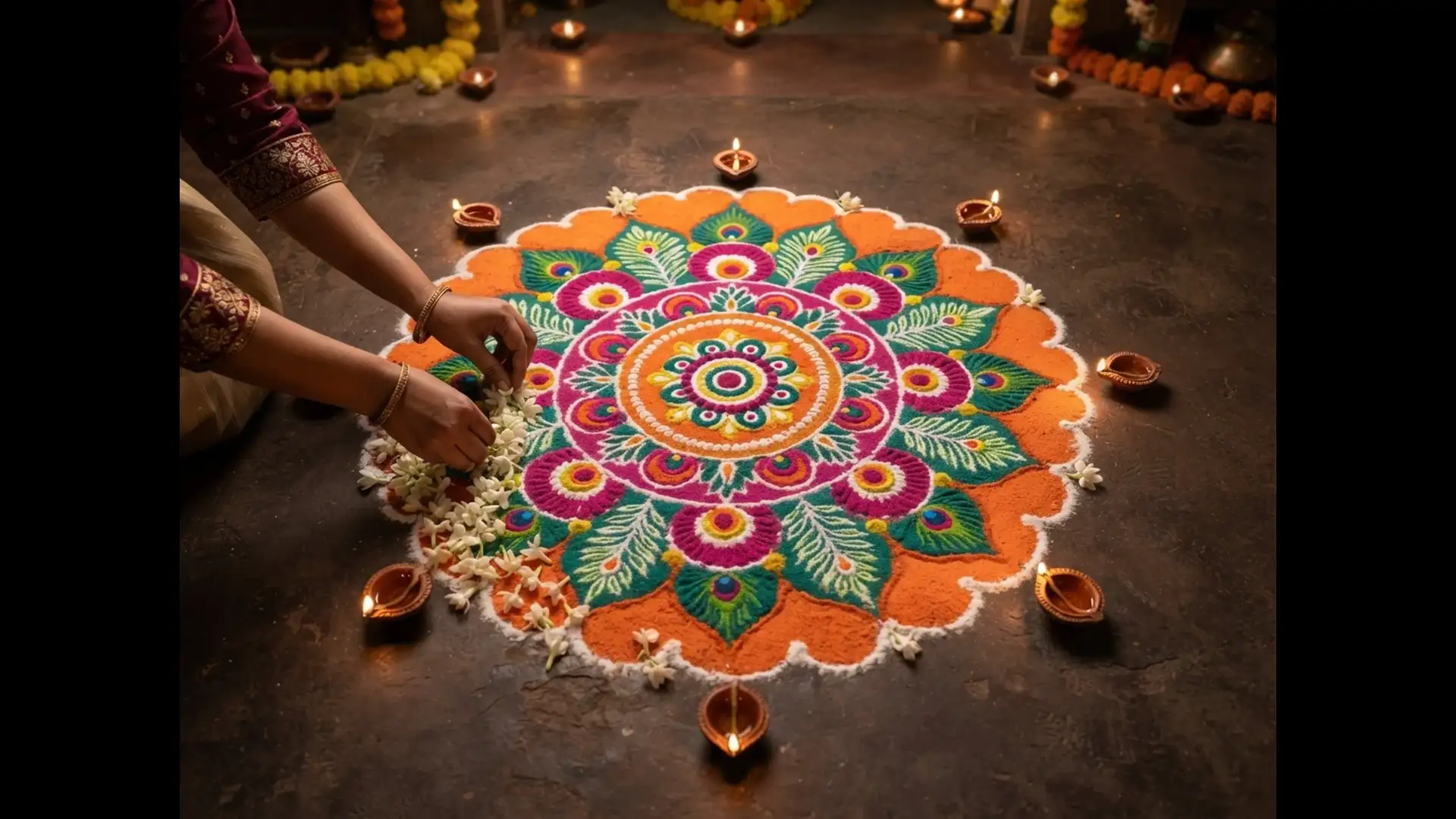
Each region developed its own geometry: the tight, dot-based kolam of the south; the flowing floral forms of Maharashtra; the earthy ochre and white of Rajasthan. The differences in style reflect local materials as much as local taste, rice flour in the south, chalk in the north, flower petals where they were plentiful.
he act of drawing it is considered as significant as the pattern itself: the maker bends close to the earth, works with her hands, and brings intention to a space that strangers cross every day. Some traditions hold that rice flour rangoli also feeds small creatures, ants, birds, making the act one of offering as much as of decoration. The belief is not incidental to the practice. It is the practice.
Mathematicians who have studied the kolam have noted that many traditional patterns encode principles found in graph theory and knot mathematics, not because the makers were working from equations, but because the tradition itself, passed from mother to daughter over generations, had arrived at the same solutions through practice. The dots are not a guide to be erased. They are part of the form, and a correctly completed kolam leaves no dot untouched.
The making of it does. This is why machine-printed rangoli stickers, however convenient, feel like a different thing to those who grew up watching the practice. The sticker is a symbol. The hand-drawn pattern is the act itself.
A bride's first rangoli in a new home was watched by her in-laws as a statement of who she was and what she had been taught. In communities where women had few public platforms, the doorstep was one.
The quality of the kolam outside a home was read as a reflection of the household's attention and care. This is why the tradition carries emotional weight that goes well beyond its visual appeal: it was one of the few forms of creative expression that belonged entirely to women, practiced in public, evaluated by the community, and passed down as a form of inheritance.
Rangoli is one of those traditions that looks simple from the outside and turns out to be carrying everything: belief, mathematics, daily discipline, regional identity, and a form of female artistry that survived centuries without needing anyone to write it down. The doorstep was always the canvas. The hand that drew on it was always telling you something about the home behind it.
Where Rangoli Comes From
The word rangoli is believed to derive from the Sanskrit rangavalli, meaning a row of colours. Regional names tell the same story differently: kolam in Tamil Nadu and Kerala, alpana in West Bengal, aripana in Bihar, muggu in Andhra Pradesh and Telangana, mandana in Rajasthan. The practice appears in descriptions from ancient texts and in the decorative traditions of temple towns long before it settled into the domestic doorstep.Each region developed its own geometry: the tight, dot-based kolam of the south; the flowing floral forms of Maharashtra; the earthy ochre and white of Rajasthan. The differences in style reflect local materials as much as local taste, rice flour in the south, chalk in the north, flower petals where they were plentiful.
The Belief Behind the Threshold
In Hindu tradition, the threshold of a home is neither fully inside nor fully outside. It is a liminal space, a crossing point. Rangoli placed here is understood, in popular belief and in texts like the Griha Sutras, as an invitation to Lakshmi, the goddess of prosperity, and a gentle deterrent to negative energies.he act of drawing it is considered as significant as the pattern itself: the maker bends close to the earth, works with her hands, and brings intention to a space that strangers cross every day. Some traditions hold that rice flour rangoli also feeds small creatures, ants, birds, making the act one of offering as much as of decoration. The belief is not incidental to the practice. It is the practice.
The Mathematics Hidden in the Pattern
The kolam tradition of South India carries something that surprises people when they first encounter it: a rigorous underlying geometry. A kolam begins with a grid of dots, called pulli, placed in precise rows. The line then weaves around these dots without lifting from the surface, forming a continuous loop.Mathematicians who have studied the kolam have noted that many traditional patterns encode principles found in graph theory and knot mathematics, not because the makers were working from equations, but because the tradition itself, passed from mother to daughter over generations, had arrived at the same solutions through practice. The dots are not a guide to be erased. They are part of the form, and a correctly completed kolam leaves no dot untouched.
Why It Is Made Fresh Every Day
The impermanence is not a flaw in the tradition. It is the point. A kolam or rangoli made at dawn is walked over, rained on, and faded by evening. The next morning, it is made again. This daily renewal carries its own meaning: the home begins each day with an act of care and attention. The pattern does not need to survive.The making of it does. This is why machine-printed rangoli stickers, however convenient, feel like a different thing to those who grew up watching the practice. The sticker is a symbol. The hand-drawn pattern is the act itself.
Rangoli as a Language Between Women
For most of Indian history, rangoli was a skill transmitted exclusively between women, grandmother to mother to daughter. The patterns carried regional identity, family style, and sometimes personal signature.A bride's first rangoli in a new home was watched by her in-laws as a statement of who she was and what she had been taught. In communities where women had few public platforms, the doorstep was one.
The quality of the kolam outside a home was read as a reflection of the household's attention and care. This is why the tradition carries emotional weight that goes well beyond its visual appeal: it was one of the few forms of creative expression that belonged entirely to women, practiced in public, evaluated by the community, and passed down as a form of inheritance.
Rangoli is one of those traditions that looks simple from the outside and turns out to be carrying everything: belief, mathematics, daily discipline, regional identity, and a form of female artistry that survived centuries without needing anyone to write it down. The doorstep was always the canvas. The hand that drew on it was always telling you something about the home behind it.
Next Story