
Meteor vs Meteorite: Why a Shooting Star Isn't the Same as a Space Rock

A bright streak racing across the night sky is often called a shooting star, but scientists use more specific terms to describe what is happening. While "meteor" and "meteorite" sound similar and are often used interchangeably, they refer to different stages of the same cosmic traveler’s journey.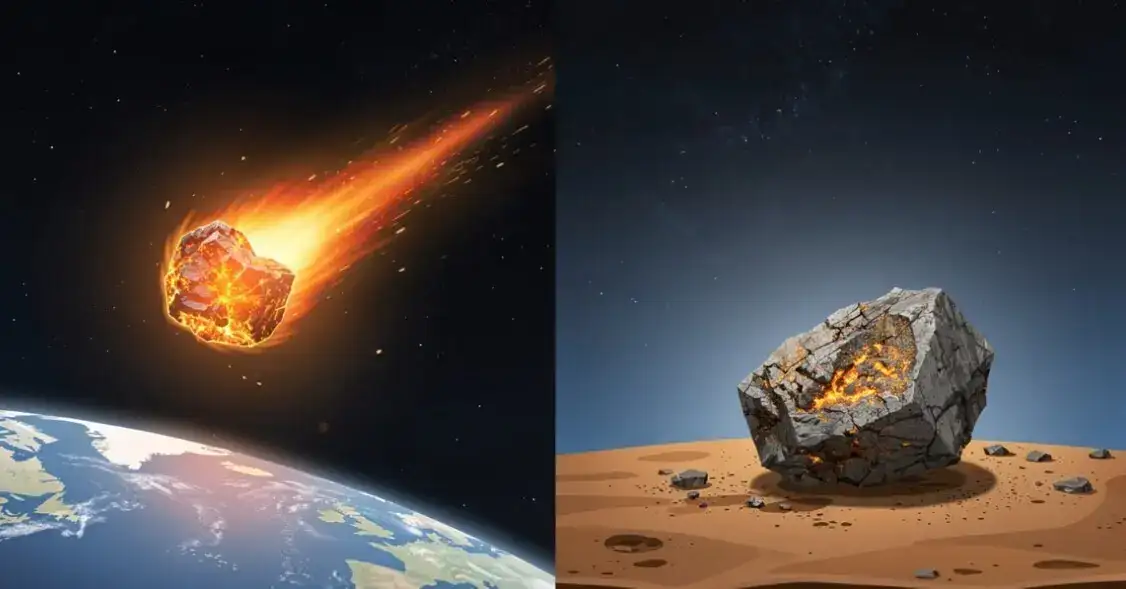
Every day, Earth encounters tiny fragments from comets, asteroids, and other space debris. Most of these particles burn up before reaching the ground, while a few survive the fiery descent. Whether the object is called a meteoroid, meteor, or meteorite depends entirely on where it is in that journey.
What Is a Meteor ?
A meteor is the bright flash of light produced when a piece of space rock enters Earth's atmosphere at tremendous speed. Friction and compression heat the surrounding air, causing the object to glow and create the streak of light visible from the ground.
This glowing phenomenon, not the rock itself, is what scientists call a meteor.
What Is a Meteorite ?
A meteorite is the portion of the space rock that survives its trip through the atmosphere and lands on Earth. Instead of completely burning away, part of the object remains intact and can be collected and studied.
Meteorites provide valuable clues about the formation of the Solar System and the history of space objects.
The Key Difference: Location
The simplest way to tell them apart is by location.
How They Look
Meteors appear as brief flashes of light, sometimes lasting only a second. Larger meteors can be exceptionally bright and may leave glowing trails behind them.
Meteorites are much less dramatic. They usually look like dark rocks or metal fragments with a scorched outer layer created by intense heating during descent.
Every day, Earth encounters tiny fragments from comets, asteroids, and other space debris. Most of these particles burn up before reaching the ground, while a few survive the fiery descent. Whether the object is called a meteoroid, meteor, or meteorite depends entirely on where it is in that journey.
What Is a Meteor ?
A meteor is the bright flash of light produced when a piece of space rock enters Earth's atmosphere at tremendous speed. Friction and compression heat the surrounding air, causing the object to glow and create the streak of light visible from the ground.This glowing phenomenon, not the rock itself, is what scientists call a meteor.
What Is a Meteorite ?
A meteorite is the portion of the space rock that survives its trip through the atmosphere and lands on Earth. Instead of completely burning away, part of the object remains intact and can be collected and studied.Meteorites provide valuable clues about the formation of the Solar System and the history of space objects.
The Key Difference: Location
The simplest way to tell them apart is by location. - A meteor exists in the atmosphere as a glowing streak.
- A meteorite exists on the ground after surviving atmospheric entry.
How They Look
Meteors appear as brief flashes of light, sometimes lasting only a second. Larger meteors can be exceptionally bright and may leave glowing trails behind them. Meteorites are much less dramatic. They usually look like dark rocks or metal fragments with a scorched outer layer created by intense heating during descent.
Next Story