
The Surprising Reason Birds Choose Human Homes Over Trees

A bird building its nest on a tree branch feels completely natural.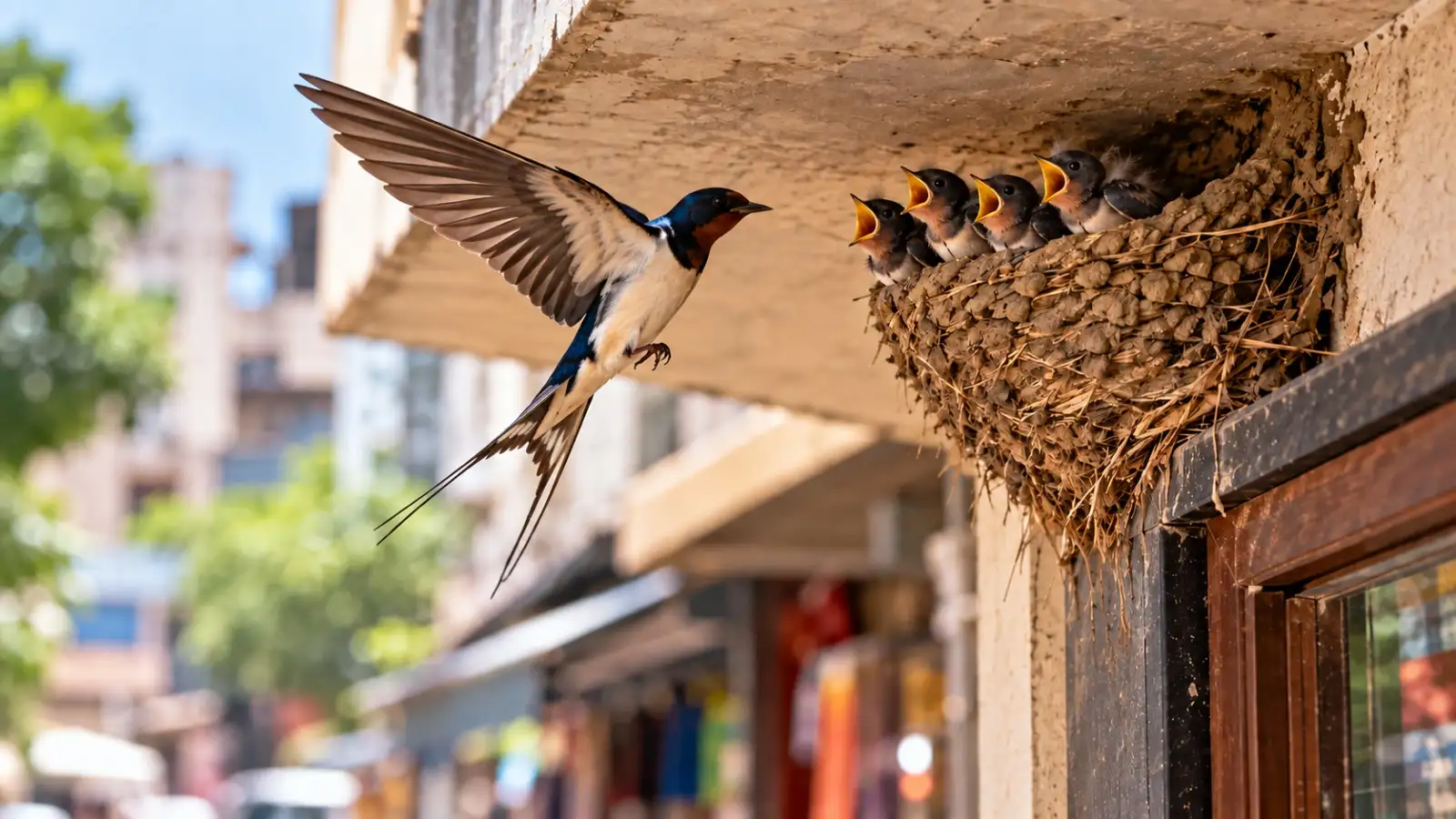
A nest inside a shop, underneath a roof, on a building ledge or beside an electrical structure feels much more surprising.
Yet birds are not necessarily making a mistake when they choose these locations.
For many species, a good nesting site is simply a place that provides the right combination of safety, shelter, food access and suitable space to raise young. As cities and villages change, some birds have discovered that human structures can sometimes offer those conditions surprisingly well.
In parts of India, this relationship has become particularly visible. Wildlife Institute of India research has documented birds nesting inside buildings, on artificial supports and even on some man-made structures in urban landscapes.
The strange-looking nest may actually be a carefully chosen solution.
What matters is the structure.
A narrow ledge, sheltered corner or exposed beam can provide a stable platform at a useful height. For species that naturally prefer elevated or protected nesting locations, parts of a building can resemble the surfaces they would use in natural habitats.
Barn Swallows provide a particularly interesting example.
Research across the Indian Himalaya found that more than 70 to 90 per cent of recorded Barn Swallow nests were located inside buildings, frequently on walls, bulb holders and other artificial supports. Shops and traditional buildings were particularly important nesting locations.
To people, a shop may seem like an extremely unsuitable place for a wild bird.
To a swallow, it can provide a sheltered nesting surface with a roof overhead.
Birds have a different checklist.
Is the nest difficult for predators to reach?
Is there enough space?
Is the structure stable?
Is there shelter from rain and excessive heat?
Can the parents reach the nest easily?
Is food available nearby?
A location that looks strange to us can score highly on all of these factors.
This is why an apparently inconvenient corner of a building can become a successful breeding site.
Yet some birds have developed a close relationship with human buildings.
Research on Barn Swallows in the Indian Himalaya found that commercial structures such as shops were among the common nesting locations. The same research found that residents often tolerated these nests, with some people reporting nesting traditions continuing for decades or even generations.
The birds may benefit from the architecture.
A shop roof protects against rain.
Walls provide attachment points.
Open entrances allow birds to move in and out.
And human activity does not necessarily scare away species that have become accustomed to people.
This is where urban environments can become surprisingly attractive.
Black Kites are a particularly good example.
Wildlife Institute of India research describes the species as highly adaptable to urban environments, where it can exploit food associated with human activity and waste. Studies in Delhi have also found that nesting density is influenced by the availability of food and green cover.
The result is an unusual combination.
A city provides food opportunities.
Trees and structures provide nesting locations.
Open spaces provide areas for hunting and movement.
For an adaptable bird, the urban environment can become a workable ecosystem.
Wildlife Institute of India monitoring of Black Kites has recorded occasional nesting on man-made structures including electricity pylons and lamp posts.
From the human perspective, these are pieces of infrastructure.
From a bird's perspective, they may simply be tall structures with suitable platforms and a clear view of the surrounding area.
Height can be valuable because it gives adults a better view of potential threats and allows them to approach and leave the nest more easily.
However, such locations can also expose birds to serious risks, particularly electricity, maintenance activity and disturbance.
A structure being usable does not necessarily mean it is safe.
Branches break.
Trees are cut.
Floods alter riverbanks.
Predators move through forests.
Buildings, on the other hand, can remain in place for decades.
A bird that discovers a reliable nesting site may return to the same area repeatedly.
Research on Barn Swallows in Uttarakhand has documented strong nest-site fidelity, with local residents reporting nesting histories extending back many decades in some places.
This can create a remarkable relationship between a bird species and a particular building.
The nest becomes part of the building's annual cycle.
People tolerate them.
A bird nesting on a balcony or inside a traditional building could easily be disturbed or removed.
But in some communities, residents deliberately leave nests alone.
Research into Barn Swallows in the Indian Himalaya found widespread positive attitudes towards the birds and reported practices of protecting nests from disturbance. The study also documented cultural associations linking the swallows with prosperity, gods and domestic well-being.
This creates an unusual form of coexistence.
The bird gets a safe place to raise its young.
People get to watch the breeding cycle from close range.
Neither side necessarily needs to interfere with the other.
A nest tucked underneath a balcony roof may be protected from heavy rain.
A nest inside a building may be harder for some predators to reach.
A ledge high above street level can provide a clear view.
This does not mean buildings are universally safer than trees.
Glass windows, ceiling fans, electrical wires, domestic cats, dogs and human disturbance can create serious risks. Wildlife Institute of India research on Himalayan Barn Swallows has documented threats including nestling mortality from ceiling fans and predation by domestic animals.
The choice is therefore not simply between a good natural nest and a bad artificial one.
Birds are making decisions within a changing environment.
A small gap beneath a roof tile may be enough.
A ventilation opening can become a shelter.
A bridge structure can provide a nesting surface.
A quiet corner behind a signboard may offer protection from weather.
Birds are extremely sensitive to small differences in their surroundings, so what looks like an insignificant architectural feature to a person may be a valuable nesting opportunity.
This is particularly important in dense settlements where natural nesting spaces have become limited.
Some bird species are highly flexible.
Others depend on very specific habitats, vegetation, nesting trees or food sources.
Research on Pallas's Fish-eagle in the Rajaji-Corbett landscape, for example, found that nest-site selection was strongly associated with tall, robust trees, unobstructed branches and proximity to water.
This illustrates an important point.
Birds do not all respond to human development in the same way.
A Black Kite may use an urban structure.
A Barn Swallow may nest inside a shop.
Another species may require a particular tree beside a river and struggle when that habitat disappears.
Temperature, sunlight, wind and rainfall can all affect eggs and chicks.
A sheltered building corner may provide conditions that are difficult to obtain in an exposed tree.
This can become particularly important in areas experiencing changing weather patterns.
Research on Barn Swallows in the Indian Himalaya has found variation in breeding timing and linked nesting patterns with regional climate, monsoon dynamics and habitat conditions.
For birds, therefore, architecture can sometimes provide more than physical support.
It can alter the environment around the nest.
A swallow nesting inside a shop suggests that the building provides something the bird needs.
A Black Kite nesting near a green area may indicate a combination of trees and nearby food resources.
Birds choosing drainage channels, bridges or riverfront structures can reveal connections between different parts of an urban ecosystem.
This is why urban bird behaviour can be useful to researchers.
Birds are not simply surviving inside cities.
Some are responding to the opportunities created by the way cities are built.
That balcony corner may provide shelter.
That shop wall may offer a dependable nesting surface.
That lamp post may provide height.
That building roof may protect chicks from rain.
And the busy neighbourhood below may provide an unexpectedly reliable source of food.
Birds do not understand buildings, roads and electricity poles as humans do.
They see structures, shelter, height, access and opportunity.
As Indian towns and cities continue to expand, some birds are adapting to the new landscapes around them. Their unusual nesting choices are a reminder that urban spaces are not exclusively human environments.
Sometimes, a building that looks completely unnatural to us can become home to a family of birds.
A nest inside a shop, underneath a roof, on a building ledge or beside an electrical structure feels much more surprising.
Yet birds are not necessarily making a mistake when they choose these locations.
For many species, a good nesting site is simply a place that provides the right combination of safety, shelter, food access and suitable space to raise young. As cities and villages change, some birds have discovered that human structures can sometimes offer those conditions surprisingly well.
In parts of India, this relationship has become particularly visible. Wildlife Institute of India research has documented birds nesting inside buildings, on artificial supports and even on some man-made structures in urban landscapes.
The strange-looking nest may actually be a carefully chosen solution.
1. A building can sometimes look like a cliff to a bird
Birds do not necessarily need a tree to build a nest.What matters is the structure.
A narrow ledge, sheltered corner or exposed beam can provide a stable platform at a useful height. For species that naturally prefer elevated or protected nesting locations, parts of a building can resemble the surfaces they would use in natural habitats.
Barn Swallows provide a particularly interesting example.
Research across the Indian Himalaya found that more than 70 to 90 per cent of recorded Barn Swallow nests were located inside buildings, frequently on walls, bulb holders and other artificial supports. Shops and traditional buildings were particularly important nesting locations.
To people, a shop may seem like an extremely unsuitable place for a wild bird.
To a swallow, it can provide a sheltered nesting surface with a roof overhead.
2. Birds are looking for safety, not beauty
Humans tend to judge a nest location by how unusual it looks.Birds have a different checklist.
Is the nest difficult for predators to reach?
Is there enough space?
Is the structure stable?
Is there shelter from rain and excessive heat?
Can the parents reach the nest easily?
Is food available nearby?
A location that looks strange to us can score highly on all of these factors.
This is why an apparently inconvenient corner of a building can become a successful breeding site.
3. Shops can become surprisingly good bird nurseries
A busy shop does not sound like an obvious place to raise chicks.Yet some birds have developed a close relationship with human buildings.
Research on Barn Swallows in the Indian Himalaya found that commercial structures such as shops were among the common nesting locations. The same research found that residents often tolerated these nests, with some people reporting nesting traditions continuing for decades or even generations.
The birds may benefit from the architecture.
A shop roof protects against rain.
Walls provide attachment points.
Open entrances allow birds to move in and out.
And human activity does not necessarily scare away species that have become accustomed to people.
4. Some birds have learned that cities contain food
A safe nest is useful only if adults can find enough food to feed their young.This is where urban environments can become surprisingly attractive.
Black Kites are a particularly good example.
Wildlife Institute of India research describes the species as highly adaptable to urban environments, where it can exploit food associated with human activity and waste. Studies in Delhi have also found that nesting density is influenced by the availability of food and green cover.
The result is an unusual combination.
A city provides food opportunities.
Trees and structures provide nesting locations.
Open spaces provide areas for hunting and movement.
For an adaptable bird, the urban environment can become a workable ecosystem.
5. Electricity structures can become accidental nesting platforms
Some birds also use structures that were never designed for wildlife.Wildlife Institute of India monitoring of Black Kites has recorded occasional nesting on man-made structures including electricity pylons and lamp posts.
From the human perspective, these are pieces of infrastructure.
From a bird's perspective, they may simply be tall structures with suitable platforms and a clear view of the surrounding area.
Height can be valuable because it gives adults a better view of potential threats and allows them to approach and leave the nest more easily.
However, such locations can also expose birds to serious risks, particularly electricity, maintenance activity and disturbance.
A structure being usable does not necessarily mean it is safe.
6. Some birds prefer human structures because they are predictable
Natural nesting sites can change.Branches break.
Trees are cut.
Floods alter riverbanks.
Predators move through forests.
Buildings, on the other hand, can remain in place for decades.
A bird that discovers a reliable nesting site may return to the same area repeatedly.
Research on Barn Swallows in Uttarakhand has documented strong nest-site fidelity, with local residents reporting nesting histories extending back many decades in some places.
This can create a remarkable relationship between a bird species and a particular building.
The nest becomes part of the building's annual cycle.
7. Humans sometimes make the perfect neighbours
Another reason unusual nests survive is surprisingly simple.People tolerate them.
A bird nesting on a balcony or inside a traditional building could easily be disturbed or removed.
But in some communities, residents deliberately leave nests alone.
Research into Barn Swallows in the Indian Himalaya found widespread positive attitudes towards the birds and reported practices of protecting nests from disturbance. The study also documented cultural associations linking the swallows with prosperity, gods and domestic well-being.
This creates an unusual form of coexistence.
The bird gets a safe place to raise its young.
People get to watch the breeding cycle from close range.
Neither side necessarily needs to interfere with the other.
8. A balcony can be safer than an exposed tree branch
Urban birds face many dangers, but human structures can sometimes provide protection from certain natural threats.A nest tucked underneath a balcony roof may be protected from heavy rain.
A nest inside a building may be harder for some predators to reach.
A ledge high above street level can provide a clear view.
This does not mean buildings are universally safer than trees.
Glass windows, ceiling fans, electrical wires, domestic cats, dogs and human disturbance can create serious risks. Wildlife Institute of India research on Himalayan Barn Swallows has documented threats including nestling mortality from ceiling fans and predation by domestic animals.
The choice is therefore not simply between a good natural nest and a bad artificial one.
Birds are making decisions within a changing environment.
9. Some birds choose locations humans barely notice
Not all unusual nests are obvious.A small gap beneath a roof tile may be enough.
A ventilation opening can become a shelter.
A bridge structure can provide a nesting surface.
A quiet corner behind a signboard may offer protection from weather.
Birds are extremely sensitive to small differences in their surroundings, so what looks like an insignificant architectural feature to a person may be a valuable nesting opportunity.
This is particularly important in dense settlements where natural nesting spaces have become limited.
10. Not every bird can adapt this way
Urban nesting should not be confused with universal adaptability.Some bird species are highly flexible.
Others depend on very specific habitats, vegetation, nesting trees or food sources.
Research on Pallas's Fish-eagle in the Rajaji-Corbett landscape, for example, found that nest-site selection was strongly associated with tall, robust trees, unobstructed branches and proximity to water.
This illustrates an important point.
Birds do not all respond to human development in the same way.
A Black Kite may use an urban structure.
A Barn Swallow may nest inside a shop.
Another species may require a particular tree beside a river and struggle when that habitat disappears.
11. Climate can influence where birds choose to nest
A nest is also a microclimate.Temperature, sunlight, wind and rainfall can all affect eggs and chicks.
A sheltered building corner may provide conditions that are difficult to obtain in an exposed tree.
This can become particularly important in areas experiencing changing weather patterns.
Research on Barn Swallows in the Indian Himalaya has found variation in breeding timing and linked nesting patterns with regional climate, monsoon dynamics and habitat conditions.
For birds, therefore, architecture can sometimes provide more than physical support.
It can alter the environment around the nest.
12. The nest tells us something about the city
An unusual bird nest can be a small clue about how wildlife is using an urban landscape.A swallow nesting inside a shop suggests that the building provides something the bird needs.
A Black Kite nesting near a green area may indicate a combination of trees and nearby food resources.
Birds choosing drainage channels, bridges or riverfront structures can reveal connections between different parts of an urban ecosystem.
This is why urban bird behaviour can be useful to researchers.
Birds are not simply surviving inside cities.
Some are responding to the opportunities created by the way cities are built.
You may also like
- No more worrying about confirmed tickets for Diwali and Chhath; 9 special trains to run starting October 1st
- "Pay ₹1 crore in taxes yet still stand in line": Businessman calls Indian passport 'useless'
- Bengaluru CEO says company will not hire men from UP, Bihar, Rajasthan and MP, sparks debate over workplace safety and bias
- Meet Prabhat Kumar Yadav from Jaunpur: Auto driver's son scores 627, earns MBBS seat at KGMU through NEET UG 2026
- Is It Better to Shower in the Morning or at Night? Here's What Experts Say
When the strangest nest makes perfect sense
The next time you see a bird nesting somewhere that seems completely unsuitable, it is worth looking at the location from the bird's perspective.That balcony corner may provide shelter.
That shop wall may offer a dependable nesting surface.
That lamp post may provide height.
That building roof may protect chicks from rain.
And the busy neighbourhood below may provide an unexpectedly reliable source of food.
Birds do not understand buildings, roads and electricity poles as humans do.
They see structures, shelter, height, access and opportunity.
As Indian towns and cities continue to expand, some birds are adapting to the new landscapes around them. Their unusual nesting choices are a reminder that urban spaces are not exclusively human environments.
Sometimes, a building that looks completely unnatural to us can become home to a family of birds.






Loving Newspoint? Download the app now
