
Why Is It So Hard to Stop Doomscrolling? It’s Quietly Rewiring Your Brain

There was a time when the news arrived at your doorstep once every morning. If you missed the evening bulletin, you caught up the next day. Bad news still existed, but it had an ending. You folded the newspaper, switched off the television and got on with your life. Now, there is no ending.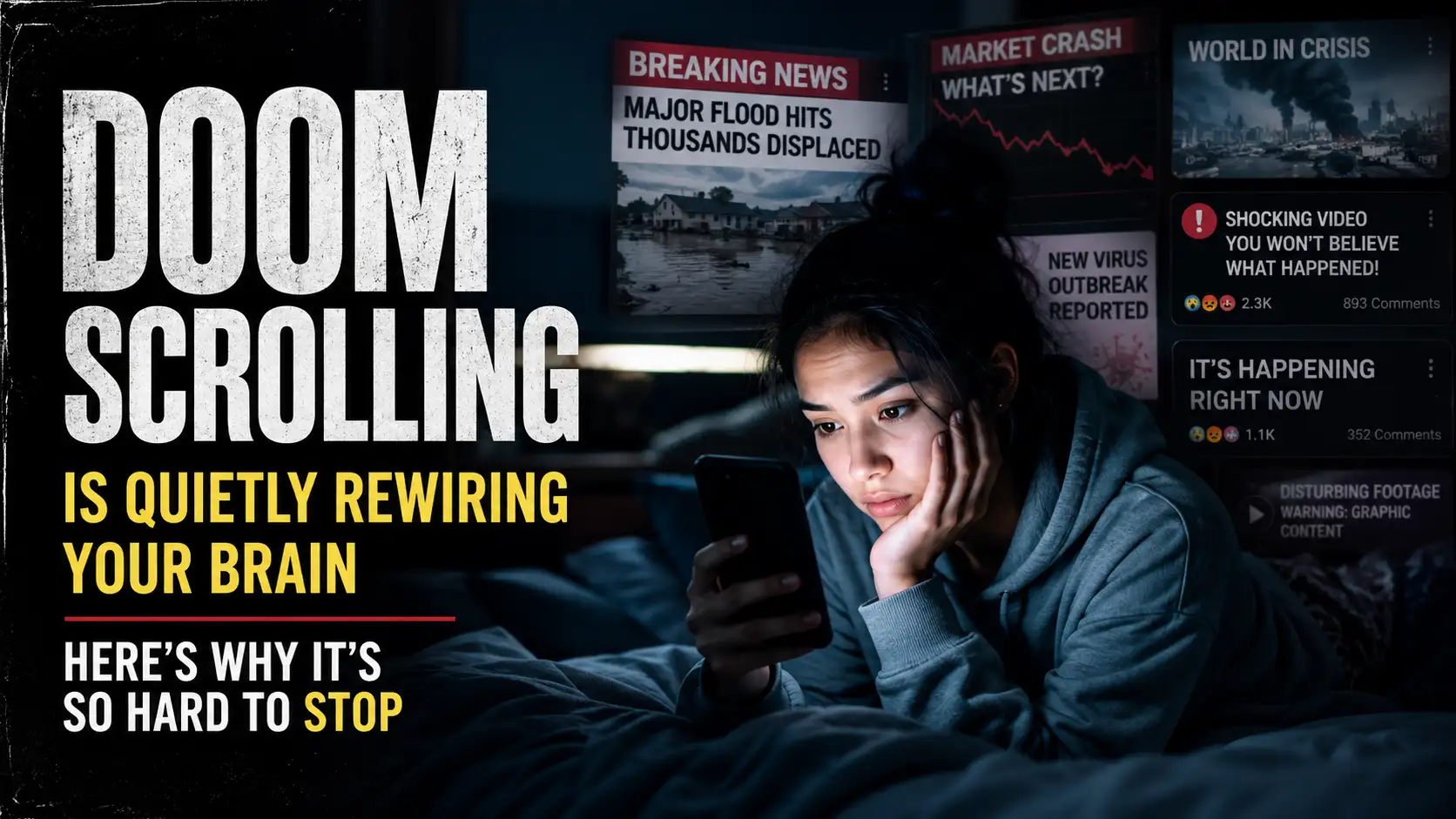
The headlines refresh every few seconds. One swipe brings another tragedy, another debate, another disaster unfolding somewhere in the world. Even after deciding you've seen enough, your thumb keeps moving almost on its own. Most people don't even realise when they're doing it. They just know that by the time they put the phone down, they feel strangely exhausted.
It's Not Really About the News
People often assume doomscrolling means being obsessed with bad news. That's only part of the story. The habit isn't about wanting negative information. It's about wanting certainty. When something worrying happens, a conflict, a natural disaster, a financial crisis or even a rumour on social media, our first instinct is to keep searching for updates. Somewhere in the back of our minds, we convince ourselves that the next article or the next video will finally make everything clearer.
It rarely does. Instead, every answer leads to another question, another notification and another headline demanding attention. Before long, you're no longer looking for information. You're simply scrolling because stopping feels harder than continuing.
Your Brain Thinks It's Helping You
This isn't just about willpower. Psychologists have long spoken about something called negativity bias, our tendency to pay more attention to potential threats than positive events. It's an instinct that helped humans survive long before smartphones existed.
Imagine hearing rustling in the bushes thousands of years ago. Ignoring it could have been dangerous. Paying attention increases your chances of staying alive.
Our brains still operate in much the same way. Only today, the "danger" isn't just about a wild animal. It's an endless stream of alarming headlines, breaking news alerts and emotionally charged videos. The brain reacts as if every update might contain something important. That's why it's so difficult to look away.
The Scroll Never Really Ends
Social media has quietly changed the way we consume information. Unlike newspapers or television broadcasts, there is no natural stopping point. Platforms are designed to keep feeding you content, one post after another, without asking whether you've had enough.
One moment you're watching a recipe. Next, you're reading about a flood. A few seconds later, you're looking at footage from a war zone. Then comes a celebrity controversy, followed by a crime report, then another breaking update. Your emotions barely have time to process one story before another arrives.
The headlines refresh every few seconds. One swipe brings another tragedy, another debate, another disaster unfolding somewhere in the world. Even after deciding you've seen enough, your thumb keeps moving almost on its own. Most people don't even realise when they're doing it. They just know that by the time they put the phone down, they feel strangely exhausted.
It's Not Really About the News
People often assume doomscrolling means being obsessed with bad news. That's only part of the story. The habit isn't about wanting negative information. It's about wanting certainty. When something worrying happens, a conflict, a natural disaster, a financial crisis or even a rumour on social media, our first instinct is to keep searching for updates. Somewhere in the back of our minds, we convince ourselves that the next article or the next video will finally make everything clearer.
It rarely does. Instead, every answer leads to another question, another notification and another headline demanding attention. Before long, you're no longer looking for information. You're simply scrolling because stopping feels harder than continuing.
Your Brain Thinks It's Helping You
This isn't just about willpower. Psychologists have long spoken about something called negativity bias, our tendency to pay more attention to potential threats than positive events. It's an instinct that helped humans survive long before smartphones existed.
Imagine hearing rustling in the bushes thousands of years ago. Ignoring it could have been dangerous. Paying attention increases your chances of staying alive.
Our brains still operate in much the same way. Only today, the "danger" isn't just about a wild animal. It's an endless stream of alarming headlines, breaking news alerts and emotionally charged videos. The brain reacts as if every update might contain something important. That's why it's so difficult to look away.
The Scroll Never Really Ends
Social media has quietly changed the way we consume information. Unlike newspapers or television broadcasts, there is no natural stopping point. Platforms are designed to keep feeding you content, one post after another, without asking whether you've had enough.
One moment you're watching a recipe. Next, you're reading about a flood. A few seconds later, you're looking at footage from a war zone. Then comes a celebrity controversy, followed by a crime report, then another breaking update. Your emotions barely have time to process one story before another arrives.
Next Story