
Why Horses and Other Animals Sleep Standing Up: The Evolutionary Threat Behind This Survival Instinct


The Body That Cannot Afford to RestA horse can fall into slow-wave sleep on its feet. Its legs do not buckle. A passive stay apparatus, a system of tendons and ligaments in each leg, locks the joints without any muscular effort, holding the animal upright while its brain cycles through lighter sleep stages. This is not a trick or an adaptation to domestic stables. It is a response to 55 million years of being hunted.
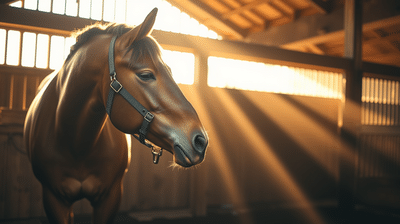 Horses, zebras, bison, and elephants all share a common evolutionary pressure: they are prey animals large enough to attract large predators, and slow enough on the ground that getting up from a lying position costs them two to four critical seconds. In open grassland, two seconds is the difference between escape and capture. The body solved this problem not through behavior but through anatomy.
The stay apparatus is the clearest example of evolution building a workaround rather than eliminating a need. The animal still requires sleep. The solution was to make sleep compatible with readiness. What the Brain Does When the Body Cannot Go DownStanding sleep is only partial sleep. Horses must lie down for REM sleep, the deep, restorative phase, but they do so for short windows, often less than two hours total per day, and almost always only when another horse is standing watch nearby. The herd functions as a distributed alarm system. One animal's wakefulness covers another's vulnerability.
Dolphins take a different route entirely. Unihemispheric slow-wave sleep allows one hemisphere of the dolphin's brain to rest while the other stays active. The animal keeps swimming, keeps surfacing to breathe, and keeps one eye open, literally. Researchers at the Okinawa Institute of Science and Technology have documented this in bottlenose dolphins, showing that the sleeping hemisphere produces the slow electrical waves characteristic of deep sleep while the waking hemisphere maintains full sensory processing.
The biological cost of this arrangement is real. Unihemispheric sleep is less restorative than full bilateral sleep. Dolphins accept a less efficient version of rest because the ocean offers no safe place to go completely offline. Predator Pressure as an ArchitectThe relationship between predator presence and sleep posture is measurable. A 2011 study published in the journal PLOS ONE by Jerome Siegel and colleagues at UCLA examined sleep duration and posture across a range of mammals and found that prey animals consistently sleep less than predators, and that exposure to predation risk correlates with reduced REM sleep specifically. Predators, lions, tigers, domestic cats, sleep between 12 and 20 hours a day, often in deep, sprawled postures that signal complete environmental safety. A lion in the Serengeti lying on its back is advertising that nothing in its vicinity threatens it.
Giraffes, among the most vulnerable animals when horizontal because of the time required to stand their full height, average less than two hours of sleep per day total. Much of that sleep happens in micro-bursts of a few minutes while standing. Full lying-down REM sleep in giraffes lasts only minutes at a time. What Domestication Changed, and Didn'tDomestic horses kept in stables with no predators still use the stay apparatus. They still sleep standing for most of their rest period. They still need a companion or a sense of security before lying down for REM. The threat that built the system is gone; the system remains.
The stay apparatus is the clearest example of evolution building a workaround rather than eliminating a need. The animal still requires sleep. The solution was to make sleep compatible with readiness. What the Brain Does When the Body Cannot Go DownStanding sleep is only partial sleep. Horses must lie down for REM sleep, the deep, restorative phase, but they do so for short windows, often less than two hours total per day, and almost always only when another horse is standing watch nearby. The herd functions as a distributed alarm system. One animal's wakefulness covers another's vulnerability.
Next Story