
<b>Why Your Eyes Keep Moving Even When You're Looking at One Thing</b>

Try staring at a small object without moving your eyes. It feels as though you are holding your gaze perfectly still. But if scientists track your eyes with sensitive equipment, they discover something very different. Your eyes are constantly making tiny, involuntary movements. Some are so small that you never notice them. These movements are called microsaccades and form part of a broader collection of fixational eye movements . Far from being pointless twitching, they are closely connected with how the visual system maintains information about the world. Without these subtle movements, stationary images can behave in surprisingly strange ways.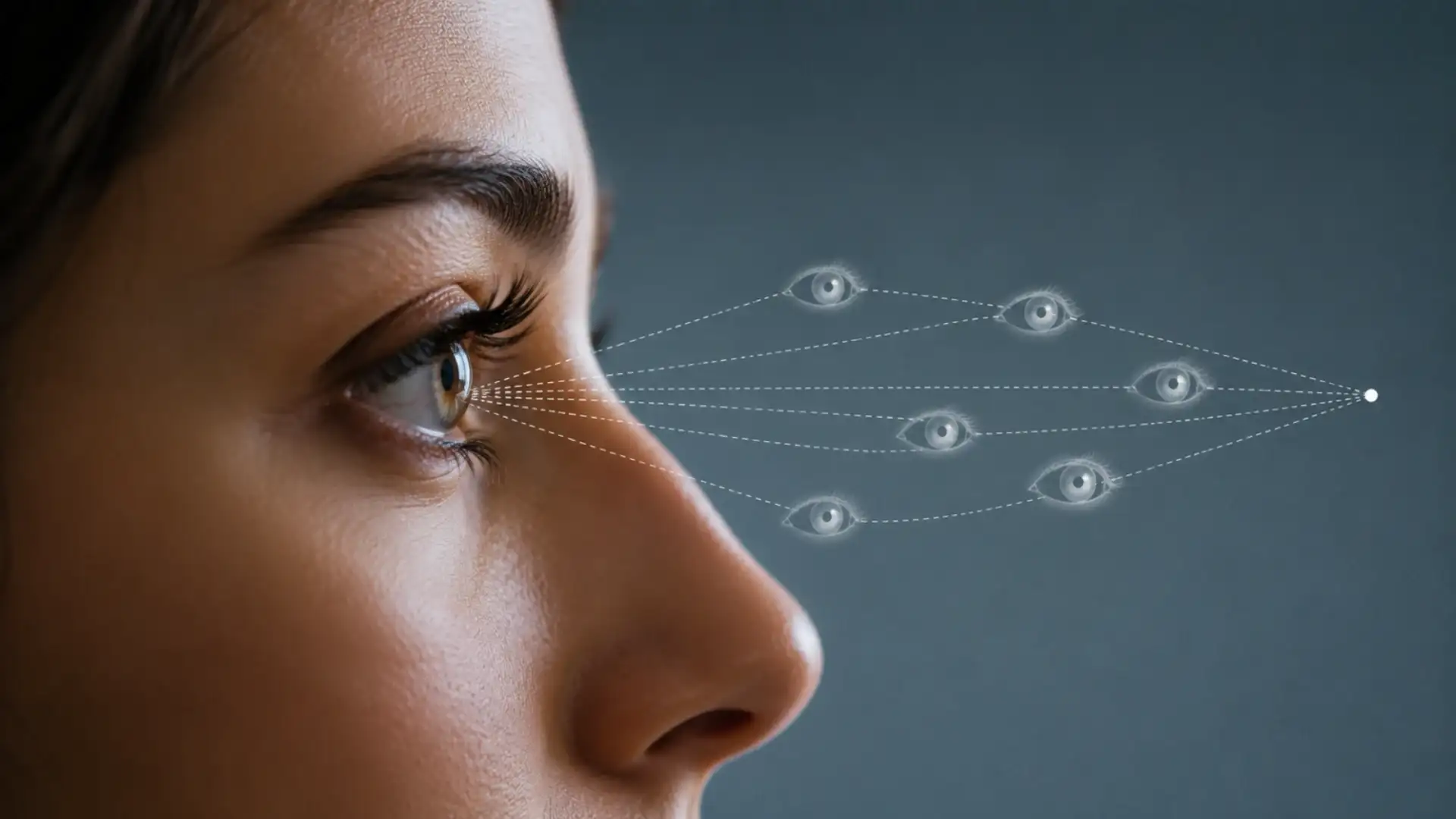
Research has shown that fixational eye movements occur continuously during attempted fixation. Microsaccades are among the fastest and largest of these small movements.
They are largely outside conscious control.
The retina and visual neurons adapt to unchanging stimulation. If a visual image remained perfectly fixed on exactly the same retinal receptors, parts of the image could gradually fade from conscious awareness.
Experiments have demonstrated that stationary targets can fade during fixation and that changes in microsaccade activity are linked with the restoration of visibility.
Your brain integrates the rapidly changing retinal information into a stable perceptual experience. You therefore experience the book in front of you as stationary even though your eyes are making tiny movements across its surface.
We often imagine seeing as a straightforward process in which light enters the eyes and the brain displays an image. In reality, vision involves continuous adjustment, prediction and neural processing.
So the next time you stare at a single point and think your eyes are completely still, remember that they are quietly moving all the time.
Your brain simply does an excellent job of hiding the evidence.
Your Eyes Are Never Completely Still
Even when you deliberately fix your gaze, the eyes make tiny movements.Research has shown that fixational eye movements occur continuously during attempted fixation. Microsaccades are among the fastest and largest of these small movements.
They are largely outside conscious control.
Why Movement Can Help You See
It may seem strange that movement is necessary for seeing something that is not moving.The retina and visual neurons adapt to unchanging stimulation. If a visual image remained perfectly fixed on exactly the same retinal receptors, parts of the image could gradually fade from conscious awareness.
Experiments have demonstrated that stationary targets can fade during fixation and that changes in microsaccade activity are linked with the restoration of visibility.
The World Looks Stable Despite the Movement
One of the remarkable things about the visual system is that you are generally unaware of these constant corrections.Your brain integrates the rapidly changing retinal information into a stable perceptual experience. You therefore experience the book in front of you as stationary even though your eyes are making tiny movements across its surface.
Why This Matters
Microsaccades are important to researchers because they reveal how active vision really is.We often imagine seeing as a straightforward process in which light enters the eyes and the brain displays an image. In reality, vision involves continuous adjustment, prediction and neural processing.
So the next time you stare at a single point and think your eyes are completely still, remember that they are quietly moving all the time.
Your brain simply does an excellent job of hiding the evidence.
Next Story